Saturday, February 28, 2009

March 1, 2009: First Sunday of Lent (B)


Few days ago I was visiting a church office, and I asked the receptionist, "What are you giving up for Lent?" She said, "I'm giving up gossiping and complaining." "Oh," I said. "I'm giving up diet coke and chocolate." After I said that she gave me a look that said, "Oh Father, is that all you're giving up?" I have to tell you it seemed shallow at the moment, but my body is telling me that it's not so shallow. How many of y'all drink more than one cup of coffee or caffeinated soda a day? For a couple of days after Ash Wednesday, I had a headache this big. I was going through caffeine withdrawal. Believe me, I wanted to grab a diet coke or a dark chocolate when that headache came. I could hear in my head the jingle, "Just for the taste of it, Diet Coke!"

Here is an interesting fact about caffeine withdrawal. As little as one cup of coffee can begin your addiction to caffeine. Some of the young people here may drink energy drinks. Well, the so called "energy" is really caffeine, and lots of it. So what happens when you pull back, cold turkey? Like any addiction, your body craves it when it's gone. Then from two to nine days, you can have the following withdrawal symptoms: headache, fatigue or drowsiness, "unhappy" mood or irritability, difficulty concentrating, and flu-like symptoms such as nausea, muscle pain, and stiffness. This is only Day 4 of my cold turkey from diet coke and chocolate. So if I seem irritable, I'm still having withdrawal symptoms.

Many of you have promised God that during this Lent you're going to give up something. Believe me when we make promises, we make them when we are strong and able. But how does that promise stand when we have pounding headache, feel "unhappy" and drowsy from withdrawal? What happens when we renege on our Lenten promise? Is it a sin? The answer is no. The promise we make is a voluntary devotion which the Church does not regulate. Giving up on things like TV, caffeine, chocolate really falls into self-discipline. Does God ever make promises to us? He certainly has since the time of Adam and Eve. But he uses a different word for 'promise.' In our First Reading, we hear the word, "Covenant" spoken by God to Noah. God said, "I will establish my covenant with you, that never again shall all bodily creatures be destroyed by the waters of a flood...This is the sign that I am giving for all ages to come, of the covenant between me and you and every living creature with you: I set my bow in the clouds to serve as a sign of the covenant between me and the earth."

So what is a covenant? Is it like a promise or a contract? A contract involves promises that one party makes to another. Buying a house is a contract between a seller and a buyer where the buyer promises to pay certain amount and the seller promises that his house is in great shape. The covenant on the other hand involves persons taking oath to each other. Whereas in a contract, property is exchanged, in a covenant persons are exchanged. Think for example of marriage; marriage is not about property or service exchanged. At wedding spouses take oaths that they would give their entire self to each other. That is covenant.

The reason why I focus on the word 'covenant' on this First Sunday of Lent is that our readings show that someone greater than us has taken an oath to make covenant with us. God who is infinitely greater than us chose to take an oath to give Himself to us. In the Old Testament, the sign of that covenant is the rainbow as He told Noah. What do you think the sign of His covenant is in the New Testament? We hear it from the elevation of the chalice by the priest: "Take this all of you and drink from it. This is the cup of my blood, the blood of the new and everlasting covenant. It will be shed for you and for all so that sins may be forgiven. Do this in memory of me." The sign of God's new covenant is His very own Son who shed blood through his side and emptied Himself for us. He became the victim lamb for our sake. And for our part of the covenant, all we can do is give up diet coke and chocolate? And even then, we renege on our promise time to time? Why does God make such a covenant with us, knowing that we're not going to hold up our side of the oath?

We read in our Second Reading: "Beloved, Christ suffered for sins once, the righteous for the sake of the unrighteous, that he might lead you to God." The reason why Jesus entered the desert for 40 days and 40 nights to be tempted by Satan was to lead us back to the Father. Think of it this way. Why do parents sacrifice all their sleep, all their disposable income, and available time for a small and weak new-born infant? What do they benefit from all that work and energy spent? Materially the parents get nothing in return from the infant who can't even begin to work for his own food until 16 years of age. If marriage and raising a family was a contract, it makes absolutely no sense. But it is a covenant where parents take oath to give all of themselves to the child knowing fully well that child cannot return much in kind. At the heart of this parents-and-child covenant is love. Likewise, at the heart of God-and-man covenant is love. It's the only motive that makes sense. Therefore, Lent is not about us making our small promises to give up something and end up breaking our promises. Lent is about being aware that Someone who loves me is going to be tempted for me, going to suffer for me, and even die for me. The greatest gift of Lent is the awareness that, "I am loved by God."

Wednesday, February 25, 2009

Feb. 25, 2009: Ash Wednesday

(Note: Fr. Paul is now assigned as the temporary administrator of Mater Dolorosa Parish in Independence, LA)

What is Ash Wednesday about? For non-Catholics who attend our services today, they know they'll receive ashes on their forehead. One parishioner joked that I should use a Sharpie marker to mark the forehead instead of my finger to keep my hands clean.

Of course there is a deeper reason why we use ashes instead of a black marker. We burn the palm branches that we used on Palm Sunday last year to make these ashes. On Palm Sunday, each of us had a palm frond which symbolized triumph and victory. We laid it in honor of Jesus as he entered Jerusalem. But, before the victory and triumph of the Resurrection, Jesus had to undergo suffering and dying. Hence we wear the ashes of these palms as a sign that we too will follow Jesus in his footsteps.
Many who have attended early mass this morning will head to work wearing their ash. It's a powerful visual witness to their co-workers of the words that priest or deacon spoke as ashes were given: "Remember that you are dust, and to dust you shall return," and "Turn away from sin and be faithful to the Gospel."

Ash Wednesday marks the start of Lent. We become fellow companions with Jesus who heads to the desert for 40 days of fasting and prayer. There in the desert he is tempted by Satan. Even in the midst of physical hunger and thirst, Jesus nourishes himself with His Father's words in the scripture. And Jesus rebukes Satan's temptation with Heavenly Father's words. This morning at Mater Dolorosa School mass, I showed the kids this large, 2.5 LB block of chocolate that I found in my pantry. (By the way, if I ate this block of chocolate in one sitting, I would have consumed 6,200 calories which is equivalent to 12 BicMacs). You could just imagine kids' mouths watering. I told them that our mouths water automatically because of our memory and habit.

The point of Lent, I told the kids, is to have the same savory response to things of God. How do you do that? By fasting from our favorite things of this world and to feast on things of God--prayer, scripture, almsgiving. Losing weight may be one of our goals this Lent. It will certainly be one of the result of fasting from chocolate and sweets. Yet more important is to use this 40 days to learn to savor again how sweet God's words are. You can do this by going to weekday mass. Another way is to pick one of the gospel (Matthew, Mark, Luke, John) and pace yourself to read the entire gospel during the 40 days. See after the 40 days, how much spiritual weight you have gained and not how much physical weight you have lost.

Saturday, February 21, 2009

Feb. 22, 2009: 7th Sunday Ordinary (B)

Few days ago, our youth director asked me, "Fr. Paul, what is this about indulgence?" and he handed me a recent article from New York Times (http://www.nytimes.com/2009/02/10/nyregion/10indulgence.html?_r=1&scp=1&sq=indulgence&st=cse). It reads, "For Catholics, a Door to Absolution is Reopened," and the caption says, "Indulgences Return, and Heaven Moves a Step Closer for Catholics." Its opening paragraph read as follows: The announcement in [New York] church bulletins and on Web sites has been greeted with enthusiasm by some and wariness by others. But mainly, it has gone over the heads of a vast generation of Roman Catholics who have no idea what it means: “Bishop Announces Plenary Indulgences.” So my question to you is, if you had to teach your children about indulgence, how would you teach it? I suppose the first question is, what is indulgence?

The following is the New York Times version of its explanation: "The indulgence is among the less noticed and less disputed traditions to be restored. But with a thousand-year history and volumes of church law devoted to its intricacies, it is one of the most complicated to explain.According to church teaching, even after sinners are absolved in the confessional and say their Our Fathers or Hail Marys as penance, they still face punishment after death, in Purgatory, before they can enter heaven. In exchange for certain prayers, devotions or pilgrimages in special years, a Catholic can receive an indulgence, which reduces or erases that punishment instantly, with no formal ceremony or sacrament."

Not bad of an explanation. How many of y’all heard of indulgence? How many of y’all know what indulgence is? Those of us who are under 50 have not heard of this or even have sought indulgence. As the article says, it is one of those traditions that has been decoupled from mainstream Catholic practice in the 1960s. I only became aware of it when I came back to the Church in my junior year in college. But I only began to understand it when I was aware of the other topic--Hell, Purgatory, and Heaven. Back in my high school 18 years ago, a protestant classmate tried to explain Hell and Heaven, but failed. As you know, I told you before that in high school I was a Goth, and frankly I felt I was invincible and believed that if I died, there was nothing thereafter. I felt that 'sin' was just a concept made up by men and therefore, Hell, Purgatory, and Heaven were also just fabrication of men. So if 18 years ago you tried to explain to me about God's mercy and forgiveness for the consequences of my sins, which the indulgence addresses, then you've would have gotten a blank stare from me, just as from most readers of New York Times about this article on indulgence. For most readers, the topic is strictly in the realm of Catholic guilt which is not applicable for them but a source of novelty and amusement. But is this just a topic for scrupulous Catholics?

In order to begin diving into this topic, we need to begin where we are. My generation is more likely to question why we need forgiveness for our sins in the first place. My generation hears so much about God's forgiveness and mercy, but we're saying so what? I don't have sins to be forgiven for--what is sin? My parents’ generation, on the other hand, can appreciate today's emphasis on God's forgiveness and mercy because when they were growing up, they were drilled to be aware of their own sinfulness and feel guilty about it. When you watch the recent movie, "Doubt" (http://en.wikipedia.org/wiki/Doubt_(2008_film)) you can begin to appreciate the era in which my parent's generation grew up. This was the era when authority, obedience, and corporal punishment were accepted as general rule; and I'm not talking about just the Catholic Church and the nuns. Whether you were a protestant, Jewish, or of no faith, in those days, you had it worse at home than what you received at school or at church. A boy in that time understood what consequence of bad action felt like on your behind.

My generation understands well what happens to other people when they do bad things. We experience sin vicariously. We watch a lot of TV programs like CSI and Law and Order, where people who do bad things get punished. We watch reality TV and watch people do foolish things and laugh about it. But we convince ourselves that that's not us. Yet when I visit Dixon Correctional Institute and hear young guys' confessions, the reality of the consequence of sin has come too late for them. You'll find a captive audience in prison when you teach about God's generosity in his forgiveness and mercy through His gift of indulgence which takes away the temporal punishment due to sin. You see in prison, the memory of their own crime reminds them over and over that the only place they deserve after death is Hell. Yet, these tortured men know that God allows them to show their gratitude for the forgiveness of their awful sin by their charitable works, sacrifice, and prayer--God is generous enough to allow a brand new start with our meager spiritual work.

In our Gospel when Jesus says to the paralytic, “Child, your sins are forgiven,” we, like the Scribes, question Jesus. “Why does this man speak that way?” Our generation is more likely to be aware of the illness that afflicts our body—those that can be seen and captured on camera and CT Scan. But God sees the illness that afflicts our soul due to sin. Therefore, He speaks the following in our First Reading: “You burdened me with your sins, and wearied me with your crimes. It is I, I, who wipe out, for my own sake, your offenses; your sins I remember no more…see, I am doing something new!” It’s not so difficult to understand what indulgence is when we begin to appreciate that God sees the invisible spiritual cancer that afflicts us. He provides us the spiritual chemo therapy, by ways of indulgence, to treat and relieve the after-effects of our spiritual illness.

Saturday, February 14, 2009

Feb. 15, 2009: 6th Sunday Ordinary (B)

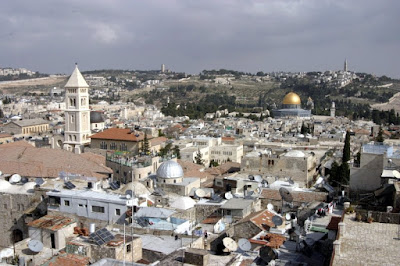
I spent the past ten days in the Holy Land. Five of that I spent in the streets of Old City of Jerusalem. It is interesting to see how three different faiths and ethnicity--Christians, Jews, and Muslims--live and make their livelihood in an area less than half a square mile. Our guide told us that there were about 30,000 people living in an enclosed land that is less than the size of the land on which Mall of Louisiana and surrounding shops sit on. You can imagine it takes a bit of tolerance for each other to live shoulder to shoulder. Our guide also warned me that some religious persons may say something colorful or may spit on the side when they see a Catholic priest. That's nothing new, however. I have been cursed out in the Walmart parking lot on College wearing my collar before. Personally I was not aware of it happening to me, but six other parishioners of St. Aloysius who went on this trip with me said that they did notice it happening to me. I suppose it's natural for us to see one who is different from us as 'unclean,' to use the word from our First Reading and our Gospel. In our readings, we see what a person with leprosy is supposed to do according to the Jewish law. It says, "If the man is leprous and unclean, the priest shall declare him unclean." And "the one who bears the sore of leprosy shall cry out, 'Unclean, unclean!'" To some, I was an 'unclean' religious person of a different faith. There was nothing as powerful of emotion to be let known that I was different and unwanted from the larger community.

In the old city of Jaffa near Tel Aviv, we celebrated mass at St. Peters Church. Acts Chapter 9 and 10 describe what happened to St. Peter as he stayed with Simon the Tanner. St. Peter received a vision in which he was told to slaughter and eat four-legged creatures, reptiles, and birds which descended from heaven. St. Peter protested,"Certainly not, sir. For never have I eaten anything profane and unclean."And the voice spoke to him again, a second time, "What God has made clean, you are not to call profane." When St. Peter wondered about what this meant, two servants of gentile Cornelius arrived to escort him. St. Peter baptized the entire gentile household of Cornelius. This was a lesson that in the plan of God, gentiles were also to receive the salvation promised to Jews. It was a sign that God's saving hand was reaching beyond our human barriers and discrimination.


It was interesting to see the vast number of Muslim and Jewish vendors lining up the Via Dolorosa or the streets that commemorate the Way of the Cross to sell Christian artwork and rosaries. In these streets, it was a disadvantage to wear my priestly collar. I got tugged in every shop, "Father, I'll give you a good deal!" I didn't know how to appear mean enough to stop unwanted solicitations. I suppose we can cross all sorts of human barriers and boundaries when money is involved. How did Jewish vendors feel about selling picture of Jesus in their shops? How about a Muslim vendor selling Pope's photos? When money was involved, we seemed to set aside our human categories; there seemed to be no distinction between what's clean and unclean. If we can cross boundaries because of money, we are certainly capable of crossing boundaries for more noble purpose--to love, as Jesus commanded us. In our Gospel, when a leper approached Jesus, Jesus did the unthinkable. He touched the leper and said, "I do will it. Be made clean."

So here is a challenge for us as Ash Wednesday and Lent are approaching in a week and a half. During Lent pick one person in our life that we have categorized as 'unclean' or untouchable. Make the effort during Lent to have the same attitude to that person as Jesus, "I do will it. Be made clean," remembering that St. Peter was told, "What God has made clean, you are not to call profane." At least make an effort to change our attitude.