Monday, May 31, 2010

May 31, 2010: The Feast of the Visitation

Click to preview 5-31-10-Visitation.mp3.mp3 Click to hear the audio of the homily.
This Feast of the Visitation (May 31) marks my second anniversary of priestly ordination. The following homily was given on the feast day.


Saturday, May 29, 2010

May 30, 2010: The Most Holy Trinity


Click to preview SunHomily-5-30-10.mp3.mp3 Click to hear audio of homily.

Whenever I baptize a baby, a curious thought always comes up. I wonder if this baby looks more like the daddy or the mommy. Yeah, the nose looks like the daddy, and the eyes are definitely moms...But at that age it's hard to tell. I showed a recent photo of myself with my parents to parishioners, and one said I look more like my dad and another said I look more like my mom. But people cannot tell just from the photo what's I have inherited from mom and dad that's not visible. For example, my sister got my dad's awesome brain while I got his gentleness. My sister got my mom's gregariousness while I got my mom's industriousness. Those of you who have more than two children know that it is a great mystery why out of the same sets of parents there are so many diverse personality traits in their children. So how our children turn out to be is a demonstration of a great mystery of how we cannot judge from the visible appearance what is underneath--the invisible reality. And there is one trait that all of us inherited that is invisible.

In chapter 1 of the Book of Genesis, God says something curious after creating the light, the earth, the plants, and the animals, "Let us make man in our image, after our likeness...God created man in his image; in the divine image he created him; male and female he created them...God looked at everything he had made, and he found it very good." (Gen 1:26-27, 31) God says something that perks our curiosity. He said, "Let us make," not "Let me make." It makes us wonder who is all included in the word, "us." He then said, "in the divine image he created him; male and female he created them." Here we begin to go deeper into the mystery. The divine image is not a solitude, but a family.

When someone looks at my family photo, my visible features cannot be just explained by looking at my mom's features. They also need to look at my dad's features to make sense of my features. My existence, also, cannot be explained by looking at my dad alone. I exist because of my mom's and dad's continual love for each other and their love for me. Likewise, in a much more deeper way, I exist because of the Heavenly Father's love for His Son, and the Son's love for the Father, and even that love between them--the Holy Spirit--all sustains me. Truly, my entire being, who I am, who I am suppose to be, all that I am is immersed in this mystery of the Trinity. I may not acknowledge what they do for me and may even deny their existence, but the reality is that once they ceased to love, I do not exist. Would I exist if my mom and dad had not loved each other? If I tried to explain to someone that I don't have an earthly father, would they believe me? No. It's so self-evident that in order for me to come into being, I needed a father and a mother. And it should be as self-evident that without the love between the persons of the Trinity, I would not exist, for I was created out of Love.

Our short life here on earth is like a practice run, like a sandbox in which little children begin to learn how to live in this Heavenly Family. We learn their Family Values which are faith, hope, charity; we try to live out these family values by our kindness, patience, and gentleness and gentleness toward our earthly family members. When our very short life here on earth is over, we already know how to live among the eternal Heavenly Family members.

Someone asked me, "Father, I don't get why we have to believe in all these saints, especially Mary." And I give them this analogy. Suppose you are a teenager who live in a two-story house, and your room is on the second floor. You recently got your own cell phone, so you're busy texting away. In your room is all sorts of things that modern teenager would have--computer connected to the internet, a Nintendo Wii, a nice flat screen TV connected to digital cable, and any other toys that you can think of. Down stairs, your mom and dad are calling you down to eat dinner. Since you are in the midst of texting while watching TV, you say, "In a moment." While the family down stairs has begun dinner and having a lively conversation, you are left out, preoccupied with the toys that distract you. Somehow this teenager feels that these toys are more worthwhile and meaningful than spending time with the family in conversations.

This sometimes describes our attitude toward spending time with the Heavenly Family especially on Sundays. A sumptuous banquet is going on every Sunday here at the sanctuary at mass with lively conversations between the Heavenly Family members and the earthly family members. St. John Chrysostom, a Doctor of the Church, said that, "When Mass is being celebrated, the sanctuary is filled with countless angels who adore the divine victim immolated on the altar." Sometimes when I celebrate mass here, I feel the unexplainable presence of Blessed Mother and the saints here at the sanctuary. When we come to mass preoccupied with distractions, it's much harder to experience this daily miracle. When our heart is prepared to enjoy this Heavenly Banquet, however, we experience from it unexplainable joy.

Saturday, May 22, 2010

May 23, 2010: Pentecost

Click to preview SundayHomily-5-23-10.mp3 Click to hear the audio of homily

Several weeks ago I was at the St. Joseph Cathedral to give a talk on Blessed Mother to their RCIA class. Before the talk, I was chatting with some of the newly baptized and confirmed Catholics, and a group of them facinated me. I learned that the whole family entered the Church during this Easter Vigil. I was talking to the mother of the family who was originally Baptist, and she remembered the first time she set her foot in St. Joseph Cathedral. She was at the Farmer's Market on the parking lot across from the Cathedral one Saturday morning when she and her daughter decided to set foot in the Cathedral out of curiosity. They both remember experiencing unexplainable peace inside. It was the beginning of their journey to receiving the Sacrament of Confirmation. She showed photos of the family receiving communion, and the mother was moved to tears as she received communion. (Photos by John Ballance)


What do you remember about your own Sacrament of Confirmation? Was your experience anything like what that family experienced or like what Blessed Mother and the Apostles experienced at the Upper Room? When I recall my own confirmation in high school, all I remember was that I had a shaved head when I took photo with the bishop of Dallas. This was of course after having my hair down almost to my neck for a couple of years. The fire of the Holy Spirit did touch that poor atheist with a shaved head. It took some time, but the Spirit certainly transformed a reluctant soul into an instrument of God. The moment the Holy Spirit was given at baptism and sealed at that Confirmation, this body became the temple of the Holy Spirit. Yet, the heart in that temple was unwilling to change.  This heart did not welcome the Spirit; it was too attached to the old ways of pride and unbelief. Yet now, I'm standing before you as a priest; this all goes to show that the Holy Spirit who came upon the Apostles two thousand years ago is still present and available today, ready to make dramatic transformations. I often meditate on what happened to St. Peter immediately after the Pentecost. What a dramatic transformation did he go through from a man who feared ridicule and persecution, to a man boldly proclaiming what Jesus did for him in the face of persecution. In today's Second Reading, we even hear St. Paul, a man who resisted the Holy Spirit from the beginning proclaiming about what Holy Spirit has done for him. He said, "No one can say, 'Jesus is Lord,' except by the Holy Spirit." This was coming from a man who once despised Christians and sought to kill them. By the transformation of the Holy Spirit, St. Paul knew by heart that there was someone greater than he, someone who deserved to be called and worshipped as the Lord.  

These past few weeks, a man that I gave the Sacrament of Anointing kept lingering in my mind. He was dying of cancer in a hospice, and when I was there few weeks ago, he was a bitter man, unforgiving and unforgiven. My first impression was that this was a homeless man who was dealt an unlucky deck of cards. Yet I found out that he was a very well educated man. He was dying however, estranged from his wife and children. During the Sacrament of the Anointing of the Sick, I laid my hands on his forehead in silence and asked the Holy Spirit to transform his life. I heard his confession, then left. This past Sunday, I dropped by the hospice again with the Holy Eucharist, not knowing whether he was still living or have died. The hospice worker said that there was a great change in that man the past few weeks. He was withdrawn at first, but now he was laughing and enjoying the company of the hospice workers. And an hour before my arrival, his estranged children came to visit him. When I saw him, he was a changed man. He was clean shaven with a good hair cut. I did not recognize him at first. I woke him up, gave him the Eucharist, and told him, "Now you are ready to meet Jesus with joy." 


What are the lessons to be learned from this man's experience of the Holy Spirit? We are dedicated as the temple of the Holy Spirit, the Spirit who freely pours out abundant gifts, especially the gifts of transformation and peace. Yet peace and forgiveness are inseparable. The unforgiving person and the unforgiven person live without peace; they are mutually tied to the sin that divides them. Their willingness to forgive sets them free to live at peace. Forgiveness, then, is the first step in inviting Holy Spirit to transform our lives.   

Saturday, May 15, 2010

Sanctity Joy Action: A talk given to the parents of St. Joseph Academy parents

Click to preview SJA-Talk-5-11-10-ed.mp3 Click to hear the audio of the talk

The following talk was given to the parents of St. Joseph Academy (where I am the chaplain) on the topic of Sanctity, Joy, and Action--the motto of their school.


Prayer to St. Joseph and Blessed Mother
Lord, Jesus, in the person of St. Joseph you have shown us how to be holy, joyful, and prompt in doing what you ask of us. St. Joseph, we ask you to teach us today about the holiness in life and the holiness in marriage. Teach us to be simple, not encumbered by our possessions, but to truly love what is important, willing to sacrifice ourselves for all that is holy.
With your spouse, Blessed Virgin Mary, we also ask you to intercede for all members of the Academy community-- alumnae, parents, friends, present students and faculty.
Keep us in your tender care; strengthen our faith; heal our sorrows; and guide us, finally, to the fullness of joy and peace. We pray all this through Christ, Our Lord.

SJA Alma Mater
Lift up your voices to our Alma Mater.
Pledge her your loyalty as long as she may live.
Always remember the spirit and the way
Of Sanctity, Joy and Action,
Dearest SJA

Several weeks ago, I was contacted by a local hospice to come and give the Sacrament of Anointing for a man. He was just admitted to the hospice. He was relatively young, in his late 50's. He was dying of lung cancer, but he was also an alcoholic with some drug abuse in the past. Then the hospital worker said, "Father, I want to warn you ahead of time. When he got here, he began to curse at us and mistreat the workers here. He resented being here, so to protest, he began to urinate and defecate. So we put in a catheter and put a diaper on him. I just wanted to warn you about that." Then I thought, 'Oh this is great.' My desire to go and visit him just vanished. I told the hospice worker, "Can I come tomorrow?" He said, "Sure."

The next day, I got into the car and said a prayer, "Okay my holy guardian angel and saints, restrain that dude if he begins to harm me. Blessed Mother please soften his heart so that I can talk to him." I entered his room, and he was watching TV. By the look on his face, he was probably thinking, "A priest. Well this is amusing." The room was hot, for he put on the heater when the rest of the building was on A/C. I saw that he had his diaper on, and it was not exactly a flattering view. I thought to myself, 'Which side of the bed will be safe, the left or right?' I chose the chair next to the window, less than an arm's length away from him. His hair was disheveled like a homeless man. I said, "Hi, my name is Fr. Paul from Our Lady of Mercy." I shook his hand and sat down. He opened his mouth to say something, and I noticed that he had all but three upper teeth and bottom row of teeth. I thought to myself, 'Where did he lose the rest of his teeth, from fighting?'

To break the ice I said, looking out the window, "How beautiful the weather today." He briefly took his eye off of me and looked out the window. He said, "Yes. It is beautiful." We had a quiet moment of silence for a minute. Then I said, "I came by to give you the Sacrament of Annointing today. Would you like that?" He said, "Okay." I began some more small talks and asked about the picture on the window sill. It was a picture of his sibling. Then I asked about where he grew up and what his childhood was like. It sounded like he was raised in a good Catholic family. Then he began to tell me his education background. He had a bachelors degree, a masters degree, and a PhD. In fact he taught at college level. Something inside me was not 'jibing.' I'm seeing a man before me who looks like a homeless man who is dying of dissipated life of addiction, malnutrition, and cancer, yet he is telling me that he was a university professor? Is he lying to me or is he telling me the truth? Before he told me his life story, I presumed in my mind a man who was angry, bitter, and resentful about life because he was dealt an unlucky deck of cards from the beginning. But unfolding before me was a man who is angry, bitter, and resentful whose background suggests a blessed life from the beginning. How did he get here, to a life without joy? We read in the Letter of St. James, "Consider it all joy, my brothers, when you encounter various trials, for you know that the testing of your faith produces perseverance." (James 1:2-3) Did he just give up in the face of trials of his life, taking up a life of dissipation and drinking?

I presumed that he had no one to visit him because he lived most of his life on the streets. Yet he began to tell me that he had a wife and several children. However, I didn't see their photos on the window sill. He told me that he was divorced and was estranged from his children. Then he would not tell me any more about his life. So his life from his early 40s to now remained shrouded in darkness. I had lots of questions. "How did he get here if he was blessed with intellectual gifts and raised in a good family?" But I didn't pursue asking him more questions. He wasn't so cooperative from that point on.

Then I said, "I have been a priest now for two years, and I have given many Last Rites to dying people. Based on those experiences and based on what I read about from folks who went through Near-Death experiences, I would like to give you a tour, a tour of what happens at the end of your life. Consider me a tour guide, then, to your after-life." His eyes widened with interest. I continued:

When you are about to die, you will encounter in this room the souls of your parents or loved ones who have passed from this life. They'll come so that you will not be afraid of the journey you are about to take. Sometimes, if you had a strong devotion to the Blessed Mother, she'll come and welcome you (which happened in couple of Last Rites I did in the past--and if you want to know how I knew she was there, let's just say that I knew). You'll then enter a dark tunnel (as all of the folks who experienced near-death attest) with the faint light at the end of the tunnel. As you travel through this tunnel, the light becomes brighter, and as you come out of the tunnel, you'll see a garden (as some describes) but ultimately meet the source of light, Jesus himself. (My patient's eyes really widened at that point). Jesus will embrace you, and you'll experience the most profound, unconditional love that you've ever experienced. This is the love that you've been searching for on earth all your life, sometimes you found it briefly, but most of the time, you tried to find it in all the wrong places and all the wrong persons.

Then Jesus shows you the movie of your entire life (most if not all of those who experience near-death attest to this). As you watch this movie of your life, you will not be seeing it from your own perspective but from Jesus' point of view. All of us had our own reasons why we behaved in certain way or treated another person certain way, but this time we will see each moment from His point of view. In each moment of our lives, Jesus called us to be his compassionate hand to others, as he said, "Love one another as I have loved you." We will know whether in each moment we answered that call or not. If we have answered that call, we will feel Our Lord's joy that we have been faithful to his call. But on those moments when we did not answer his call, the moments when we became self-absorbed, selfish, or inconsiderate to others, we will feel Our Lord's sadness and disappointment that his request was rejected. If we hurt another person by what we said or did, we will also feel and see for ourselves how much hurt it caused another person. In addition, we will witness for ourselves how that hurt remains with that person and affects that person's life down the road. Few months ago, an Iraqi American came to various parishes in Baton Rouge to give a testimony about the movie of his life that he had seen. He said as he was a playboy when he was in his 20's, and as he watched himself womanizing and treated a woman like an object, he felt for himself how that woman carried that hurt into her life and affected her future relationships with other men.

I wonder sometimes what I'll see in the movie of my life. I know I've caused lots of hurts in others in my life prior to becoming a priest, so I'll need lots of boxes of Kleenex to mop up all the tears of contrition. I also know that I'll see all the moments after I became a priest how I was not faithful to my priestly vow. I took the vow of obedience and chastity and a promise to live a simple life. I know I'll feel Our Lord's disappointment for all the time and money I spent going to Best Buy to hoard electronic toys when I should have spent that time for others. I know also that I'll see all the moments when I celebrated mass irreverently, all the moments when I failed in my charity toward those who come to confession or for counseling. I'll see all the moments when I failed to uphold what I vowed to the bishop on the day of my ordination--that I was going to faithfully teach the Church teachings even if I wasn't 100% behind it, even if it meant I would be rebuked or ridiculed. How about you guys? What would be your embarrassing moments when Jesus would be sad and disappointed? Wouldn't it be the moments when in the family life, holiness was secondary where it was not modeled by the parents to the children? Wouldn't it be all of our selfish preoccupations, self-absorptions that kept us from giving ourselves to our children and our spouse? Wouldn't it be all the moments that we didn't keep our marriage vow, to honor and to respect our spouse and to raise our children in the faith?

After seeing the movie of all of our life, we'll be asked just two questions by Jesus. "Are you sorry for your sins?" Then, "Do you love me?" And we'll say to Jesus, "Lord, I know you have forgiven me for all of my sins through the Sacrament of Reconciliation and the Anointing of the Sick. But after seeing the hurts that I caused in some of the people, I cannot bear to enter Heaven just yet.  I want to be able to to forgive myself for what I have done. I want to come to peace with what I have done. So I would like to do reparation for the hurts that I caused the persons still living." And that place or time of reparation where we come to terms with what we have done is called 'Purgatory.'

After telling all this, I then began to hear his confession. He said he cannot remember his sins. So I simply said, "Say, 'yes' or 'no' to the following questions." Are you sorry for all the times you have been prideful where you placed yourself above others and even God and His Church? Are you sorry for all the times you have been angry, resentful, and even harbored hatred? Are you sorry for all the times you have been lustful and when you have not been faithful to your marriage vows? Are you sorry for all the times you have been gluttonous when you consumed, used, or drank something more than you should? Are you sorry for all the times when you were envious or jealous? Are you sorry for all the times when you were spiritually or physically lazy? Are you sorry for all the times you have been greedy? Are you sorry for all the times when you were not the compassionate hands of God to others? Finally, answer the two questions that Jesus would ask you at the end of watching the movie of your life. Are you sorry for all your sins? Do you love Jesus?" To the last two questions, he answered, 'yes' to both. As a penance, I told him, "You don't have to do the purgatory at the end of your life. You can make reparation right now." And I instructed him to say some prayers for those he hurt in his life. Then I said, "Now you are prepared to meet Our Lord. And I'm finished with my tour of your end of life." He was silent. He simply said, "Thank you for coming." I had the sense that he was pondering what he would see in the movie of his life. And I sensed him thinking to himself, "Why did I wait so long to live a more holy and joyful life?" As I got into my car, I was thinking to myself, 'I need to do what I told him. I need to live a holy and joyful life now." I hope that's what all of us can take away from that visit to the hospice.        

Monday, May 10, 2010

May 10, 2010: Funeral of Ulysse "June" Fontenot


The day before June passed away, I was there in the room where he was sitting and taking a nap on a chair. I looked around and saw that there were many old panorama photos on the wall. They were photos of service men during WWII whom June belonged to. In each photo were hundreds of men lined up in their uniforms. I wondered to myself, 'Where is June?' and  his wife Mary said she marked her husband with a red dot, but still she had a hard time finding where he was. Looking at the photos of these men, you can appreciate that these men sacrificed better part of their youth and even their lives to be in an uncertain war. When Mary told me that June would fuss at people who leave out their American flag in the rain or when their flags were in tatters, I understood why he would be so upset, looking at the photos of these men. I've seen a photo of military cemetery for WWII soldiers, and the sight of endless crosses dotting the grass gives you an enormous sense of the cost of sacrifice.

His wife, Mary tells me that June was a man who never complained, especially about pain. He kept to himself if there was pain at all. Only when it got unbearable, he let her know. In his case, it was too late when he let her know. It was his way to to show how much he loved his wife and children by not letting them worry about how much he was suffering. Perhaps for June, he knew that his suffering and sacrifice was not in vain. The Letter of St. Paul to the Timothy from our reading today is very appropriate:


I, for my part am already being poured out like a libation.
The time of my dissolution is near.
I have fought the good fight,
I have finished the race,
I have kept the faith.


From Now on a merited crown awaits me;
On that day the Lord,
just judge that he is,
will award it to me and not only to me,
but to all who have looked for his appearing with eager longing.


As I leaned over to his chair, I laid my hand on his head and prayed the prayer of commendation for the soul. My hand was on a soul who spent most of his life giving of himself, and learned to sacrifice to love, like Our Lord who created him. I want to leave you with beautiful words of this commendation, for this is what Our Lord desires for all the souls.


I commend you, my dear brother, to almighty God,
and entrust you to your Creator.
May you return to him
who formed you from the dust of the earth.
My holy Mary, the angels, and all the saints 
come to meet you as you go forth from this life.
May Christ who was crucified for you
bring you freedom and peace.
May Christ who died for you
admit you into his garden of paradise.
May Christ, the true Shepherd,
acknowledge you as one of his flock.
May he forgive all your sins,
and set you among those he has chosen.
May you see your Redeemer face to face, 
and enjoy the vision of God for ever.
Amen.   

Saturday, May 8, 2010

May 9, 2010: 6th Sunday Easter (C) Mother's Day

 Click to preview 
SundayHomiliy-5-9-10.mp3.mp3 Click to hear the audio of the homily

Few days ago, I began to ponder what to write on the Mother's Day card for my mom. This is one of those Mother's Day when I didn't forget or rush through. Last year, I sent my mom a bouquet of flowers, and my mom told me that she and dad laughed because how small it was. The flower arrangement you see on the Internet is not exactly what our moms get. So this year, the envelop inside the card was empty of any gift cards or presents. It simply had few Korean words which I scribbled which said, 'Mom I love you and thank you for continuing to pray for me that my homilies will not be boring.' Really, that's what she prays for, that my homilies will not be boring! I also included in the card a photo of me talking to the Second Grade class at Mercy about the death of Stanley the Fish. Although the photos aren't worth much in dollar value, I know my mom would be proud to see me in action as a priest. Many folks ask me, "Fr. Paul, I bet your mom was so proud of you when you told her that you wanted to become a priest." And I tell them, "No. My dad wanted to disown me, and my mom began to cry because she wanted her son to get married." Now, both mom and dad are quite proud of me. It took 4 years into seminary for both of them to get comfortable with me becoming a priest, though. These days, when I go to my parents' house, my mom is busy being my secretary for getting her friends lined up for home mass or for confession. So now, she considers my priesthood as one of the best gifts that I could have given her.


At 9AM Sunday mass, we have the children and an expectant mother crown Blessed Mother with flowers. How appropriate on the month of May and on Mother's Day to do this! Now I wondered for some time why we use a crown made of flowers rather than fancy gold crown. Around the time of Mother's Day, all the jewelers around town are advertising diamond and gold jewelery for moms. Wouldn't more pricey jewelery more appropriate to show how much we love our Heavenly Mother?

On one occasion when I was at a home of a young family, the little daughter who was playing outside brought back her mom a little flower. And her mom said, "That's for me? How beautiful? Thank you, my darling." What made that flower such a beautiful gift? It was a gift from a humble and pure heart brimming with affection for her mother. I wonder how big will be Blessed Mother's smile when she see the little ones process in with a precious gift from their hearts?

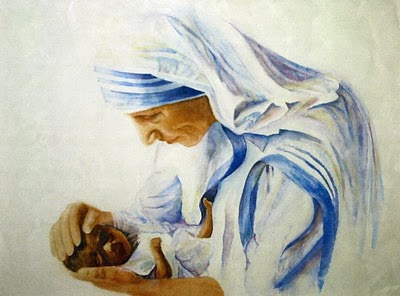
This week, I gave a couple of talks. On Tuesday, I spoke about Mother Teresa and the next morning, I was on the Catholic Radio to talk about Blessed Mother. During the radio talk, Deacon Jodi Moscona asked me to talk about Blessed Mother. And I said, if there is one thing that Blessed Mother wants more than anything is that she wants us to know her not as Mary of the theology, but Blessed Mother who is sitting next to us, in our car on the way to work, in our dining room at breakfast, with her arms around us, gently urging us, "Do whatever my Son asks you to do."  

Take for example of Mother Teresa. For Mother Teresa Blessed Mother was a concrete, daily presence to be met with, welcomed, known, cherished, and learned from. Mother Teresa taught her followers not only to pray to Blessed Mother, but to live in company with her. Living with her implies an ongoing, daily encounter with her unseen but powerful presence. This requires not only faith on our part, but also the willingness to invest the time to draw near to her. Mother Teresa taught her Sisters and co-workers that Blessed Mother's was a presence that helps us to see through the darkness, a presence that consoles and sustains us when we are weak, a presence that reminds us of the cry of her Son when we are forgetting him or following the voice of ego.  Blessed Mother knows well what her Son can give us, as He said in our gospel: "Peace I leave with you; my peace I give to you. Not as the world gives do I give it to you. Do not let your hearts be troubled or afraid."


Monday, May 3, 2010

Fr. Paul will give a talk on Mother Teresa, Tuesday 7PM May 4, 2010 at Our Lady of Mercy's Parish Activity Center

Please come and hear Fr. Paul speaking on Blessed Teresa of Calcutta's (Mother Teresa) life and spirituality on Tuesday, May 4, 7PM at Our Lady of Mercy's Parish Activity Center (445 Marquette Ave. Baton Rouge, LA 70806) Open to everyone.

May 3, 2010: Monday, Daily Homily

Monday daily homily after reflecting on morning paper's article on a mother who lost her son.

 Click to preview DailyHomily-5-3-10.mp3  Click to hear the audio homily

Saturday, May 1, 2010

May 2, 2010: 5th Sunday Easter (C)


Click to preview SundayHomily-5-2-10.mp3  (Click to hear the audio homily)

Last week Friday morning, if you were out at our school's football field, you would have seen a cutest scene. Early last week, the rides for our parish fair was being set up, and many of the parents who drove by the field with little ones in their cars had to stop, get out and let the little ones see all the activities. But that wasn't the cutest scene. The cutest scene was when the entire Pre-K and Kindergarten classes were led out to the football field for a training--a training for what could potentially happen at the parish fair, which really did happen many times. And on Sunday at the fair, I witnessed it for myself how effective this training was.  After devouring a hamburger, nachos, a cup of ice cream, and cotton candy, I went near the big tent to rest. In the big tent was also the main public announcement booth. I saw a small 5 yr. old girl in the booth, teary eyed and one of the parents was consoling the child. The parent then made the following announcement over the PA: "Mother of (so and so), you are lost. Please report to the main booth." The parent then said to me, "A child is never lost. However, a parent can be."

Wouldn't it be nice if our older children, our teenagers, college age, and adult children receive the same training and find their lost parents? Our Pre-K and Kindergarten were trained to walk immediately to the announcement booth when their parents were lost and report them so they can be found. Wouldn't it be nice if our older children and adult children walk immediately walk over somewhere when their parents are lost?

For our little ones, helping them find their parents is easy. But for our older children, helping them find their lost parents is difficult. With the Pre-K and Kindergarten, you still have dependence and obedience. The little ones do what you ask them to do because they trust you. Here at Our Lady of Mercy School, when the little ones are about to cross the street, their teachers ask them to join hands and follow closely. Do you think the same happens for 8th graders or high school students? They are self-sufficient and self-confident with 'a hint' of disobedience and distrust of authority. Dads remember that when their kids were little, they were treated as the strongest and the smartest dad in town. It seems like these days with shows like, "Are You Smarter than a 5th Grader?" dads lose their glory very early. The same is for our attitude toward Heavenly Father. Before the First Communion, the little ones prayed diligently and obediently, treating Him with utmost respect. But with the gift of Nintendo, iPod, a cellphone, and all the new toys that arrive with each consecutive birthdays, we lost sight of the Heavenly Father quick. We may even be bold enough, even be arrogant enough to claim that He doesn't exist or that He is irrelevant--that's exactly what I said to myself 18 years ago. If you had seen me 18 years ago, I was a cocky, self-absorbed, selfish young man who had no room for others and definitely no room for Heavenly Father. I trusted myself only--I distrusted God and I was disobedient.

Then when a crisis hits, when we come upon a situation where we can't get ourselves out of it, we begin to cry. We begin to walk toward that announcement booth, looking for our lost Heavenly Father. Many of us ask  why Heavenly Father would so readily come find us when we are so ungrateful and disobedient. It really speaks of His boundless love. We read in our Second Reading that, "Behold, God's dwelling is with the human race. He will dwell with them and they will be his people and God himself will always be with them as their God. He will wipe every tear from their eyes..." Wouldn't it be nice if we train ourselves to go to the announcement booth when we are lost--to walk over to the Church, to open our Bible that's gathering dust, to go to Confession, and to say, "Heavenly Father, you are lost, come find me!"