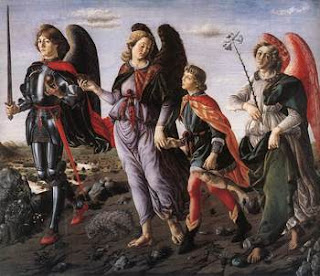
-St. Therese of Lisieux, "Story of a Soul: The Autobiography of St. Therese of Lisieux"
Friday, September 30, 2011
Oct. 1, 2011 Saturday: St. Therese of Lisieux
Elevator to Jesus
The good God would not inspire unattainable desires; I can, then, in spite of my littleness, aspire to sanctity. For me to become greater is impossible; I must put up with myself just as I am with all my imperfections. But I wish to find the way to go to Heaven by a very straight, short, completely new little way. We are in a century of inventions: now one does not even have to take the trouble to climb the steps of a stairway; in the homes of the rich an elevator replaces them nicely. I, too, would like to find an elevator to lift me up to Jesus, for I am too little to climb the rough stair-way of perfection. So I have looked in the books of the saints for a sign of the elevator I long for, and I have read these words proceeding from the mouth of eternal Wisdom: “He that is a little one, let him turn to me.” I came, knowing that I had found what I was seeking, and wanting to know, O my God, what You would do with the little one who would answer Your call, and this is what I found: “As one whom the mother caresses, so will I comfort you. You shall be carried at the breasts and upon the knees they shall caress you.” Never have more tender words come to make my soul rejoice. The elevator which must raise me to the heavens is Your arms, O Jesus! For that I do not need to grow; on the contrary, I must necessarily remain small, become smaller and smaller. O my God, You have surpassed what I expected, and I want to sing Your mercies.
-St. Therese of Lisieux, "Story of a Soul: The Autobiography of St. Therese of Lisieux"
Thursday, September 29, 2011
Sept. 30, 2011 Friday: St Jerome
St. Jerome

Jerome was a Roman Christian who lived in the fourth and fifth centuries. His father instructed him in the Christian faith, but sent him to a famous pagan school. There, Jerome grew to love pagan writings and lost some of his love for God. Yet, in the com-pany of a group of holy Christians, with whom he became great friends, his heart was turned completely to God. He was baptized as a young adult.
Later, this brilliant young man decided to live alone in a wild desert. For four years he lived a life of prayer and penance, struggling against temptations. He learned Hebrew and wrote a biography of St. Paul of Thebes. He became such a great scholar of Hebrew that he could later translate the Bible into Latin, which, at that time, was understood by anyone who could read. Many more people were then able to read and understand the Holy Bible. After his time in the desert, Jerome went to Antioch and was ordained a priest. He went to Constantinople to study Scripture and then to Rome, where he revised the Latin version of the Gospels.
St. Jerome spent long years of his life in a little cave at Bethlehem. There he prayed, studied, and translated the Bible. He taught many people how to serve God. He wrote a great many letters and books to explain the faith.
St. Jerome died in Bethlehem in 420. He is a Doctor of the Church.
To overcome his strong temptations, St. Jerome worked and studied hard. He also read the Bible. We can imitate Jerome’s wonderful habits of hard work, serious study, and frequent reading of the Bible. God’s holy Word has the power to change us for the better.
-Daughters of St Paul

Jerome was a Roman Christian who lived in the fourth and fifth centuries. His father instructed him in the Christian faith, but sent him to a famous pagan school. There, Jerome grew to love pagan writings and lost some of his love for God. Yet, in the com-pany of a group of holy Christians, with whom he became great friends, his heart was turned completely to God. He was baptized as a young adult.
Later, this brilliant young man decided to live alone in a wild desert. For four years he lived a life of prayer and penance, struggling against temptations. He learned Hebrew and wrote a biography of St. Paul of Thebes. He became such a great scholar of Hebrew that he could later translate the Bible into Latin, which, at that time, was understood by anyone who could read. Many more people were then able to read and understand the Holy Bible. After his time in the desert, Jerome went to Antioch and was ordained a priest. He went to Constantinople to study Scripture and then to Rome, where he revised the Latin version of the Gospels.
St. Jerome spent long years of his life in a little cave at Bethlehem. There he prayed, studied, and translated the Bible. He taught many people how to serve God. He wrote a great many letters and books to explain the faith.
St. Jerome died in Bethlehem in 420. He is a Doctor of the Church.
To overcome his strong temptations, St. Jerome worked and studied hard. He also read the Bible. We can imitate Jerome’s wonderful habits of hard work, serious study, and frequent reading of the Bible. God’s holy Word has the power to change us for the better.
-Daughters of St Paul
Wednesday, September 28, 2011
Sept. 29, 2011 Thursday: Feast of Saint Michael, Saint Gabriel and Saint Raphael, archangels
You must believe in the love of Jesus for you. Love calls for love. How do you give Jesus love for love? Before all and above all, by your confidence in Him. This word, confidence, summarizes the three theological virtues: faith, hope, and charity—sovereign virtues which bring all the others in their train. But if these are the highest virtues, then the greatest heroism is demanded of us in order to realize them in the face of the mystery of a “hidden God.” A man must be heroic to live always in faith, hope, and love. Why? Because, as a result of Original Sin, no one can be certain with the certainty of faith that he is saved, but only with a moral certainty based upon fidelity to grace; and because as sinners we are constantly tempted by doubt and anxiety. It was in order to resolve this conflict between our desires and our powerlessness that Jesus came to earth and took our infirmities upon Himself.
- Fr. Jean d'Elbée, "I Believe in Love: A Personal Retreat Based on the Teaching of St. Therese of Lisieux"
Tuesday, September 27, 2011
Sept. 28, 2011 Wednesday: 26th Week in Ordinary Time
"The Son of Man has nowhere to rest his head"
O Lady Poverty, the Son of the Most High, having become a lover of your beauty» (Wsd 8,2)... found you most faithful in all things. Even before he left his bright realms for the earth, you prepared him a fitting place, a throne on which to sit, a couch in which to rest: a most poor Virgin from whom he sprung and shone upon the world. At his Nativity you ran to meet him so that he might find comfort in you. You «laid him in a manger because there was no room in the inn» (Lk 2,7) and always, inseparably, accompanied him so that, during his whole life, while he dwelt amongst us: «Though the foxes had dens and the birds of the air had nests, he had no place to lay his head». And when he who in the past had opened the lips of the prophets opened his own lips to preach, he first praised you, saying: «Blessed are the poor in spirit for theirs is the Kingdom of Heaven» (Mt 5,3). And when he chose friends as witnesses to his holy preaching and glorious work for the salvation of humankind, he did not take rich merchants but poor fishermen, that by this choice he might show how the value he placed on you, Lady Poverty, was to create love for you in all. And finally, in order that your goodness, greatness and power might be made manifest to everyone and show how you are above all the virtues and how your kingdom is not of this world but from heaven: you alone remained with the King of Glory when all his chosen friends had fled from him in fear. Like a most dear companion and faithful spouse, you did not leave him for an instant. The more he was despised by all, the more you cleaved to him... You alone consoled him. You were with him «unto death, even death on a cross» (Phil 2,8). And on the cross itself, his body stripped, his arms extended, his hands and feet pierced... nothing seemed more glorious in him than you.
-Account of a companion of Saint Francis of Assisi
Sacrum commercium, 6 (trans. Fr Cuthbert OFM; adapted)
O Lady Poverty, the Son of the Most High, having become a lover of your beauty» (Wsd 8,2)... found you most faithful in all things. Even before he left his bright realms for the earth, you prepared him a fitting place, a throne on which to sit, a couch in which to rest: a most poor Virgin from whom he sprung and shone upon the world. At his Nativity you ran to meet him so that he might find comfort in you. You «laid him in a manger because there was no room in the inn» (Lk 2,7) and always, inseparably, accompanied him so that, during his whole life, while he dwelt amongst us: «Though the foxes had dens and the birds of the air had nests, he had no place to lay his head». And when he who in the past had opened the lips of the prophets opened his own lips to preach, he first praised you, saying: «Blessed are the poor in spirit for theirs is the Kingdom of Heaven» (Mt 5,3). And when he chose friends as witnesses to his holy preaching and glorious work for the salvation of humankind, he did not take rich merchants but poor fishermen, that by this choice he might show how the value he placed on you, Lady Poverty, was to create love for you in all. And finally, in order that your goodness, greatness and power might be made manifest to everyone and show how you are above all the virtues and how your kingdom is not of this world but from heaven: you alone remained with the King of Glory when all his chosen friends had fled from him in fear. Like a most dear companion and faithful spouse, you did not leave him for an instant. The more he was despised by all, the more you cleaved to him... You alone consoled him. You were with him «unto death, even death on a cross» (Phil 2,8). And on the cross itself, his body stripped, his arms extended, his hands and feet pierced... nothing seemed more glorious in him than you.
-Account of a companion of Saint Francis of Assisi
Sacrum commercium, 6 (trans. Fr Cuthbert OFM; adapted)
Sept. 27, 2011 Tuesday: St. Vincent de Paul
Although he had no advantages of birth, fortune, or handsome appearance, or any showy gifts at all, Vincent de Paul's later years became one long record of accomplishment. In the midst of great affairs, his soul never strayed from God; always when he heard the clock strike, he made the sign of the cross as an act of divine love. Under setbacks, calumnies, and frustrations, and there were many, he preserved his serenity of mind. He looked on all events as manifestations of the Divine will, to which he was perfectly resigned. Yet by nature, he once wrote of himself, he was "of a bilious temperament and very subject to anger." Without divine grace, he declared, he would have been "in temper hard and repellent, rough and crabbed." With grace, he became tenderhearted to the point of looking on the troubles of all mankind as his own. His tranquillity seemed to lift him above petty disturbances. Self-denial, humility, and an earnest spirit of prayer were the means by which he attained to this degree of perfection. Once when two men of exceptional learning and ability asked to be admitted to his congregation, Vincent courteously refused them, saying: "Your abilities raise you above our low state. Your talents may be of good service in some other place. As for us, our highest ambition is to instruct the ignorant, to bring sinners to a spirit of penitence, and to plant the Gospel spirit of charity, humility, and simplicity in the hearts of all Christians." One of his rules was that, so far as possible, a man ought not to speak of himself or his own concerns, since such discourse usually proceeds from and strengthens pride and self-love.
Letter of St. Vincent de Paul to Pope Alexander VII
June 6, 1659
Most Holy Father:
I know that the whole of France and many other nations are urgently beseeching Your Holiness to deign to inscribe on the calendar of Saints the name of the Most Illustrious and Most Reverend Francis de Sales, Bishop of Geneva. I am also aware that Your Holiness, filled with admiration for the rare virtues that shone in him, and the books of lofty devotion which he composed, holds his memory in profound veneration, and, consequently, that Your Holiness seems inclined to carry out this design, without there being any need of petitions from others and, especially, from such a wretched and unknown individual as myself. Nevertheless, Most Holy Father, as I was on rather familiar terms with this servant of God, who often deigned to hold converse with me, either about the Institute of the Religious of the Visitation of Holy Mary, which he established and founded, or on other pious matters, I have admired so many, and so great, virtues in him, that it is hard for me now to keep silence; I cannot be the only person who says nothing.
Faith, Hope, Charity, and the other cardinal and moral Christian virtues seemed almost innate in him and, taken together, formed in him, at least to my way of thinking, such a fund of goodness that, during an illness which occurred to me shortly after a conversation with him, I turned over in my mind his sweetness and exquisite meekness, and often repeated to myself: 'Oh! how good must God be, since the Bishop of Geneva is so kind.'
If I were alone, Most Holy Father, in thus thinking about him, I might believe I was deceiving myself but, as the whole world shares these sentiments, what else is needed, Most Holy Father, but a word from Your Holiness to consummate such a holy enterprise, by resolving to inscribe his name in the catalogue of the saints, and setting him up for the veneration of the whole world! All the priests of our Congregation and myself prostrate at the feet of Your Holiness, now most humbly beg you to do so. May God Almighty deign to grant you many long years for the welfare of His Church!
Monday, September 26, 2011
Sept. 26, 2011 Monday: St. Cosmas and St. Damian
St. Cosmas and St. Damian

These two martyrs were twin brothers from Syria who died at the beginning of the fourth century. They were very famous students of science and both became excellent doctors. Cosmas and Damian saw in every patient a brother or sister in Christ. For this reason, they showed great charity to all and treated their patients to the best of their ability. Yet, no matter how much care a patient required, neither Cosmas nor Damian ever accepted any money for their services. For this reason, they were called by a name in Greek, which means “the penniless ones.”
Every chance they had, the two saints told their patients about Jesus Christ, the Son of God. Because the people all loved these twin doctors, they listened to them willingly. Cosmas and Damian often brought health back to both the bodies and the souls of those who came to them for help.
In 303, when Diocletian’s persecution of Chris-tians began in their city, the saints were arrested at once. They had never tried to hide their great love for their Christian faith. Nothing could make them give up their belief in Christ. They had lived for him and had brought so many people to faith in him. They were put to death along with their three other brothers. These holy martyrs are named in the First Eucharistic Prayer of the Mass.

These two martyrs were twin brothers from Syria who died at the beginning of the fourth century. They were very famous students of science and both became excellent doctors. Cosmas and Damian saw in every patient a brother or sister in Christ. For this reason, they showed great charity to all and treated their patients to the best of their ability. Yet, no matter how much care a patient required, neither Cosmas nor Damian ever accepted any money for their services. For this reason, they were called by a name in Greek, which means “the penniless ones.”
Every chance they had, the two saints told their patients about Jesus Christ, the Son of God. Because the people all loved these twin doctors, they listened to them willingly. Cosmas and Damian often brought health back to both the bodies and the souls of those who came to them for help.
In 303, when Diocletian’s persecution of Chris-tians began in their city, the saints were arrested at once. They had never tried to hide their great love for their Christian faith. Nothing could make them give up their belief in Christ. They had lived for him and had brought so many people to faith in him. They were put to death along with their three other brothers. These holy martyrs are named in the First Eucharistic Prayer of the Mass.
Sunday, September 25, 2011
Saturday, September 24, 2011
Sept. 25, 2011: 26th Sunday in Ordinary Time (A)
Have you ever had the experience of your mind wanting to go in one direction, yet your body goes in another direction? One of the best examples of this is a game we played as kids whenever we went on school outings, called Dizzy Bat Race. The game was played on a grassy field and the teacher would set out an orange cone as the goal for the kids to reach. Two students at a time were each given a baseball bat. With the baseball bat standing on end and the student’s forehead pressed down on the bat, the student would then spin around the bats 10 times. After spinning, the students would then have to run toward the orange cone. Of course, after spinning around the bat that many times, your mind wants to go toward the orange cone but your body is confused and wanders sideways. I don't know who had more fun, we kids who were hopelessly falling down or the classmates and teachers who were laughing at our expense. There are other occasions where our mind and body go separate ways. Last time I was at the nursing home here in Donaldsonville to celebrate mass, I noticed a lady in her 90's in her wheelchair. Her family member commented that now she is like a sweet child. I noticed how this lady was clutching a baby doll just as a 6-yr. old child would.
There is a great mystery hidden behind how our will and our body interact. Many folks here who were taught by the religious nuns and brothers know that a ruler was not only used to measure length but also to teach our mind and the will through the pain felt on the body. When I was in middle school, the football coach handed out our report cards in the locker room. Afterward, the guys who got D's or F's had to line up outside the shower room where the coach would then offer an “incentive” to them to study. The sound of 'POW!' that the rest of us heard reverberate from the paddling seemed so loud and so painful that we knew not to procrastinate on our homework, less the same would happen to us the next time. Occasionally, before those guys would line up for their “incentive”, some of the guys in the line grumbled that it was not fair, but after their behind received some heat, they no longer dared to say, 'It's not fair!'
In the First Reading, we hear people grumbling and saying, "The Lord's way is not fair!" But then the Lord puts forth this question, "Is it my way that is unfair, or rather, are not your ways unfair? When someone virtuous turns away from virtue to commit iniquity, and dies, it is because of the iniquity he committed that he must die. But if he turns from the wickedness he has committed, he does what is right and just, he shall preserve his life." For most of us who live through daily aggravating, frustrating, and confusing situations, all we can say is "Why? This is not fair."
To all of our questions of "Why," St. Paul gives us an explanation in the Second Reading. Look at Jesus he says. "Have in you the same attitude that is also in Christ Jesus, Who, though he was in the form of God, did not regard equality with God something to be grasped. Rather, he emptied himself, taking the form of a slave, coming in human likeness; and found human in appearance, he humbled himself, becoming obedient to the point of death, even death on a cross." We may wonder why our Lord lived and suffered as he did? Jesus said, "For I have come down from heaven not to do my will but to do the will of him who sent me." (John 6:38) At the very heart of why Jesus did what he did is, that he loved his Father. The accusation that the evil one heaps on Jesus as he faithfully follows the Way of the Cross, is 'Why would a loving Father let this happen to you, Jesus? Does He really love you?' This is the same accusation that the evil one whispers in our ears when we face our earthly crosses. We may be enduring one unexplainable tragedy after another even though we are faithful to our prayers, to our church, and to our work. As we go through struggles, we probably wonder how Blessed Mother was able to say to the Archangel Gabriel, "Be it done to me according to thy word." (Luke 1:38). What Blessed Mother and Jesus did was to surrender to the Father's Will.
In another words, they were obedient to the Father's Will for them.Mother Teresa made the following observation about our culture. "Today we have many broken homes because there is not that obedience, that surrender to each other between husband and wife, parents and children. There is so much trouble with the young people because they want to be free to do everything, as they like. [In one book] it says let the child do what he wants from the age of one, so from that age he can say, 'Oh no, I won't go today, I will go where I want.' The person given totally to God knows obedience. I am not talking of the obedience of a slave, but of love. My parents--I love them and they love me and so I obey. There must also be some fear: The fear of offending God, of offending our parents, of offending our superiors. What an empty life is ours if we have not understood this: that I belong to Jesus and He can do with me what He wants."
It is easy for our mind and will to get disoriented and lose direction like the child who tries to walk straight after turning ten times around a baseball bat. Just as Our Lord and Blessed Mother surrendered daily saying "Be it done to me according to thy word," we also need that spirit of surrender, trusting that God has a plan, a future filled with hope.
Thursday, September 22, 2011
Sept. 23, 2011 Friday: St. Pio of Pietricina ("Padre Pio")
Padre Pio (Francesco Forgione) was born to Giuseppa and Grazio Forgione, in the small farming town of Pietrelcina, Italy on May 25, 1887. Although the Forgiones were poor in material goods, they were certainly rich in their faith life and in the love of God.
Even as a young boy, Francesco had already shown signs of extraordinary gifts of grace. At the age of five, he dedicated his life to God. From his early childhood, he showed a remarkable recollection of spirit and a love for the religious life. His mother described him as a quiet child who, from his earliest years, loved to go to church and to pray. As a young boy, he was able to see and communicate with, not only his guardian angel but also with Jesus and the Virgin Mary. In his simplicity, Francesco assumed everyone had the same experiences. Once a woman who noticed his spiritual demeanor asked him, "When did you consecrate your life to God? Was it at your first Holy Communion?" and he answered, "Always, daughter, always."
When Francesco was fifteen years old, he was admitted to the novitiate of the Capuchin Order of the Friars Minor in Morcone, Italy. He was admired by his fellow-students as well as by his Superiors for his exemplary behavior and his deep piety. One of the novices stated, "There was something which distinguished him from the other students. Whenever I saw him, he was always humble, recollected, and silent. What struck me most about Brother Pio was his love of prayer."
On August 10, 1910, at the age of twenty-three, Padre Pio was ordained to the priesthood. The celebration of the Holy Mass was for Padre Pio, the center of his spirituality. Due to the long pauses of contemplative silence into which he entered at various parts of the Holy Sacrifice, his Mass could sometimes last several hours. Everything about him spoke of how intensely he was living the Passion of Christ. The parish priest in Pietrelcina called Padre Pio's Mass, "an incomprehensible mystery." When asked to shorten his Mass, Padre Pio replied, "God knows that I want to say Mass just like any other priest, but I cannot do it."
" I live for Jesus Christ, I live for his glory, I live to serve him, I live to love him"
His parishioners were deeply impressed by his piety and one by one they began to come to him, seeking his counsel. For many, even a few moments in his presence, proved to be a life changing experience. As the years passed, pilgrims began to come to him by the thousands, from every corner of the world, drawn by the spiritual riches which flowed so freely from his extraordinary ministry. To his spiritual children he would say, "It seems to me as if Jesus has no other concern but the sanctification of your soul."
Padre Pio is understood above all else as a man of prayer. Before he was thirty years old he had already reached the summit of the spiritual life known as the "unitive way" of transforming union with God. He prayed almost continuously. His prayers were usually very simple. He loved to pray the Rosary and recommended it to others. To someone who asked him what legacy he wished to leave to his spiritual children, his brief reply was, "My child, the Rosary." He had a special mission to the souls in Purgatory and encouraged everyone to pray for them. He used to say, "We must empty Purgatory with our prayers." Father Agostino Daniele, his confessor, director, and beloved friend said, "One admires in Padre Pio, his habitual union with God. When he speaks or is spoken to, we are aware that his heart and mind are not distracted from the thought and sentiment of God."
Padre Pio suffered from poor health his entire life, once saying that his health had been declining from the time he was nine years old. After his ordination to the priesthood, he remained in his hometown of Pietrelcina and was separated from his religious community for more than five years due to his precarious health. Although the cause of his prolonged and debilitating illnesses remained a mystery to his doctors, Padre Pio did not become discouraged. He offered all of his bodily sufferings to God as a sacrifice, for the conversion of souls. He experienced many spiritual sufferings as well. "I am fully convinced that my illness is due to a special permission of God," he said.
Shortly after his ordination, he wrote a letter to his spiritual director, Father Benedetto Nardella, in which he asked permission to offer his life as a victim for sinners. He wrote, "For a long time I have felt in myself a need to offer myself to the Lord as a victim for poor sinners and for the souls in Purgatory. This desire has been growing continually in my heart so that it has now become what I would call a strong passion. . .It seems to me that Jesus wants this." The marks of the stigmata, the wounds of Christ, appeared on Padre Pio's body, on Friday, September 20, 1918, while he was praying before a crucifix and making his thanksgiving after Mass. He was thirty-one years old and became the first stigmatized priest in the history of the Church. With resignation and serenity, he bore the painful wounds in his hands, feet, and side for fifty years.
In addition, God endowed Padre Pio with many extraordinary spiritual gifts and charisms including the gift of healing, bilocation, prophecy, miracles, discernment of spirits, the ability to abstain beyond man's natural powers from both sleep and nourishment, the ability to read hearts, the gift of tongues (the ability to speak and understand languages that he had never studied), the gift of conversions, the grace to see angelic beings in form, and the fragrance which emanated from his wounds and which frequently announced his invisible presence. When a friend once questioned him about these charisms, Padre Pio said, "You know, they are a mystery to me, too." Although he received more than his share of spiritual gifts, he never sought them, never felt worthy of them. He never put the gifts before the Giver. He always remained humble, constantly at the disposal of Almighty God.
His day began at 2:30 a.m. when he would rise to begin his prayers and to make his preparation for Mass. He was able to carry on a busy apostolate with only a few hours of sleep each night and an amount of food that was so small (300-400 calories a day) that his fellow priests stated that it was not enough food even to keep a small child alive. Between Mass and confessions, his workday lasted 19 hours. He very rarely left the monastery and never took even a day's vacation from his grueling schedule in 51 years. He never read a newspaper or listened to the radio. He cautioned his spiritual children against watching television.
In his monastery in San Giovanni Rotondo, he lived the Franciscan spirit of poverty with detachment from self, from possessions, and from comforts. He always had a great love for the virtue of chastity, and his behavior was modest in all situations and with all people. In his lifetime, Padre Pio reconciled thousands of men and women back to their faith.
The prayer groups that Padre Pio established have now spread throughout the world. He gave a new spirit to hospitals by founding one which he called "The Home for the Relief of Suffering." He saw the image of Christ in the poor, the suffering, and the sick and gave himself particularly to them. He once said, "Bring God to all those who are sick. This will help them more than any other remedy."
Serene and well prepared, he surrendered to Sister Death on September 23, 1968 at the age of eighty-one. He died as he had lived, with his Rosary in his hands. His last words were GesĂş, Maria – Jesus, Mary - which he repeated over and over until he breathed his last. He had often declared, "After my death I will do more. My real mission will begin after my death."
In 1971, Pope Paul VI, speaking to the superiors of the Capuchin order, said of Padre Pio, "What fame he had. How many followers from around the world. Why? Was it because he was a philosopher, a scholar, or because he had means at his disposal? No, it was because he said Mass humbly, heard confessions from morning until night and was a marked representative of the stigmata of Our Lord. He was truly a man of prayer and suffering."
In one of the largest liturgies in the Vatican's history, Pope John Paul II canonized Padre Pio on June 16, 2002. During his homily, Pope John Paul recalled how, in 1947, as a young priest he journeyed from Poland to make his confession to Padre Pio. "Prayer and charity–this is the most concrete synthesis of Padre Pio's teaching," the Pope said.
Drawing approximately eight million pilgrims each year, San Giovanni Rotondo, where St. Pio lived and is now buried, is second only to the shrine of Our Lady of Guadalupe in Mexico in its number of annual visitors.
St. Pio's whole life might be summed up in the words of St. Paul to the Colossians, "Now I rejoice in my sufferings for your sake, and in my flesh I complete what is lacking in Christ's afflictions for the sake of his body, that is, the Church."
http://www.padrepiodevotions.org/biography.asp
http://caccioppoli.com/01%20Padre%20Pio;%20child%20,%20novice,%20and%20friar.html
Wednesday, September 21, 2011
Sept. 22, 2011 Thursday: 25th Week in Ordinary (A)
I want to be a saint according to His Heart, meek and humble—therefore at these two virtues of Jesus I will try my best. My second resolution is to become an apostle of joy—to console the Sacred Heart of Jesus through joy. Please ask Our Lady to give me Her heart so that I may with greater ease fulfill His desire in me. I want to smile even at Jesus and so hide if possible the pain and the darkness of my soul even from Him … Let me go, and give myself for them, let me offer myself and those who will join me for those unwanted poor, the little street children, the sick, the dying, the beggars, let me go into their very holes and bring in their broken homes the joy and peace of Christ.
-Mother Teresa
Sept. 21, 2011 Wed.: St. Matthew the Apostle
Pope Benedict XVI
Homily (from Osservatore Romano)
"You too go into my vineyard" (Mt 20,4)
It is Saint Matthew, the apostle and evangelist whose feast we are celebrating today, who tells the parable of the owner of the vineyard who calls laborers to work in in his vineyard (20.1f.). I like to emphasize that Matthew had personally had this experience. Before Jesus called him, he exercised the function of publican and, as a result, was thought of as a sinner, excluded from «the Lord's vineyard». However, it all changes when Jesus, passing by his tax-collector's table, looks at him and says: «Follow me». Matthew stood up and followed him. The publican had changed immediately into a disciple of Christ. He was one of the «last» who found himself to be «first» (Mt 20,16) thanks to God's way of thinking, which – happily for us! - is different from the world's. «Your thoughts are not my thoughts,» as the Lord says through the mouth of the prophet Isaiah, «nor are my ways your ways» (55,8).
Saint Paul, too, experienced the joy of feeling himself called by our Lord to work in his vineyard. And what a great work he accomplished! But, as he himself testifies, it was the grace of God working in him, that grace which transforms the persecutor of the Church into the apostle of the gentiles (1Cor 15,9-10).
Monday, September 19, 2011
Sept. 20, 2011 Tuesday: St. Andrew Kim and Korean Martyrs
St. Andrew Kim Daegeon and St. Paul Cho˘ng Hasang

St. Andrew Kim Daegeon was a priest and St. Paul Cho˘ng Hasang was a layperson. These two martyrs represent the many Catholics who died for their faith in Korea. They were proclaimed saints by Pope John Paul II during his visit to Korea in 1984.
Christianity was brought to Korea by lay people in the seventeenth century. Believers quietly grew and flourished, nourishing their faith on the Word of God. Missionary priests arrived in Korea from France and introduced the Korean people to the sacramental life of the Church. Off and on throughout the nineteenth century the Christian faith came under attack by the Korean government. A total of 103 Korean Catholics were killed between 1839 and 1867. Ten members of the Foreign Mission Society of Paris were martyred too: three bishops and seven priests. This brought the total number of martyrs to 113.
St. Andrew Kim Daegeon and St. Paul Cho˘ng Hasang represent the courageous Korean Catholics who paid with their lives for their love for Christ. St. Andrew Kim Daegeon, the first Korean priest, was martyred on September 16, 1846, just a year after his ordination. Andrew’s father had been martyred in 1821. St. Paul Cho˘ng Hasang was a heroic lay catechist. He was martyred on September 22, 1846.
The Church continues to grow rapidly in Korea. The gift of faith is received and nurtured because of the sacrifices of the martyrs who paved the way.
-Daughters of St. Paul

St. Andrew Kim Daegeon was a priest and St. Paul Cho˘ng Hasang was a layperson. These two martyrs represent the many Catholics who died for their faith in Korea. They were proclaimed saints by Pope John Paul II during his visit to Korea in 1984.
Christianity was brought to Korea by lay people in the seventeenth century. Believers quietly grew and flourished, nourishing their faith on the Word of God. Missionary priests arrived in Korea from France and introduced the Korean people to the sacramental life of the Church. Off and on throughout the nineteenth century the Christian faith came under attack by the Korean government. A total of 103 Korean Catholics were killed between 1839 and 1867. Ten members of the Foreign Mission Society of Paris were martyred too: three bishops and seven priests. This brought the total number of martyrs to 113.
St. Andrew Kim Daegeon and St. Paul Cho˘ng Hasang represent the courageous Korean Catholics who paid with their lives for their love for Christ. St. Andrew Kim Daegeon, the first Korean priest, was martyred on September 16, 1846, just a year after his ordination. Andrew’s father had been martyred in 1821. St. Paul Cho˘ng Hasang was a heroic lay catechist. He was martyred on September 22, 1846.
The Church continues to grow rapidly in Korea. The gift of faith is received and nurtured because of the sacrifices of the martyrs who paved the way.
-Daughters of St. Paul
Sunday, September 18, 2011
Saturday, September 17, 2011
Sept. 18, 2011: 25th Sunday in Ordinary Time (A)
Click to hear audio homily
St. Augustine Catholic Chapel is like any other Catholic chapel around the state. In the sanctuary of the chapel is a crucifix, surrounded by statues of Blessed Mother and St. Joseph. There is a Tabernacle where Jesus in the Eucharist resides and the Stations of the Cross hang on the walls. Unfortunately, it's not easy to visit the chapel because of its remote location. It would take you about two hours to drive there from here. More importantly, you would need a special visitor’s pass in order to visit the chapel, that is, unless you are a registered member of the community. Frequently, there are buses filled with adults and young people from Baton Rouge, Lafayette, and New Orleans making pilgrimages to that chapel. No miracle has happened in that chapel that would attract people to go there--at least not a miracle in our worldly terms. So what interests people in that chapel?
To get to the chapel, you have to take a 20-mile drive on the sparsely populated Highway 66. In fact, sometimes people get lost in the woods and then it takes days to find them. There is a must-see museum on the way to the chapel. If you were to view the photographs in the museum, you might think that only evil things happen beyond the entrance--violence, theft, and murder. Some photos are gruesome examples of what one human can do to another. Weapons of every kind are displayed on the sidewall of the museum. However, these are not sophisticated or expensive guns or knives, but weapons made from everyday bathroom and kitchen utensils. You might be shocked by how people used their intelligence and energy toward hate and revenge. You may be wondering where this museum and chapel are located. It’s the museum and chapel at Angola State Prison. The prison is nicknamed the "Alcatraz of the South," and it is also a prison farm. It is the largest maximum-security prison in the United States with 5,000 offenders and 1,800 staff. It is located on an 18,000-acre land surrounded on 3 sides by the Mississippi River. Over 95% of men living there will die there as they serve their prison terms.
The other day, a group of men from our area went to Angola Prison to conduct a communion service and visit the prisoners. One of our parishioners noticed a touching sight during the communion service held in St. Augustine Catholic Chapel. He observed an elderly inmate in a wheelchair being attended by a fellow inmate. After the service, our parishioner spoke to both men to learn about their relationship. The inmate in the wheelchair is dying of cancer, and the man helping him was assigned by the prison's new hospice program to assist him. The man in the wheelchair said, "I don't know what I would do without him." And the man assisting him said, "He is doing for me much more than what I am doing for him."
Is it too late for anybody to turn their life around, to change their hearts? Some men in the maximum security Angola Prison show us that numerous miracles of conversion of hearts can take place even for those imprisoned for violence and murder. This is what Jesus is teaching us when he gave us the Parable of Workers in the Vineyard. At the end of the day, the workers hired earlier in the day were complaining to the landowner because he was paying the workers hired just an hour before the end of the day the same wage. They grumbled against the landowner, saying, 'These last ones worked only one hour, and you have made them equal to us who bore the day's burden and the heat.' The landowner replied, 'My friend, did you not agree with me for the usual daily wage? Take what is yours and go. What if I wish to give this last one the same as you? Or am I not free to do as I wish with my own money? Are you envious because I am generous?'
"The Lord is near to all who call upon him," our Responsorial Psalm said. For Jesus, the maximum-security walls, electric fences, and guards with automatic weapons are no hindrance for him to reach anyone who calls out for Him. He is so generous with his forgiveness and mercy, whether early in our life or late in life, whether when we are obedient to Him or when we have lived many years of disobedience. His mercy is endless and the treasury of His compassion is inexhaustible. Turn to Him today and call out for Him. It is never too late.
Friday, September 16, 2011
Sept. 16, 2011 Friday: 24th Week in Ordinary Time
What is Prayer?

(CCC 2559) "Prayer is the raising of one's mind and heart to God or the requesting of good things from God." But when we pray, do we speak from the height of our pride and will, or "out of the depths" of a humble and contrite heart? He who humbles himself will be exalted; humility is the foundation of prayer, Only when we humbly acknowledge that "we do not know how to pray as we ought," are we ready to receive freely the gift of prayer. "Man is a beggar before God."
(CCC 2565) In the New Covenant, prayer is the living relationship of the children of God with their Father who is good beyond measure, with his Son Jesus Christ and with the Holy Spirit. The grace of the Kingdom is "the union of the entire holy and royal Trinity . . . with the whole human spirit." Thus, the life of prayer is the habit of being in the presence of the thrice-holy God and in communion with him. This communion of life is always possible because, through Baptism, we have already been united with Christ. Prayer is Christian insofar as it is communion with Christ and extends throughout the Church, which is his Body. Its dimensions are those of Christ's love.
(CCC 2567) God calls man first. Man may forget his Creator or hide far from his face; he may run after idols or accuse the deity of having abandoned him; yet the living and true God tirelessly calls each person to that mysterious encounter known as prayer. In prayer, the faithful God's initiative of love always comes first; our own first step is always a response. As God gradually reveals himself and reveals man to himself, prayer appears as a reciprocal call, a covenant drama. Through words and actions, this drama engages the heart. It unfolds throughout the whole history of salvation.

(CCC 2559) "Prayer is the raising of one's mind and heart to God or the requesting of good things from God." But when we pray, do we speak from the height of our pride and will, or "out of the depths" of a humble and contrite heart? He who humbles himself will be exalted; humility is the foundation of prayer, Only when we humbly acknowledge that "we do not know how to pray as we ought," are we ready to receive freely the gift of prayer. "Man is a beggar before God."
(CCC 2565) In the New Covenant, prayer is the living relationship of the children of God with their Father who is good beyond measure, with his Son Jesus Christ and with the Holy Spirit. The grace of the Kingdom is "the union of the entire holy and royal Trinity . . . with the whole human spirit." Thus, the life of prayer is the habit of being in the presence of the thrice-holy God and in communion with him. This communion of life is always possible because, through Baptism, we have already been united with Christ. Prayer is Christian insofar as it is communion with Christ and extends throughout the Church, which is his Body. Its dimensions are those of Christ's love.
(CCC 2567) God calls man first. Man may forget his Creator or hide far from his face; he may run after idols or accuse the deity of having abandoned him; yet the living and true God tirelessly calls each person to that mysterious encounter known as prayer. In prayer, the faithful God's initiative of love always comes first; our own first step is always a response. As God gradually reveals himself and reveals man to himself, prayer appears as a reciprocal call, a covenant drama. Through words and actions, this drama engages the heart. It unfolds throughout the whole history of salvation.
Thursday, September 15, 2011
Sept. 15, 2011 Thursday: Our Lady of Sorrows
A Musical Side Note: The Symphony No. 3, Op. 36, also known as the Symphony of Sorrowful Songs (Polish: Symfonia pieśni żałosnych), is a symphony in three movements composed by Henryk Górecki in Katowice, Poland, between October and December 1976.
A solo soprano sings a different Polish text in each of the three movements. The first is a 15th-century Polish lament of Mary, mother of Jesus, the second a message written on the wall of a Gestapo cell during World War II, and the third a Silesian folk song of a mother searching for her son killed in the Silesian uprisings.[2] The first and third movements are written from the perspective of a parent who has lost a child, and the second movement from that of a child separated from a parent. The dominant themes of the symphony are motherhood and separation through war.
GĂłrecki learned of an inscription scrawled on the wall of a cell of a Gestapo prison in the town of Zakopane, which lies at the foot of the Tatra mountains in southern Poland. The words were those of 18-year-old Helena Wanda BĹ‚aĹĽusiakĂłwna, a highland woman incarcerated on 25 September 1944. It read O Mamo nie pĹ‚acz nie—Niebios Przeczysta KrĂłlowo Ty zawsze wspieraj mnie (Oh Mamma do not cry—Immaculate Queen of Heaven support me always). The composer recalled, "I have to admit that I have always been irritated by grand words, by calls for revenge. Perhaps in the face of death I would shout out in this way. But the sentence I found is different, almost an apology or explanation for having got herself into such trouble; she is seeking comfort and support in simple, short but meaningful words". He later explained, "In prison, the whole wall was covered with inscriptions screaming out loud: 'I'm innocent', 'Murderers', 'Executioners', 'Free me', 'You have to save me'—it was all so loud, so banal. Adults were writing this, while here it is an eighteen-year-old girl, almost a child. And she is so different. She does not despair, does not cry, does not scream for revenge. She does not think about herself; whether she deserves her fate or not. Instead, she only thinks about her mother: because it is her mother who will experience true despair. This inscription was something extraordinary. And it really fascinated me."
Górecki now had two texts: one from a mother to her son, the other from a daughter to her mother. While looking for a third that would continue the theme, he decided on a mid-15th century folk song from the southern city of Opole. Its text contains a passage in which the Virgin Mary speaks to her Son dying on the cross: "O my son, beloved and chosen, Share your wounds with your mother ..." (Synku miły i wybrany, Rozdziel z matką swoje rany ...). -from Wikipedia
Wednesday, September 14, 2011
Sept. 14, 2011 Wednesday: Exaltation of the Holy Cross
Exaltation of the Holy Cross
"What a great thing it is to possess the Cross! He who possesses it possesses a treasure" (Saint Andrew of Crete, Homily X on the Exaltation of the Cross, PG 97, 1020). On this day when the Church's liturgy celebrates the feast of the Exaltation of the Holy Cross, the Gospel you have just heard reminds us of the meaning of this great mystery: God so loved the world that he gave his only Son, so that men might be saved (cf. Jn 3:16). The Son of God became vulnerable, assuming the condition of a slave, obedient even to death, death on a cross (cf. Phil 2:8). By his Cross we are saved. The instrument of torture which, on Good Friday, manifested God's judgement on the world, has become a source of life, pardon, mercy, a sign of reconciliation and peace. "In order to be healed from sin, gaze upon Christ crucified!" said Saint Augustine (Treatise on Saint John, XII, 11). By raising our eyes towards the Crucified one, we adore him who came to take upon himself the sin of the world and to give us eternal life. And the Church invites us proudly to lift up this glorious Cross so that the world can see the full extent of the love of the Crucified one for all, for us men. She invites us to give thanks to God because from a tree which brought death, life has burst out anew. On this wood Jesus reveals to us his sovereign majesty, he reveals to us that he is exalted in glory. Yes, "Come, let us adore him!" In our midst is he who loved us even to giving his life for us, he who invites every human being to draw near to him with trust.
This is the great mystery that Mary also entrusts to us this morning, inviting us to turn towards her Son. In fact, it is significant that, during the first apparition to Bernadette, Mary begins the encounter with the sign of the Cross. More than a simple sign, it is an initiation into the mysteries of the faith that Bernadette receives from Mary. The sign of the Cross is a kind of synthesis of our faith, for it tells how much God loves us; it tells us that there is a love in this world that is stronger than death, stronger than our weaknesses and sins. The power of love is stronger than the evil which threatens us. It is this mystery of the universality of God's love for men that Mary came to reveal here, in Lourdes. She invites all people of good will, all those who suffer in heart or body, to raise their eyes towards the Cross of Jesus, so as to discover there the source of life, the source of salvation.
The Church has received the mission of showing all people this loving face of God, manifested in Jesus Christ. Are we able to understand that in the Crucified One of Golgotha, our dignity as children of God, tarnished by sin, is restored to us? Let us turn our gaze towards Christ. It is he who will make us free to love as he loves us, and to build a reconciled world. For on this Cross, Jesus took upon himself the weight of all the sufferings and injustices of our humanity. He bore the humiliation and the discrimination, the torture suffered in many parts of the world by so many of our brothers and sisters for love of Christ. We entrust all this to Mary, mother of Jesus and our mother, present at the foot of the Cross.
In order to welcome into our lives this glorious Cross, the celebration of the Jubilee of Our Lady's apparitions in Lourdes urges us to embark upon a journey of faith and conversion. Today, Mary comes to meet us, so as to show us the way towards a renewal of life for our communities and for each one of us. By welcoming her Son, whom she presents to us, we are plunged into a living stream in which the faith can rediscover new vigour, in which the Church can be strengthened so as to proclaim the mystery of Christ ever more boldly. Jesus, born of Mary, is the Son of God, the sole Saviour of all people, living and acting in his Church and in the world. The Church is sent everywhere in the world to proclaim this unique message and to invite people to receive it through an authentic conversion of heart This mission, entrusted by Jesus to his disciples, receives here, on the occasion of this Jubilee, a breath of new life. After the example of the great evangelizers from your country, may the missionary spirit which animated so many men and women from France over the centuries, continue to be your pride and your commitment!
Tuesday, September 13, 2011
Sept. 13, 2011 Tuesday: Saint John Chrysostom
St. John Chrysostom
"Helping a person in need is good in itself. But the degree of goodness is hugely affected by the attitude with which it is done. If you show resentment because you are helping the person out of a reluctant sense of duty, then the person may recieve your help but may feel awkward and embarrassed. This is because he will feel beholden to you. If,on the other hand, you help the person in a spirit of joy, then the help will be received joyfully. The person will feel neither demeaned nor humiliated by your help, but rather will feel glad to have caused you pleasure by receiving your help. And joy is the appropriate attitude with which to help others because acts of generosity are a source of blessing to the giver as well as the receiver."
— St. John Chrysostom
St. John Chrysostom was born in Antioch around 344. His father died when he was a baby. His mother chose not to marry again. She gave all her attention to bringing up her son and daughter. She made many sacrifices so that John could have the best teachers. He was very intelligent and could have become a great man in the world. When he gave speeches everyone loved to listen to him. In fact, the name Chrysostom means “Golden-mouthed.” Yet John wanted to give himself to God. He became a priest and later was made bishop of the great city of Constantinople.
St. John was a wonderful bishop and accomplished a tremendous amount of good. He preached once or twice every day, fed the poor, and took care of orphans. He corrected sinful customs and stopped bad plays from being performed. He loved everyone, but he was not afraid to tell even the empress when she did something wrong.
Because he fought sin, St. John had enemies, even the empress herself. She had him sent away from Constantinople. On the trip he suffered greatly from fever and from lack of food and sleep. Yet, he was happy to suffer for Jesus. Just before he died, he cried out, “Glory be to God!”
St. John died in Turkey on September 14, 407. A terrible hailstorm fell on Constantinople when he died. Four days later, the empress died, too. Her son honored St. John’s body and showed how sorry he was for the harm his mother had done. -From Daughters of St. Paul
Monday, September 12, 2011
Sept. 12, 2011 Monday: Most Holy Name of the Blessed Virgin Mary
Most Holy Name of the Blessed Virgin Mary

Honoring Mary’s name in the liturgy goes back to the sixteenth century, when individual churches celebrated the feast of the Name of Mary. In 1683, Pope Innocent XI made September 12 a feast of the universal Church to honor Mary’s name and to thank her for her protection.
Mary’s name means “star of the sea” in Hebrew. Just as sailors caught in a storm will use the stars to keep their coarse, we can look to Mary as our “star” who keeps us on the path that Jesus marked out for us. If we get off track in our life, we can look to Mary and she will guide us back to Jesus and his Church.
St. Bernard wrote: “As you struggle through the stormy sea of life, do not turn away from Mary, star of the sea. If the winds of temptation blow your little boat, or if you are headed toward the rocks of suffering, look at the star—call Mary! If you are tossed by waves of ambition or envy, look at the star—call Mary! If anger or greed rocks the little boat of your heart, look at Mary! If you are getting discouraged because of your sins, think of Mary! In dangers and difficulties, remember Mary—call Mary! Do not let her name be far from your lips. Keep the thought of her fixed in your heart! She will keep you from losing your way. She will protect you so you have nothing to fear. She will guide you to Jesus, your Savior!”
When we experience sadness, doubt, or disappointment, do we think of Mary and call to her? Do we believe that Mary truly loves us and wants us to be happy? How is Mary leading us closer to Jesus?
-From Daughters of St. Paul

Honoring Mary’s name in the liturgy goes back to the sixteenth century, when individual churches celebrated the feast of the Name of Mary. In 1683, Pope Innocent XI made September 12 a feast of the universal Church to honor Mary’s name and to thank her for her protection.
Mary’s name means “star of the sea” in Hebrew. Just as sailors caught in a storm will use the stars to keep their coarse, we can look to Mary as our “star” who keeps us on the path that Jesus marked out for us. If we get off track in our life, we can look to Mary and she will guide us back to Jesus and his Church.
St. Bernard wrote: “As you struggle through the stormy sea of life, do not turn away from Mary, star of the sea. If the winds of temptation blow your little boat, or if you are headed toward the rocks of suffering, look at the star—call Mary! If you are tossed by waves of ambition or envy, look at the star—call Mary! If anger or greed rocks the little boat of your heart, look at Mary! If you are getting discouraged because of your sins, think of Mary! In dangers and difficulties, remember Mary—call Mary! Do not let her name be far from your lips. Keep the thought of her fixed in your heart! She will keep you from losing your way. She will protect you so you have nothing to fear. She will guide you to Jesus, your Savior!”
When we experience sadness, doubt, or disappointment, do we think of Mary and call to her? Do we believe that Mary truly loves us and wants us to be happy? How is Mary leading us closer to Jesus?
-From Daughters of St. Paul
Sunday, September 11, 2011
Saturday, September 10, 2011
Sept. 11, 2011: 24th Sunday in Ordinary Time (A)
Click to hear audio homily
The other day I was surfing on the Internet and I came across a website that promised that it would transform your child’s bad behavior. Curious, right? On this website, in bold print is this teaser, "Say Goodbye to Disrespectful, Obnoxious and Abusive Behavior, and Regain Control of Your Child, Your Family & Your Life." How many of you would like to buy that product now? One of the techniques is, "The 10 Words to Say When He Gets Mouthy." Supposedly, this technique puts the brakes on "back talk" and cursing immediately… no matter how nasty your child gets. Have you had your share of trying to stop siblings who are fighting? When one child strikes the other, the child who is hit is angry and bitter, so he swings back. What do you do as a parent in such a situation? Spank both children? For three easy payments of $109 ($327 total!), no more pleading, negotiating, or yelling with the kids. Not even therapy for your child is necessary. Does this sound too good to be true?
We know that kids do not behave like we think they should. Their actions do not always coincide with their intentions. They are often irrational because they can’t control themselves like adults can. I'm sure that some of us are thinking, 'some adults I know are irrational and can't control themselves, either.' So how do you handle anger problems that lead to lashing out and leave behind hurt, bitterness, and desire for revenge? I'll turn to Mother Teresa for a solution (at least I know I don't have to make three easy payments of $109 to get her advice).
Her solution begins with turning our attention to our loving Father and understanding how the Heavenly Father sees us. She said, "He is loving Father for us all. He is always ready to forgive, to forget. He is always there. He is loving us, calling us, protecting us, in tenderness and love. We need lots of love to forgive, and we need lots of humility to forget. It is not complete forgiveness unless we forget also. As long as we cannot forget, we have not forgiven fully. This is how we hurt each other, we bring one hurt from yesterday, and we keep on repeating. This means we really have not forgotten. We need humility to forget. That's why it's very important to learn humility. That is one of the beautiful things that Jesus has asked us. Learn of me, because I am meek and humble of heart. He first puts meekness with each other, meekness with our brothers and sisters, and humility with God. Meekness and humility completes that forgiveness. Because before we forgive somebody, we must realize that we need forgiveness. That is where humility of heart comes from. And the forgiveness is the greatest presence of peace.”
We all know that it is not easy to forget a hurt inflicted on us. It is impossible for a child who has been hurt to forget what his brother just did to him. We know if our loved one said ugly and hurtful words to us, these words play in our mind and heart repeatedly. So what is Mother Teresa really saying to us? In fact, our First Reading and our Gospel echo Mother Teresa. The First Reading said, "Wrath and anger are hateful things, yet the sinner hugs them tight. Forgive your neighbor's injustice; then when you pray, your own sins will be forgiven. Could anyone nourish anger against another and expect healing from the LORD? Could anyone refuse mercy to another like himself, can he seek pardon for his own sins?" In the Gospel, Peter asked …” how often must I forgive? As many as seven times?" Jesus answered, "I say to you, not seven times but seventy-seven times." How do we get from the point of being hurt to forgiveness, instead of bitterness and revenge? So the question remains. What is Mother Teresa saying when she says 'forget'?
It is a great mystery that the 10th Anniversary of the 9/11 tragedy and this Gospel on forgiveness coincide this Sunday. What message can we glean from this? The second day after the World Trade Center towers were bombed, the search and rescue workers digging through the rubble came upon a cavernous space. Once inside this space they saw an amazing sight. Against all odds, a 17-foot-long crossbeam, weighing at least two tons, had been thrust at a vertical angle in the wasteland, and it appeared like a cross. The workers began to refer to the space as 'God's House’. Shortly after its discovery, a Franciscan priest, Father Brian, persuaded city officials to allow a crew of volunteer union laborers to lift it out of the wreckage and mount it on a concrete pedestal. They placed it in a quiet part of the site on Church Street. On Oct. 3, 2001, Father Brian blessed it with the following prayer of St. Bonaventure. “May it ever compass Thee, seek Thee, find Thee, run to Thee . . . ”
Why was that cross there in the midst of the rubble, in the midst of the mess that human anger, bitterness, and revenge created? Even in the mess that humans create, Heavenly Father makes His loving presence known. What was God inviting us to remember? What was God inviting us to forget? When we look at a cross, we remember that our sins, our bitterness, our anger and our pride nailed Jesus there. It was totally irrational what we did to Him. Yet Jesus cried out, "Father, forgive them, for they do not know what they are doing." (Lk 23:34) From the Cross on Calvary, God wanted us to know, and always remember, that He forgot what we did to Him and forgave us, completely. This invitation to forget, is not to forget that this violence ever happened. The Cross is an invitation for us to remember that we were forgiven first, even when we did not deserve it. We should be humbled by His generosity. Before we get angry enough to the point where we want to harm or take revenge on another person like that servant in the Gospel, we must remember the Cross as a sign from the loving Father that we have been forgiven. Therefore, in humility, we should forgive.
I don't think three easy payments of $109 will ever teach an angry child to forgive the offense of his brother. Instead, it’s cheaper, and far more effective, for a child to experience his mommy’s and daddy’s forgiveness no matter how many times he offends them. This child will learn by his parent’s example and will come to forgive his brother as well.
Friday, September 9, 2011
Sept 8, 2011 Nativity of Mary: Audio Homily
Click below to hear the audio homily
https://vr.shapeservices.com/play.php?hash=6bf72283e992f0f22acbdf05a910740562f9762e1d5212d0b
Thursday, September 8, 2011
Sept. 9, 2011 Friday: St. Peter Claver
St. Peter Claver

This Spanish priest of the Society of Jesus was born in 1580. He is known as the “apostle of the slaves.” While he was still studying to become a Jesuit, he felt a burning desire to go to South America as a missionary. He volunteered and was sent to the seaport of Cartagena, in present day Colombia, where shiploads of African slaves were brought to be sold.
Peter felt great pity at the sight of those poor people, sick and suffering, all crowded together. He made up his mind to help them as much as he could. As soon as a slave ship arrived, he would go among the hundreds of sick slaves. He gave them food and medicine. He taught them about Christ and baptized those who accepted the faith. He cared for the sick. It was hard work in terrible heat. One man who went once with St. Peter could not bring himself to face the heartbreaking sight again. Yet Peter did it for forty years. He baptized some 300 thousand people. He was always there when the ships came in. He cared for and loved those who were treated so unjustly by society.
Although the slave owners tried to stop Father Claver, he taught the faith to the slaves anyway. It was slow, discouraging work. Many people criticized him, saying it was all a waste of time. They thought the slaves would never understand and keep the faith. But St. Peter was patient and he trusted that God would bless his people. He also went to visit his converts after they left Cartagena, staying in the slaves’ quarters. He wanted to see firsthand how the slaves were being treated, and what their living conditions were. The priest never stopped urging the slave owners to take care of the souls of their slaves and to become better Christians themselves.
During the last four years of his life, Father Claver was so sick that he had to stay in his room. He could not even celebrate Mass. Almost everyone forgot about him, but he never complained. Then suddenly at his death on September 8, 1654, it was as if the whole city woke up. They realized that they had lost a saint. He would never again be forgotten. Pope Leo XIII proclaimed him a saint in 1888.

This Spanish priest of the Society of Jesus was born in 1580. He is known as the “apostle of the slaves.” While he was still studying to become a Jesuit, he felt a burning desire to go to South America as a missionary. He volunteered and was sent to the seaport of Cartagena, in present day Colombia, where shiploads of African slaves were brought to be sold.
Peter felt great pity at the sight of those poor people, sick and suffering, all crowded together. He made up his mind to help them as much as he could. As soon as a slave ship arrived, he would go among the hundreds of sick slaves. He gave them food and medicine. He taught them about Christ and baptized those who accepted the faith. He cared for the sick. It was hard work in terrible heat. One man who went once with St. Peter could not bring himself to face the heartbreaking sight again. Yet Peter did it for forty years. He baptized some 300 thousand people. He was always there when the ships came in. He cared for and loved those who were treated so unjustly by society.
Although the slave owners tried to stop Father Claver, he taught the faith to the slaves anyway. It was slow, discouraging work. Many people criticized him, saying it was all a waste of time. They thought the slaves would never understand and keep the faith. But St. Peter was patient and he trusted that God would bless his people. He also went to visit his converts after they left Cartagena, staying in the slaves’ quarters. He wanted to see firsthand how the slaves were being treated, and what their living conditions were. The priest never stopped urging the slave owners to take care of the souls of their slaves and to become better Christians themselves.
During the last four years of his life, Father Claver was so sick that he had to stay in his room. He could not even celebrate Mass. Almost everyone forgot about him, but he never complained. Then suddenly at his death on September 8, 1654, it was as if the whole city woke up. They realized that they had lost a saint. He would never again be forgotten. Pope Leo XIII proclaimed him a saint in 1888.
Wednesday, September 7, 2011
Sept. 8, 2011 Thursday: Nativity of Blessed Virgin Mary
The Feast of the Birth of the Blessed Virgin Mary has been celebrated in the Church at least since the 8th Century. The Church's calendar observes the birthdays of only two saints: Saint John the Baptist (June 24), and Mary, Mother of Jesus. The birth of Mary was miraculous. She was conceived without sin as a special grace because God had selected her to become the mother of His Son (the feast of her Immaculate Conception is celebrated on December 8).
St. Jean Vianney on Blessed Mother
"To serve the Queen of Heaven is already to reign there, and to live under her commands is more than to govern."
"Only after the Last Judgment will Mary get any rest; from now until then, she is much too busy with her children."
"Christian wife! Follow in the footsteps of the ideal of all womanhood, the Blessed Mother of God; in joy and in sorrow, she will be your advocate at the throne of her Son."
"Jesus Christ, after having given us all he could give, that is to say, the merit of his toils, his sufferings, and bitter death; after having given us his adorable body and blood to be the food of our souls, willed also to give us the most precious thing he had let, which was his holy Mother,"
"When our hands have touched spices, they give fragrance to all they handle. Let us make our prayers pass through the hands of the Blessed Virgin. She will make them fragrant."
St. Therese on Blessed Mother
Shortly after her religious profession, as the consecrated spouse of Christ, ThĂ©rèse painted a symbolic picture of herself. It showed a snow-white lily, symbolizing her soul, above which was a glistening star tracing the letter “M” – Marie – and letting fall its rays into the open petals below. She used to call herself, “the Little Flower of the Blessed Virgin,” and Mary, on her part, was called her “heavenly Gardener.” When she received from superiors the order to write her life, she immediately had recourse to Mary. “Before I took pen in hand,” she writes, “I knelt down before the statue of the Blessed Virgin, which had given to my family so many proofs of her maternal protection, and I begged her to guide my hand and not allow me to write a single line that might displease her.” (Autobiography, 15)
St. Pio of Pietrecina (Padre Pio) on Blessed Mother
Padre Pio said: "Some people are so foolish that they think they can go through life without the help of the Blessed Mother."
"When one acknowledges the importance of the Blessed Mother in Her Immaculate Conception, it is the first step on the path of salvation."
"Love the Madonna and pray the rosary, for her Rosary is the weapon against the evils of the world today."
"All graces given by God pass through the Blessed Mother."
Mary Pyle told me that aside from all of Padre Pio's daily priestly duties, he said a fifteen decade Rosary thirty-five (35) or more times each day.
Many photographs show Padre Pio laughing and smiling with his right hand hidden in his chest-high pocket. He is actually doing two things at the same time. He is laughing, telling humorous stories and praying his rosary. This is another gift granted by God to his special chosen son.
With great tenderness, he always spoke of the Blessed Mother as "my dear little Mother."
He always said: "The Blessed Mother is the Mother of all Mothers."
On Padre Pio's death bed, his final words that he kept repeating were: "Jesus-Mary; Jesus-Mary; Jesus-Mary."
Padre Pio often told his fellow priests when they asked him of the Blessed Mother and if she was with him during his Mass: "The Blessed Mother accompanies me to the altar and remains at my side while I offer up the Holy Mass."
Padre Pio often said Mass at the altar of "The Immaculate Conception" in her honor.
A priest, a member of the monastery, asked Padre Pio: 'Does the Blessed Mother ever come to your room?' And he replied: "Why not ask me instead, 'does she ever leave my room?"
Padre Pio's dear friend, Padre Eusebio, asked him: "Does the Blessed Mother ever appear to you, and do you see her?" Padre Pio replied: "The Blessed Mother comes to me whenever I need her."
Giuseppa Forgione, Padre Pio's mother, loved the Blessed Mother like her son. When Francesco left for the Seminary in 1902, his mother's gift to him was a large, framed, beautiful picture of the Blessed Mother entitled, "Our Lady of Purity." His mother's gift was always with him. He always hung this picture at the foot of the bed, so that he could see his beautiful Madonna as he prayed his Rosary before sleeping. The pilgrims touring the Monastery today will see in Padre Pio's bedroom, Cell #1, this picture of "Our Lady of Purity" still hanging at the foot of his bed.
TO THOSE WHO CAME TO PADRE PIO TO THANK HIM FOR FAVORS GRANTED, HE SAID: "ALL THANKS MUST BE GIVEN TO THE BLESSED MOTHER SINCE SHE IS THE MEDIATRIX FOR ALL GRACES."
Sept. 7, 2011 Wednesday: 23rd Week in Ordinary Time
"Blessed are you who are poor... But woe to you who are rich"

When our Lord was proclaiming the blessedness of the poor he was correct in saying that the kingdom of heaven is theirs, not that it will be theirs... How near must they be to the kingdom of God if they already possess and carry within their hearts their own King. To serve this King is to reign... Worldly men may quarrel among themselves about the allotment of the inheritance that they expect in this life; "Lord, it is you who are my portion and my cup" (Ps 16[15],5). Let them fight among themselves and see which of them needs the most pity; for my part, I envy them none of those things for which they are struggling. My soul and I, «we shall take our delight in the Lord" (Ps 104[103],34). o wonderful Inheritance of the poor! 0 blessed Possession of those who possess nothing! You provide us not only with all that we need; you overflow, giving all glory; you abound, giving to all happiness and joy, like «the measure in a man's lap, overflowing on every side» (cf. Lk 6,38)... 0 you poor... let your souls glory in their humility and scorn all the lofty dignities of the world... The world of eternity stands ready for you, and would you prefer the world of fleeting things, things with no more substance than dreams?... How wretched are they who... by the practice of blessed poverty, have become honorable in the sight of heaven, remarkable in the sight of the world, and to include all, terrible in the sight of hell, but who have subsequently become so blinded that they have come to look upon their poverty as misery and their humility as cowardice. In their desire to become rich they have but fallen into the snares of temptation held out to them by the devil when they were lords of all creation!... But to you, brethren, who look upon your poverty as a friend, and find your pleasure in humility of spirit, to you Truth unchangeable gives the certainty of possessing the kingdom of heaven. He declares it belongs to you and he guards it safe, laid up in readiness for you.
-Blessed Guerric of Igny

When our Lord was proclaiming the blessedness of the poor he was correct in saying that the kingdom of heaven is theirs, not that it will be theirs... How near must they be to the kingdom of God if they already possess and carry within their hearts their own King. To serve this King is to reign... Worldly men may quarrel among themselves about the allotment of the inheritance that they expect in this life; "Lord, it is you who are my portion and my cup" (Ps 16[15],5). Let them fight among themselves and see which of them needs the most pity; for my part, I envy them none of those things for which they are struggling. My soul and I, «we shall take our delight in the Lord" (Ps 104[103],34). o wonderful Inheritance of the poor! 0 blessed Possession of those who possess nothing! You provide us not only with all that we need; you overflow, giving all glory; you abound, giving to all happiness and joy, like «the measure in a man's lap, overflowing on every side» (cf. Lk 6,38)... 0 you poor... let your souls glory in their humility and scorn all the lofty dignities of the world... The world of eternity stands ready for you, and would you prefer the world of fleeting things, things with no more substance than dreams?... How wretched are they who... by the practice of blessed poverty, have become honorable in the sight of heaven, remarkable in the sight of the world, and to include all, terrible in the sight of hell, but who have subsequently become so blinded that they have come to look upon their poverty as misery and their humility as cowardice. In their desire to become rich they have but fallen into the snares of temptation held out to them by the devil when they were lords of all creation!... But to you, brethren, who look upon your poverty as a friend, and find your pleasure in humility of spirit, to you Truth unchangeable gives the certainty of possessing the kingdom of heaven. He declares it belongs to you and he guards it safe, laid up in readiness for you.
-Blessed Guerric of Igny
Tuesday, September 6, 2011
Sept. 6, 2011 Tuesday: 23rd Week in Ordinary Time (A)
Message of September 02, 2011 "Dear children; With all my heart and soul full of faith and love in the Heavenly Father, I gave my Son to you and am giving Him to you anew. My Son has brought you, the people of the entire world, to know the only true God and His love. He has led you on the way of truth and made you brothers and sisters. Therefore, my children, do not wander, do not close your heart before that truth, hope and love. Everything around you is passing and everything is falling apart, only the glory of God remains. Therefore, renounce everything that distances you from the Lord. Adore Him alone, because He is the only true God. I am with you and I will remain with you. I am especially praying for the shepherds that they may be worthy representatives of my Son and may lead you with love on the way of truth. Thank you."
-Our Lady of Medjugorje
Saturday, September 3, 2011
Sept. 4, 2011: 23rd Sunday in Ordinary Time (A)
Click to hear audio homily
There is a saying, “A remark generally hurts in proportion to its truth.” You may also have heard the saying, “The truth may hurt for a little while but a lie hurts forever.” How does this play out in a real-life situation? There is a TV show that demonstrates both of these sayings, the show "Say Yes to the Dress." Future brides-to-be stroll through an expensive bridal showroom, and the bridal consultant suggests a dress. The brides typically say, while looking directly into the camera, "This is my dress, and I like how it looks on me." The consultants seem to always agree with what the brides have to say. However, the moment the bride steps out from the mirrors to model the dress for the family and friends, reality sets in. First it begins with looks of disapproval from the family and friends. Then one by one, honest comments are made, such as, "It makes you look too big," "You look like a Big Bird," "How much is that dress?" The battle of wills begins, and the tears begin to flow. If the family keeps mum about the dress, the bride may end up with an expensive gown that costs $7,000 that she does not need. As the saying goes, "The truth may hurt for a little while but a lie hurts forever." That $7,000 may hurt for a long time if the truth is not spoken.
To say what's on our mind, or not to say it---it's always difficult to know when to be truthful or when to zip it. Jesus gave us a guideline, "How can you say to your brother, 'Brother, let me take the speck out of your eye,' when you yourself fail to see the plank in your own eye? You hypocrite, first take the plank out of your eye, and then you will see clearly to remove the speck from your brother's eye." (Luke 6:42) So Jesus instructs us to be humble, and to look at our own self before judging other's faults. Yet in today's First Reading and in the Gospel, a different instruction seems to be given. Lord tells prophet Ezekiel, "If I tell the wicked, 'O wicked one, you shall surely die,' and you do not speak out to dissuade the wicked from his way, the wicked shall die for his guilt, but I will hold you responsible for his death." In the Gospel today, Jesus says, "If your brother sins against you, go and tell him his fault between you and him alone. If he listens to you, you have won over your brother. If he does not listen, take one or two others along with you, so that 'every fact may be established on the testimony of two or three witnesses.' Here Jesus is instructing us that we have the responsibility to speak the truth, albeit discretely with charity. So should we speak the truth or refrain from it?
This past Sunday, as I was leaving an intensive care unit after anointing a patient, a lady asked me if I would anoint her husband. Immediately she began to tear up as she told me that he struggled with addictions throughout more than 15 years of their marriage. She had repeatedly asked him to turn his life around but he had not listened to her. She went on to tell me that she had recently left him because his behavior from the addiction was affecting their young daughter as well. She said the housekeeper found him overdosed, and now he was in a coma with his organs shutting down. As we stood beside his ICU bed, I put on my stole and told the wife that even in a coma a person can still hear. I said to him, "If you can respond to my questions, please twitch your eyelids. Are you sorry for all your sins?" There was a recognizable twitch. "Do you love Jesus?" A twitch. "Are you sorry for causing hurts in your loved one, especially your wife?" A twitch. His wife began to cry.
There are times when we must not fear speaking the truth, because the truth is from the Father. That which comes from Heavenly Father must be spoken to all. If some suffer the consequence of their poor choices despite hearing the truth, then so be it. But if we who know the truth fail to speak the truth, then we are responsible, and then we will suffer. We risk the esteem of others when we speak the truth. We all have a responsibility to help each other remain united with the Father, and to reach their eternal home, forever in the presence of the Father. We must know that when we join our voices with brother and sister, father and mother and neighbor, Our Lord is there and Our Father will hear our prayer.
Some brides in the show "Say Yes to the Dress" leave the store in tears with a dress that they do not like. Thanks to her truthful family and friends, she is leaving with her pride bruised but with a dress that fits her needs.
Day 9, Novena to Blessed Teresa of Calcutta
Mother Teresa's Feast Day mass will be celebrated at St. Agnes Catholic Church (737 East Boulevard Baton Rouge, LA 70802) on Monday, Sept. 5 at 9AM with Bishop Robert Muench
Thought for the day:
“Charity for each other is the surest way to great holiness.”
Ask for the grace to become a saint.
Obtain from the Heart of Jesus (here make your request).
Teach me to allow Jesus to penetrate and possess my whole being so completely that my life, too, may radiate His light and love to others. Amen.
Immaculate Heart of Mary, Cause of Our Joy, pray for me.
Blessed Teresa of Calcutta, pray for me.
Friday, September 2, 2011
Day 8, Novena to Blessed Teresa of Calcutta
Eighth Day – Jesus Made Himself the Bread of Life and the Hungry One
“Believe that He, Jesus, is in the appearance of Bread and that He, Jesus, is in the hungry, naked, sick, lonely, unloved, homeless, helpless and hopeless.”
Ask for the grace of a deep faith to see Jesus in the Bread of Life and to serve Him in the distressing disguise of the poor.
Blessed Teresa of Calcutta, you allowed the thirsting love of Jesus on the Cross to become a living flame within you, and so became the light of His love to all.
Obtain from the Heart of Jesus (here make your request).
Teach me to allow Jesus to penetrate and possess my whole being so completely that my life, too, may radiate His light and love to others. Amen.
Immaculate Heart of Mary, Cause of Our Joy, pray for me.
Blessed Teresa of Calcutta, pray for me.
Day 7, Novena to Blessed Teresa of Calcutta
Seventh Day – God Loves a Cheerful Giver
Thought for the day:
“Joy is the sign of union with God, of God’s presence. Joy is love, the normal result of a heart burning with love.”
Ask for the grace to find joy in loving and to share this joy with all you meet.
Blessed Teresa of Calcutta, you allowed the thirsting love of Jesus on the Cross to become a living flame within you, and so became the light of His love to all.Obtain from the Heart of Jesus (here make your request).
Teach me to allow Jesus to penetrate and possess my whole being so completely that my life, too, may radiate His light and love to others. Amen.
Immaculate Heart of Mary, Cause of Our Joy, pray for me.
Blessed Teresa of Calcutta, pray for me.
Thursday, September 1, 2011
Day 6, Novena to Blessed Teresa of Calcutta
Sixth Day - True Love is Surrender
Thought for the day:
“Allow God to use you without consulting you.”
Ask for the grace to surrender your whole life to God.
Blessed Teresa of Calcutta, you allowed the thirsting love of Jesus on the Cross to become a living flame within you, and so became the light of His love to all.
Obtain from the Heart of Jesus (here make your request).
Teach me to allow Jesus to penetrate and possess my whole being so completely that my life, too, may radiate His light and love to others. Amen.
Immaculate Heart of Mary, Cause of Our Joy, pray for me.
Blessed Teresa of Calcutta, pray for me.
Subscribe to:
Posts (Atom)