Saturday, October 29, 2011

Oct. 30, 2011: 31st Sunday in Ordinary Time (A)


I was in CC's Coffee a year ago with a few priest friends of mine and we were all wearing our clerical collars. As I walked toward the condiment table to add cream to my coffee, I heard someone speaking. I thought that it might be directed to me so I looked around but there was no one looking in my direction speaking to me. Then I heard more distinctly what the person was saying, "Call no one on earth your father; you have but one Father in heaven," the very scripture verse from today's gospel. Again I looked around, and still, there was no one remotely looking in my direction. As I poured the sugar, I heard the person repeat the scripture passage again. I had to smile to myself because someone was displeased that a Catholic priest was there, and in protest he was quoting a scripture about why we shouldn't call anyone on earth "father".  I smiled because I thought about all the earthly fathers that we call, "father" or "daddy." Do we stop calling them "father" because of this scripture?

While I was in the seminary, someone told me that you have to 'earn' the title of "Father." It's probably natural to think that a professional title such as Dr. is a result of years of hard work. Yet, all the earthly fathers receive that title because of God's pure gift. A child does not arrive on this earth because you earn him; a child arrives because of God's gift. Therefore, whether you are an earthly father or a spiritual father, the title and the role are both gift from the Heavenly Father who shares and delegates such awesome role. All the glory is due to our Heavenly Father, alone, for everything that we accomplish we accomplish through Him.

Yet this still leaves a great responsibility on the earthly fathers to accomplish our Heavenly Father's will. How do we become fathers (for that matter, mothers--both earthly and spiritual) who make a difference by accomplishing Heavenly Father's will? In today's Gospel, we learn from Jesus what not to do. He says, "they preach but they do not practice. They tie up heavy burdens hard to carry and lay them on people's shoulders, but they will not lift a finger to move them. All their works are performed to be seen." Children can quickly tell whether we practice what we preach. They are brutally frank with us when we ourselves do not live up to standards we set for them.

In all that we do we must remember what Jesus said, "The greatest among you must be your servant." St. Paul makes this a little more concrete in the Second Reading. He says, "We were gentle among you, as a nursing mother cares for her children. With such affection for you, we were determined to share with you not only the gospel of God, but our very selves as well." When we see someone preach with his actions, we are drawn to him, aren't we? That's especially true when he makes tremendous sacrifices. This is true of all the those in our lives who inspire us--coaches, teachers, grandparents, parents and other relatives.

This week I was listening to an interview of the author who wrote a biography about a man who recently died of cancer. The author said that the man had been adopted and at age 6, this boy had told the girl across the street that he was adopted. The girl said, "Oh, you're adopted, that means your parents abandoned you and didn't want you." He ran to his adoptive parents, the people he considered his real parents, and they told him, "No, no, no, you're special. We specially picked you out. You were chosen by us." Those words helped to give him a sense of being special and chosen. His dad also instilled in him at a young age something that would influence his life and his career. As the father and son were building a cabinet, the father said to him that even the parts unseen should be beautiful because although nobody else would know, you will know whether or not you used great craftsmanship. The father taught by example, not just by words, how every work we do can bring joy and sense of beauty to other's lives. The young man took his father's teaching to heart, and millions of us enjoy our iPods, iPhones, Macs, and iPads. That young man was Steve Jobs. Steve's adoptive father accomplished the Father's will by showing Steve how the work of our hands touch people's lives and bring glory to God.

Steve's adoptive father showed what kind of father he was by his love in action. This brings to question, what kind of father is Heavenly Father? What examples of love in action has our Heavenly Father demonstrated for us? The greatest example of His love in action is His greatest sacrifice in giving us His only Beloved Son. As great and mighty our Heavenly Father is, He demonstrated His unfathomable love by becoming our servant, washing our feet daily and feeding us. This was the example that He gave His disciples and is now ours to live out. Truly our Heavenly Father has given all of Himself to us because of His great love for us, and no wonder there is but one Father in Heaven.

Friday, October 28, 2011

Oct. 28, 2011 Friday: Apostles, St. Simon and St. Jude

St. Simon and St. Jude


These two apostles of Jesus are honored on the same day. St. Simon was called “the zealous one” because he had so much devotion to the Jewish law. Once he had been called by the Lord to be an apostle, he gave his heart and his energy to preaching the Gospel. With the other apostles, he received the Holy Spirit on the first Pentecost. Then it is believed that he went to Egypt to preach the faith. Afterward, he went to Persia with the apostle St. Jude, and the two of them were martyred there.

St. Jude is sometimes called Thaddeus, which means “the brave one.” He is known for the question he asked the Lord at the Last Supper. Jesus had said: “Whoever loves me will be loved by my Father, and I will love him and reveal myself to him.” And St. Jude wanted to know: “Lord, how is it that you are about to reveal yourself to us and not to the world?” Jesus gave him the answer: “Whoever loves me will keep my word, and my Father will love him, and we will come to him and make our dwelling with him” (Jn 14:23).

St. Jude is sometimes called the saint of “desperate or impossible cases.” People pray to him when things seem hopeless. Often God answers their prayers through the intercession of this beloved apostle.
-Daughters of St. Paul

Thursday, October 27, 2011

Oct. 27, 2011 Thursday: Blessed Contardo Ferrini

Blessed Contardo Ferrini

Contardo was born in 1859 in Milan, Italy. His father was a teacher of mathematics and physics and passed on his love for study to his little son. As a young man, Contardo could speak many languages besides Italian. He did very well in every school and college he went to. His great love for study and for his Catholic faith made his friends nickname him their own “St. Aloysius.” (St. Aloysius Gonzaga was a young Jesuit saint known for the goodness and generosity of his life.) It was Contardo who first started clubs for college students to help them become good Christians.

When he was twenty-one, he was offered a chance to continue his study of law at the University of Berlin in Germany. It was hard for him to leave his home in Italy, but he was happy to meet devout Catholics at the university. He wrote down in a little book what he felt the first time he received the Sacrament of Reconciliation in a foreign land. It thrilled him to realize that the Catholic Church is really the same everywhere a person goes.

Contardo decided to live his life for God. Even though he was very busy as a successful professor of law, he was very active in helping the poor, and he also devoted careful attention to his spiritual life. He became a member of the Franciscan Third Order and also joined the St. Vincent de Paul Society. While enjoying his favorite sport of mountain climbing, he would think of God, the Creator of all the beauty he saw. People noticed that there was something different about Professor Ferrini. Once, when he had passed by with his usual warm smile, someone exclaimed, “That man is a saint!”

Contardo Ferrini died of typhoid fever on October 17, 1902. He was only forty-three years old. He was declared a blessed by Pope Pius XII in 1947.

It is important to the life of the Church that every member do his or her part to bring about the kingdom of God. This is not just the work of priests and religious. Blessed Contardo can inspire us to take our own place in the Church and do whatever it is God may be calling us to do.
-Daughters of St Paul

Tuesday, October 25, 2011

Oct. 25, 2011 Tuesday: St. Richard Gwyn

St. Richard Gwyn

Richard was a Welshman who lived in the sixteenth century. He was raised in the Anglican Church and attended Oxford University and St. John’s College in Cambridge. After completing his studies, he returned to Wales and opened a school. He got married and had six children. It was at this time that Richard converted to the Catholic faith.

Wales was ruled by Queen Elizabeth I of England. Many people in Wales were Catholic, but the queen introduced many strict laws to enforce the Anglican religion as the only one in her reign. Catholic priests or people who were loyal to the Holy Father were put in prison. They were often tortured and killed.

Before long, Richard was a hunted man. He escaped from jail once, and the following year he was arrested again. “You will be freed,” he was told, “if you will give up the Catholic faith.” Richard absolutely refused. He was brought to an Anglican church by force. He upset the preacher’s whole sermon by clanking his chains loudly in protest. Furious, the officials put him in the stocks for eight hours, and many people came to abuse and insult him.

More prison time and torture sessions followed. The queen’s men wanted him to give them the names of other Catholics, but Richard would not. At his trial, men were paid to lie about him, as one of them later admitted. The men on the jury were so dishonest that they asked the judge whom he wanted them to condemn. After Richard was sentenced to death, his wife and baby were brought to court. “Do not imitate your husband,” the poor woman was told. In disgust, she bravely snapped, “If you want more blood, you can take my life with my husband’s. If you give more money to your witnesses, they will surely find something to say against me, too.”

As Richard was being martyred, he cried out in terrible pain: “Holy God, what is this?” One of the officials mockingly answered: “An execution of her majesty, the queen.” “Jesus, have mercy on me!” exclaimed the martyr. The beautiful religious poems Richard wrote in prison are still in existence. In them, he begged his countrymen of Wales to be loyal to the Catholic faith. Richard died a martyr in 1584. He was proclaimed a blessed by Pope Pius XI in 1929. In 1970, Pope Paul VI canonized him as one of the Forty Martyrs of England and Wales.
-Daughters of St. Paul

Monday, October 24, 2011

Oct. 24, 2011 Monday: St. Anthony Claret

St. Anthony Mary Claret

Anthony was born in Spain in 1807. It was the same year that Napoleon invaded that country. Perhaps that was a hint of the exciting events that would follow Anthony throughout his life. He became a priest in 1835 and was assigned to his home parish. For the next ten years, he preached missions and retreats in Catalonia. Later he went to the Canary Islands and worked in the missions for about a year.

In 1849, Anthony started a new religious Order called the Missionary Sons of the Immaculate Heart of Mary. They are known as Claretians. This Order is dedicated to the work of preaching missions in parishes.

Queen Isabella II of Spain thought highly of St. Anthony. She suggested that he was the best person to become archbishop of Santiago, Cuba. His apostolate in Cuba turned out to be an exciting seven years. Archbishop Anthony visited parishes, speaking out against social evils, especially slavery. He blessed marriages and baptized children. He was a reformer who had enemies who opposed the changes he introduced. He received death threats often, and was wounded in an assassination attempt, but he did not stop his wonderful work until he was recalled to Spain in 1857.

During Anthony’s priesthood he was head of a seminary in Madrid. He established the school of St. Michael to foster the study of arts and literature, and he even tried to start a school of agriculture. Father Anthony was convinced of the power of the printed word. He wrote 144 books and pamphlets, and preached over 25,000 sermons! His best-known book, The Right Way, has reached millions of people. He went to Rome to attend Vatican Council I in 1869, and he died in 1870. St. Anthony Mary Claret was declared a saint by Pope Pius XII in 1950.

St. Anthony Claret shows us how to have a missionary heart. We can pray for people all over the world, especially those who are suffering and poor. We can also help bring the light of the Gospel to other lands by giving some of our spending money to the missions.
-Daughters of St. Paul

Saturday, October 22, 2011

Oct. 23, 2011: 30th Sunday in Ordinary Time (A)

 At the Ascension Catholic School mass this past week, I asked our students what are some of the wish items that they have asked from their parents recently. A first grader said, “a cookie cake.” Another said, “a toy.” A junior said, “ a car.” “How many of you juniors have asked for a car,” I asked. Most of the hands went up. Then I said, “I’m sure for most of you that your parents asked, ‘What for? Are you going to take responsibility for your car?’ Then I asked, “How much do you think car insurance cost for you per year?” “$500,” a young man said. Then I asked, “How many teachers here have paid anywhere from $1500 to $2000, a year for insurance for your children?” Many hands of faculty went up. Then I asked, “Guys, if you were to work at McDonalds, how many hours do you have to work in order to earn $1,500?” Many shrugged. I said, “A gift comes with responsibility; there is a cost to every gift. Someone made a sacrifice of working many hours to pay for your insurance so that you can drive.  Similarly, the reason we sit here in church every week is because Our Lord made a great sacrifice for our life. He asks that we take responsibility for this great gift.”
How are we to take responsibility for our life? Our Lord was asked in the gospel today what were the most important responsibilities of our life. "Teacher, which commandment in the law is the greatest?" Jesus replied, “You shall love the Lord, your God, with all your heart, with all your soul, and with all your mind. This is the greatest and the first commandment. The second is like it: You shall love your neighbor as yourself.” We have all heard this scripture before so this is not new information for us.  We know that we have been given tremendous gifts, and we must use these gifts to help others, especially to help others grow closer to Our Lord.

I was watching one of Dr. Phil’s shows recently and he began with, “What do you do when your kids are hanging around with the wrong crowd and making destructive choices? Today we’re going to talk to parents who say that their kids will end up either in jail cells or dead." Dr. Phil was interviewing a troubled 14 years-old teen and his distraught mother. The young man named, Isaac, was involved with a gang and already risking going to jail and losing his life. On the show Dr. Phil invited a Jesuit priest, Father Greg Boyle to help understand the problem Isaac is going through. Fr. Greg runs the largest gang intervention center in America called “Homeboy Industries” in the heart of Los Angeles gang turf. In his talks and interviews to many media outlets like Dr. Phil’s Show, Fr. Greg points out that it would not be possible for him to tell about the changed lives of young people apart from God, Jesus, compassion, kinship, redemption, mercy, and our common call to delight in one another. He said, “We are put on earth for a little space that we learn to bear the beams of love...this is what we all have in common, gang member and non-gang member alike: we’re just trying to learn how to bear the beams of love.”

Dr. Phil asked Fr. Greg, “What is it that winds these kids up in this life style?” Father replied, “The common misconception is that these kids are pulled or attracted to this. But there is always a push factor. The common denominator is the lethal absence of hope. If a kid can’t imagine a future for himself, then his present isn’t compelling.  And if his present doesn’t compel him, then he doesn’t care whether he inflicts pain on others or duck to get out of harm’s way. You really can’t scare a kid straight. Isaac knows, more than anybody else, the consequences of what he has chosen. When he doesn’t care about himself, then we try to infuse him with a sense of hope. Gangs are what kids flock to when they feel miserable about themselves, and misery loves company. We can’t scare them straight when adults in their life have let them down. We have to care about them to set them straight.”

Fr. Greg said, “they say a person becomes a person through other people." If you jog back your memories, can you think of a person who has infused that gift of hope in you, who believed in you, who led you to get closer to Jesus? In high school, I wore a lot of black clothing (similar to what they call goth.) At the time, the clothing reflected what I was feeling inside, dark, somber and alone. An upperclassman who was in the same school choir with me took an interest in me. He had a great gift of writing and singing music. He asked me, "Paul, do you want to go to an A'Capella concert in Waco?" "Yeah," I replied. "Good, well, you have to drive because I'm legally blind." On the way there and on the way back, we talked a lot. He listened to what I had to say and he talked a lot about the Lord. I still remember that from 20 years ago. Little did I know then, but it was the beginning of me coming out of the darkness. It shows how somebody can make a difference in another person's life by caring. (I haven't changed much on the exterior color of my clothing, the inside certainly has been filled with love that I had not known before). We can see why Our Lord said one of the greatest responsibilities of this gift of life that God has given us is to love one another and to infuse hope for another. It is through loving our neighbor, that we love God Himself.

Thursday, October 20, 2011

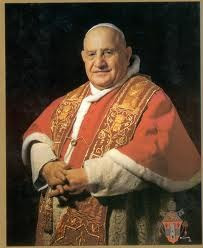
Oct. 20, 2011 Thursday: Blessed John XXIII

Blessed John XXIII


Angelo Giuseppe Roncalli was born in northern Italy in 1881. He was one of thirteen children born to a hardworking farming family. He entered the seminary in Rome and began preparing for the priesthood. He studied theology, and after some time he earned a degree in canon law.

During World War I, Father Roncalli was drafted into the Italian army, and he served as a medic and chaplain in the front lines. After the war, he became a Vatican diplomat and visited Bulgaria, Greece, and Turkey. In Turkey, during World War II, he helped people who had fled from Nazi Germany. In 1944 he was chosen to be the papal nuncio to France. Because of his success in carrying out his difficult tasks, he was made a cardinal by Pope Pius XII, and later he was named patriarch of Venice at the age of seventy-one. It seemed, due to his age, that this would be the last appointment he would be entrusted with. But six years later, in 1958, after the death of Pius XII, Cardinal Roncalli was elected pope. He took the name John XXIII.

Then it was his turn to surprise the world by calling for an ecumenical Council. Vatican Council II, the first Council in almost 100 years, had the goal of renewing and updating the Catholic Church. In opening the Council, Pope John spoke with hope and optimism about the Church’s role in the modern world. He reached out not only to Catholics, but also to all humanity with warmth and honesty. People of all faiths and from all around the world saw him as a man of goodness and truth, devoted to peace and understanding between peoples and nations. He broke with tradition and left the “prison of the Vatican” to travel outside Rome. In his encyclicals Mater et Magister and Pacem in Terris, he stressed the importance of upholding human rights and working together for peace.

Vatican Council II brought about important changes in the Church, but Pope John was not to see its conclusion. He died on June 3, 1963, one of the best-loved popes in recent centuries. Pope John XXIII was declared a blessed by Pope John Paul II on September 3, 2000.
-Daughters of St. Paul

Wednesday, October 19, 2011

Oct. 19, 2011 Wednesday: St Isaac Jogues and North American Martyrs

St. Isaac Jogues, St. John de Brebeuf, and Companions

St. Isaac Jogues was born in 1607 in Orleans, France. He entered the Society of Jesus in 1624. As a Jesuit missionary, he went to Quebec, Canada. There he worked among the Hurons, explaining to them the Gospel of Jesus Christ and baptizing those who asked to become Christians. In 1642, some Iroquois warriors captured him, five other French Jesuits, and two French laymen.

For a year, St. Isaac Jogues suffered terrible torture with his companions. But the Dutch helped him to escape, and he went back to France. In 1644, he asked to return to Quebec. While he was on his way to the Iroquois, after a peace treaty had been signed with that tribe, he was captured by Mohawks and killed.

St. John de Brebeuf became a Jesuit after a battle with tuberculosis. He and St. Gabriel Lallemont were among the group of valiant Jesuits tortured and put to death by the Iroquois. Father Anthony Daniel had just finished celebrating Mass for his Huron converts when the Iroquois attacked the village. The Christian Indians begged him to try to escape, but Father Daniel stayed to baptize all those who were crying to him for Baptism before they would be killed. The Iroquois burned him to death in his little chapel. St. Charles Garnier was shot by an Iroquois musket during a surprise attack, but he still tried to crawl to help a dying man. He was killed by a hatchet blow. Father Noel Chabanel had found missionary life in the New World very hard, but had made a vow to stay in North America. He was killed by a Huron traitor. The two lay helpers, Rene Goupil and John Lalande, were both killed with tomahawks. So it was that these heroes of Christ gave their lives for the native people of North America. These brave men, often called the North American Martyrs, were proclaimed saints in 1931 by Pope Pius XI.

Many sins committed today offend the dignity of human beings. We can ask these martyrs to share with us their great love and respect for all people. We can ask them to give us their great “missionary hearts.”

The Church also celebrates the feast of St. Paul of the Cross on this date.
-Daughters of St Paul

Tuesday, October 18, 2011

Oct. 18, 2011 Tuesday: St Luke, Audio Homily


Oct. 18, 2011 Tuesday: St. Luke

St. Luke


It is generally believed that Luke was a gentile doctor. He was a good, kind man who came to know the Lord from the great apostle Paul. After he had become a Christian, he sometimes traveled with Paul. Luke was a great help to him in spreading the faith. The Bible calls Luke “the beloved physician.”

St. Luke is the author of two books in the Bible: the Gospel of Luke and the Acts of the Apostles. Although he did not meet Jesus while the Lord was on this earth, he wanted to write about him for new converts. So he talked to those who had known Jesus. He wrote down all that they had seen the Lord do and heard him say. It is Luke who tells us some of the best-known stories about Jesus. Luke tells us the story of the first Christmas. He tells about Jesus lost in the Temple when he was twelve years old. He also tells us the story of Zaccheus the tax collector, who climbed a tree to see Jesus. Luke repeats for us the parables of the Good Samaritan and the Prodigal Son.

Luke also wrote the story of how the apostles began to teach the message of Jesus after he went back to heaven. It is in Luke’s book, the Acts of the Apostles, that we learn how the Church began to grow and spread.

St. Luke is the patron saint of painters and doctors. We are not sure when or where Luke died. He is one of the four evangelists, or Gospel writers.

Luke’s Gospel speaks especially of God’s mercy for people who are sorry for their sins. Sometimes we become discouraged because of our sins and mistakes. We can ask St. Luke to show us how to have confidence in Jesus’ mercy, as he did.
-Daughters of St. Paul

Saturday, October 15, 2011

Oct. 16, 2011: 29th Sunday in Ordinary Time (A)

 the

This week priests of our diocese were on retreat together at Manresa Retreat Center, a beautiful 130 acres wooded land next to the Mississippi River Road. It was perfect retreat weather, not too hot, not too cold, and no trace of typical Louisiana mugginess. With a rosary in hand, I set out for the deep woods for a prayerful walk. Only minutes later, I was chased out of woods by tiny mosquitoes and gnats that made a good lunch out of this priest. Back in the conference room, our retreat master told us, "Guys, I know it's going to be tempting to reach for your smart phones or something else that you depend on to distract you. Don't do it. Give God a chance to work through you on this retreat. Give Him a chance to talk to you." The first day, I listened to the retreat master and spent most of my time reading and praying. However, on the second day around evening, a thought came to my mind, 'I wonder what's going on in the world.' Ignoring the precaution from our retreat master, I turned on my iPhone and read the latest news and emails--a big no-no on a silent retreat. One of the diocesan employees replied to one of my emails, "Father, I thought you were supposed to be on a silent retreat? You couldn't keep silent, huh :) ?"

Often we long for a time away from the busy and fast paced world. But why is that when we actually get the peace and quiet, like on a retreat or at our camps, we want to get back into the busy world? We really cannot pry ourselves from the attractions of this world, can we? We all have to work, pay our utility bills and rent, and pay taxes. All of us are intertwined in this world, with many of us working 9 to 5 jobs at companies that provide service to our friends, neighbors, and even us. The local, state, and federal taxes all go into upkeep of our city, interstate highway systems, and essential social programs. Not to pay the bills and taxes, then, is to receive the services that make my life easier but neglect to pay for the work that my neighbor did for me to provide those services. When Jesus was asked, "Is it lawful to pay the census tax to Caesar or not?" he replied, "Repay to Caesar what belongs to Caesar and to God what belongs to God." So he rightly said the work and services that are performed for us by others need to be paid for with our dollars that has the face of George Washington on them.

What about paying to God what belongs to God? What kind of currency can we use to pay God for all the goods and services that He has rendered us since we were born? Does God have an organization like the IRS where they automatically withhold state, federal, and social security tax? Does it suffice for God that we pay Him at offertory collections during mass? I think the offertory prayers that priest and all of us say give us good insight. After the ordinary bread and wine are brought to the altar, the priest prays the following: "Blessed are you, Lord, God of all creation. Through your goodness we have this bread to offer, which earth has given and human hands have made. It will become for us the bread of life." The bread and wine represent all of our earthly labor from the past week and we believe that it will somehow become our spiritual food and drink. The priest then prays, "Pray brothers and sisters, that our sacrifice may be acceptable to God the almighty Father." All reply, "May the Lord accept the sacrifice at your hands for the praise and glory of His name, for our good, and the good of all His Church."  We are asking God at that moment that all the work we did the past week-- the hours we worked for pay and those that we did for our neighbor without cost--all become something to give praise and glory to Him and for the good of our Church.

Do you get the sense that during Mass everything that we do is about giving glory to God by our sacrifice? After six days of hard work, we use this seventh day to reflect and offer all our works, our prayers, and our desires of the week to give glory to God, for everything belongs to Him. Today's responsorial psalm said, "Give glory and honor to God...For great is the LORD and highly to be praised; awesome is he, beyond all gods." St. Paul reminds us of this also, "We give thanks to God always for all of you, unceasingly calling to mind your work of faith and labor of love and endurance in hope of our Lord Jesus Christ, before our God and Father, knowing how you were chosen." God has chosen us to accomplish His will even when we don't realize it. God said in the First Reading, "I have called you by your name, giving you a title, though you knew me not...so that toward the rising and the setting of the sun people may know that there is none besides me. I am the LORD and there is no other."

It is sometimes difficult to give God what He is due, isn't it? He wants to work through each one of us to accomplish His will, but we sometimes fear what He asks of us. In fear we close ourselves off from the Father, from Jesus, and from Blessed Mother. Even in that quiet and beautiful retreat center, I was afraid of what God would ask from me, so I chose instead to distract myself in the world news. But I learned something from this retreat. Heavenly Father waits patiently and lovingly for our fears to subside. And He longs for us to be patient and to wait for Him to work through us. As we grow in our love for Jesus, as we are strengthened by His love for us, then our entire day, each action of our day, will become a prayer. It is then that the Father can work through us, as He desires, not as we desire.

Friday, October 14, 2011

Oct. 14, 2011 Friday: St. Callistus

St. Callistus I

This great pope and martyr lived in the first part of the third century. He was once a young slave in Rome, who got into serious trouble. His master had put him in charge of a bank. Somehow, Callistus lost the bank’s money. In fear, he ran away from Rome. He was caught after jumping into the sea to try to get away. His punishment was to be chained and put to hard labor in a mill.

From this punishment Callistus was released, only because his creditors hoped he could get some of their money back. But once again he was arrested, this time for having gotten into a fight. He was sent to the mines of Sardinia. When the emperor freed all the Christians who had been condemned to those mines, Callistus was freed, too. From that time on, things began to go better for him.

Pope St. Zephrinus came to know and trust the freed slave. He placed him in charge of the public Christian cemetery in Rome. This cemetery is now named after St. Callistus. Many popes were buried in it. Callistus proved himself worthy of the pope’s confidence in him. St. Zephrinus not only ordained him a priest, but also made him his friend and advisor.

Later on, St. Callistus himself became pope. Some people complained because he showed too much mercy to sinners. However, the holy pope ruled that, if they truly repented, even murderers could be admitted to Communion after they had done pen-ance for their sin. This great pope always defended the true doctrine of Jesus. He was martyred around the year 223, having been killed in an uprising.

Because St. Callistus was so aware of God’s forgiveness in his own life, he was more than willing to be forgiving toward others. Do we treat others with the same forgiveness that we hope to receive from God?

-Daughters of St Paul

Saturday, October 8, 2011

Oct. 9, 2011: 28th Sunday in Ordinary Time (A)

My dear friend St. Francis of Assisi would have been proud of me this past Sunday when we had 12 dogs, 2 cats, and a lizard for the blessing of the animals because I didn't flinch one single time while I blessed them. Not even when Jax, the lizard, was on my shoulder for at least 5 seconds! I know St. Francis loved animals and lived in peace with them, but some of his animal friends who showed up for the blessing were not exactly at peace with me.

Until I learned something about St. Francis and his life, I did not understand the purpose for blessing animals. I noticed that many of you have a statue of St. Francis in your gardens so you must have a devotion to him. I learned much about St. Francis of Assisi when I watched an old movie from the 70's called, "Brother Sun, Sister Moon." The most dramatic scene that I recall from that movie is the scene where Francis' dad took Francis in front of the bishop in the town square. Amidst the crowd gathered there, his dad complained to the bishop that his son was giving away the family's possessions: "God only knows how much I gave him, how I gave him the best. And today, he threw all my possessions out of the window...all the years of hard work!" Francis explained to the bishop, "I want to be happy...I want to experience the freedom and purity that birds experience. If the purpose of life is this loveless toil, then it is not for me. There must be something better. Man is a spirit, he has a soul. That is what I want to recapture, my soul...without possessions. I want to be a beggar like Christ and his disciples. What is born of the spirit is of the spirit. Father, I give you back all that belongs to you--your clothes, your possessions, and even your name." Francis gave away all his possessions for he knew that it was in his poverty that he was able to enter into an intimate relationship with the Lord.  Francis encountered and embraced the same Lord we spoke about in today's responsorial psalm when we said, "The LORD is my shepherd; I shall not want nothing. In verdant pastures he gives me repose; beside restful waters he leads me; he refreshes my soul." (Psalm 23)

The first time I mentioned to my dad that I wanted to go to the seminary he responded with, "I'm going to disown you if you enter the seminary." Angry at me, he then went to his room, but moments later he came back and said, "Tell you what, if you take the job that has been offered to you and work for 3 years, and after that, if you still feel like going to the seminary, I won't stop you." I still ponder how I came to make that decision to let go of all that I had and enter the seminary. I had worked hard at the university, staying up many nights studying for exams and preparing for interviews with major chemical companies. I thought that a chemical engineering career was my ultimate goal, that is, until I dated a girl for 3 years. Then I thought marriage and family life were part of even a greater goal. Some how, though, something didn't seem right inside of me. Finally, I came to a realization, just as St. Francis did, that there was something better, something that would fill my soul without having to resort to possessions. It was clear to me that someone was promising that I would be filled to my heart's content, if I would just say 'yes.'

St. Paul had a similar experience, as he explained in the Second Reading. He said, "Brothers and sisters: I know how to live in humble circumstances; I know also how to live with abundance.
In every circumstance and in all things I have learned the secret of being well fed and of going hungry, of living in abundance and of being in need. I can do all things in him who strengthens me. My God will fully supply whatever you need, in accord with his glorious riches in Christ Jesus."

After the morning mass this past Tuesday, which was the feast day of St. Francis, I sat down in a pew in the dark church to pray. With just a few rays of sunlight revealing the contour of the stripped body of Jesus hanging from the cross, I thought, 'How poor he is to be stripped down to nothing, possessing nothing, to be abandoned by most of his friends...Yet, he said he was rich...Rich in what? That everything that His Father had was his. And everything that his Father had, Jesus said he was giving to us...What could he possibly give us?' I thought. Then the Prayer of St. Francis came to my mind: "Lord make me a channel of your peace..." In this prayer, we are asking our Heavenly Father to grant us one of the greatest treasures--His peace--and to make us His instrument of peace. Yet to 'possess' and to be filled with this peace, we have to do something counter-intuitive, that is, to give it away through the work of our hands...that we need to love first where we find hatred, that we need to sow hope where there is despair, to prefer to console first than to seek consolation, to try to understand than expect others to understand us. This thought is not new to us. Yet we often miss the message of the Cross and fail to carry it out. We hear Jesus speaking to us in the quiet of the morning just before waking up how he is going to give us everything we need for the day, but as soon as the alarm clock chimes, our mind gets quickly filled with all the to-do's for the day, and off we go, rushing from one thing to another. This is the challenge of each day, that we look at those we are suppose to love and love them, that we look at those who need consolation, and we console them, that we look that those who need understanding and we listen to them. It is through this that we become aware of the riches that Father gives us.

Thursday, October 6, 2011

Oct. 7, 2011 Friday: Feast of the Holy Rosary

Why pray the Rosary
by Father Kilian Byrne.

  • On the 29th of October, 1978, scarcely two weeks after his election, Blessed Pope John Paul II admitted to the world that the Rosary was his favourite prayer, ‘marvellous in its simplicity and depth’.1
  • Among the many reasons why the late Holy Father loved the Rosary one stands out in particular.  ‘To pray the Rosary’, he said, ‘is to hand over our burdens to the merciful hearts of Christ and His Mother’.2
  • Let me give you a working example of what this means.  It is taken from Fr. Benedict’s great book: The Rosary – Chain of Hope.
  • In it he describes how the Rosary can bring healing to the soul and can, even at times, be a lifeline.  Such was the case for Mother Teresa who lived through decades of deep spiritual darkness.  Fr. Groeschel quotes from a letter she posted to her spiritual director.
  • ‘The other day I can’t tell you how bad I felt – there was a moment when I nearly refused to accept – deliberately I took the Rosary and very slowly without even meditating and thinking – I said it slowly and calmly – the moment passed – but the darkness is so dark, and the pain is so painful – but I accept whatever He gives and I give whatever He takes’.
  • Commenting Fr. Groeschel adds: ‘So even for Mother Teresa the Rosary was not only an act of devotion but also a place of refuge at certain times amid interior storms of darkness’.3
  • Another beautiful reason for reciting the Rosary is because this prayer leads us into the Mysteries of Christ and can even make the power of these Mysteries touch our lives deeply.  With Mary we learn to contemplate His Mysteries and allow their grace transform our lives.
  • Take, for example, the Third Joyful Mystery: the Birth of Jesus in Bethlehem (a name which means House of Bread).  What do we see here?  A baby wrapped in swaddling clothes, lying in a manger, under the watchful gaze of His mother and foster father.  What do we hear?  The hosts of angels singing in the heavens: Glory to God on high and on earth peace to you, to all of goodwill.  The Word is Made Flesh and pitches His tent among us.  God becomes man so that man might become God.  And therein lies the grace of this great Mystery.
  • But the scene changes.  Joy yields to sorrow.  The child becomes the Man of Sorrows familiar with suffering, a plaything to the powers of darkness.  Bethlehem gives way to Gethsemane (a name which means a press for crushing olives).  ‘Here especially’, says Dom Marmion, ‘we are at the door of a sanctuary we cannot enter except with living faith and deep reverence’.4
  • The Mystery of the Agony marks the start of the Hour of the Passion.  For what did Jesus experience that night on the Mount of Olives?  The true horror of sin from Adam down to the last inhabitant on the planet.  Therefore my sin and your sin.  Fr. Romano Guardini, beloved of Benedict XVI, says that ‘We participate in this Mystery only when we realize that its content is our sin.’ 5
  • And the great grace of this Mystery: true sorrow for sin, a humble contrite heart.  ‘Why do you weep so much, Father?’  - the Curé of Ars was asked by a sinner kneeling by his side.  ‘Ah! My friend, I weep because you do not weep enough!’.
  • Another reason praying the Rosary is because it draws us into Christ, the Prince of Peace, the one who is ‘our peace’ (Eph. 2:14).  Therefore it is the great prayer for peace in our lives.  This is the peace that the world cannot give.  It is the peace that draws together the broken bits and scattered pieces of our lives.  Therefore it is a peace that heals and unites.
  • As a prayer for peace, the Rosary is then also the great prayer of and for the family.  Fr. Patrick Peyton, the world renowned Rosary Priest, from Bonniconlon, Co. Mayo, never tired of repeating: the family that prays together stays together.
  • How can this be so?  Pope John Paul II gives the answer.  ‘The family that recites the Rosary together reproduces something of the atmosphere of the household of Nazareth: its members place Jesus at the centre, they share his joys and sorrows, they place their needs and their plans in His hands, they draw from Him the hope and the strength to go on.’6
  • The Holy Father concludes his teaching on the Rosary by calling it, a treasure to be discovered and even rediscovered by the Christian community.  The saints knew this and that is why they have always been fervent lovers of the Rosary.  And it is said that the Curé of Ars last act, when he was on his deathbed, was to give a Rosary to somebody.  Pope Paul VI loved to link the Rosary to the Liturgy, for example, as a preparation and as a thanksgiving for Holy Mass and communion.  This was the practice of Padre Pio who used rise in the night to prepare for holy Mass by reciting many Rosaries.7
  • Both at Lourdes and Fatima Our Lady encourages us to pray the Rosary every day and in every home.  We pray the Rosary in times of joy and in times of sorrow, to give thanks, to ask for spiritual or bodily health, to seek the salvation of a soul gone astray and to ask deliverance for the holy souls in purgatory.
  • Sr. Lucia, to whom Our Lady appeared in Fatima said, ‘From the moment that Our Lady gave importance to the Rosary, there is no problem, material or spiritual, national or international, which cannot be solved.’8
  • In the end Mary is God’s Secret Recipe to holiness.  And such holiness, in the words of St. Maximilien Kolbe, is not a luxury, but a duty.  Amen.
1. Rosarium Virginis Mariae, 2.
2. Ibid. 25.
3. Groeschel, The Rosary: Chain of Hope, 16.
4. C. Marmion, Christ in His Mysteries, 228.
5. R. Guardini, The Lord, 447.
6. Rosarium Virginis Mariae, 41.
7. Cf. S. Manelli, Devotion to Our Lady, 142, 143.
8. Ibid. 141.


http://www.worldpriestday.com/rosary_relay_why_pray.html

Oct. 6, 2011 Thursday: Blessed Marie Rose Durocher

Blessed Marie Rose Durocher


Eulalie Durocher was born in 1811 in Quebec, Canada. She was the tenth of eleven children. When she was eighteen, Eulalie’s mother died, and her brother, who was a priest, invited his younger sister to his parish. She became a lay apostle. She took charge of the household duties for her brother. She also started the first parish sodality in Canada. The thirteen years she was involved in the life of the Church and the parish were preparing her for a special work for God.

In 1843, when Eulalie was thirty-two, the bishop of Montreal asked her to begin a very special mission. Eulalie started a new religious congregation of women called the Sisters of the Holy Names of Jesus and Mary. Their particular work for Jesus would be to educate the poorest and most neglected children. Eulalie became Mother Marie Rose. Others came to join this generous woman. They, too, believed in the importance of educating children for the love of Jesus.

Mother Marie Rose lived only six years after her congregation began. However, she helped her sisters from heaven because the community continued to grow and open new convents. They started a mission in the United States, too. They went to Oregon in 1859. Today the Sisters of the Holy Names of Jesus and Mary are spread throughout the world.

Mother Marie Rose Durocher was declared a blessed by Pope John Paul II on May 23, 1982.

Tuesday, October 4, 2011

Oct. 5, 2011 Wednesday: Blessed Francis Seelos

Blessed Francis Xavier Seelos


Francis Xavier Seelos was born on January 11, 1819 in Fussen, Bavaria, Germany. He was baptized on the same day in the parish church of St. Mang. Having expressed a desire for the priesthood since childhood, he entered the diocesan seminary in 1842 after having completed his studies in philosophy. Soon after meeting the missionaries of the Congregation of the Most Holy Redeemer (Redemptorists), founded for the evangelization of the most abandoned, he decided to enter the Congregation and to minister to the German speaking immigrants in the United States. He was accepted by the Congregation on November 22, 1842, and sailed the following year from Le Havre, France arriving in New York on April 20, 1843. On December 22, 1844, after having completed his novitiate and theological studies, Seelos was ordained a priest in the Redemptorist Church of St. James in Baltimore, Maryland, U.S.A.

After being ordained, he worked for nine years in the parish of St. Philomena in Pittsburgh, Pennsylvania, first as assistant pastor with St. John Neumann, the superior of the Religious Community, and later as Superior himself and for the last three years as pastor. During this time, he was also the Redemptorist Novice Master. With Neumann he also dedicated himself to preaching missions. Regarding their relationship, Seelos said: “He has introduced me to the active life” and, “he has guided me as a spiritual director and confessor.”

His availability and innate kindness in understanding and responding to the needs of the faithful, quickly made him well known as an expert confessor and spiritual director, so much so that people came to him even from neighboring towns. Faithful to the Redemptorist charism, he practiced a simple lifestyle and a simple manner of expressing himself. The themes of his preaching, rich in biblical content, were always heard and understood even by everyone, regardless of education, culture, or background. A constant endeavor in this pastoral activity was instructing the little children in the faith. He not only favored this ministry, he held it as fundamental for the growth of the Christian community in the parish. In 1854, he was transferred from Pittsburgh, to Baltimore, then Cumberland in 1857, and to Annapolis (1862), all the while engaged in parish ministry and serving in the formation of future Redemptorists as Prefect of Students. Even in this post, he was true to his character remaining always the kind and happy pastor, prudently attentive to the needs of his students and conscientious of their doctrinal formation. Above all, he strove to instill in these future Redemptorist missionaries the enthusiasm, the spirit of sacrifice and apostolic zeal for the spiritual and temporal welfare of the people.

In 1860 he was proposed as a candidate for the office of Bishop of Pittsburgh. Having been excused from this responsibility by Pope Pius IX, from 1863 until 1866 he dedicated himself to the life of an itinerant missionary preaching in English and German in the states of Connecticut, Illinois, Michigan, Missouri, New Jersey, New York, Ohio, Pennsylvania, Rhode Island and Wisconsin.

After a brief period of parish ministry in Detroit, Michigan, he was assigned in 1866 to the Redemptorist community in New Orleans, Louisiana. Here also, as pastor of the Church of St. Mary of the Assumption, he was known as a pastor who was joyously available to his faithful and singularly concerned for the poorest and the most abandoned. In God’s plan, however, his ministry in New Orleans was destined to be brief. In the month of September, exhausted from visiting and caring for the victims of yellow fever, he contracted the dreaded disease. After several weeks of patiently enduring his illness, he passed on to eternal life on October 4, 1867, at the age of 48 years and 9 months.

His Holiness Pope John Paul II, proclaimed Father Seelos Blessed in St. Peter's Square on April 9th of the Solemn Jubilee Year 2000. His Feast Day is October 5.

Oct. 4, 2011 Tuesday: St Francis of Assisi

Prayer of St Francis

The following variation on the prayer was delivered by Mother Theresa when she addressed the United Nations in 1985

Make us worthy Lord to serve our fellow men throughout the world,
who live and die in poverty and hunger.
Give them through our hands, this day, their daily bread
and by our understanding love give peace and joy.

Lord, make me a channel of thy peace.
That where there is hatred I may bring love,
That where there is wrong, I may bring the spirit of forgiveness,
That where there is discord, I may bring harmony,
That where there is error I may bring truth,
That where there is doubt I may bring faith,
That where there is despair I may bring hope,
That where there are shadows I may bring light,
That where there is sadness I may bring joy.
Lord, grant that I may seek rather to comfort than to be comforted,
To understand than to be understood,
To love than to be loved.
For it is by forgetting self that one finds.
It is by forgiving that one is forgiven,
it is by dying that one awakens to eternal life.


Monday, October 3, 2011

Oct. 3, 2011 Monday: Blessed Bartolo Longo

Blessed Bartolo Longo


Bartolo was born on February 11, 1841, in southern Italy. He received a good education from the Piarist Fathers. He later studied law, but the university he attended had little respect for Gospel values or the Church. Bartolo’s faith began to weaken, and in time he became interested in demonic rituals. Fortunately, Bartolo remained friends with a professor who was a devout Catholic and a deeply spiritual man. Together with a Dominican priest, this professor was able to bring Bartolo back to the practice of his Catholic faith.

Bartolo earned his law degree and became an attorney in his hometown. He began living a holy life of prayer and good deeds. He was especially devoted to praying the Rosary.

Bartolo went to Naples in order to help the poor in the city’s slums. He became tutor to the children of a wealthy widow. He traveled with her when she visited her properties, and he saw firsthand the poverty and ignorance of her tenant laborers. He knew that God was calling him to bring faith and hope to these people. He decided that the best way to present the faith to people who couldn’t read was to teach them to pray the Rosary. By meditating the mysteries of the Rosary, they would learn of the life, death, and resurrection of the Lord, and of Mary’s important role in leading Christians to her Son.

Soon, people were crowding the little church in Pompeii to pray the Rosary before a picture of Mary, which he had found at a flea market. The church had to be enlarged, and Bartolo began raising funds for a magnificent basilica in honor of Mary, Queen of the Holy Rosary. He also began a magazine called The Rosary and the New Pompeii, featuring articles explaining the faith. In order to live out the Gospel message, and not just write about it, Bartolo built an orphanage and a home for children whose parents were in prison.

Bartolo was often misunderstood and ridiculed by people who did not agree with him. As he grew older, he suffered from illness. But he never gave up trusting in the power of the Rosary to accomplish all that God asked of him. He spent the last years of his life in continual prayer.

On October 5, 1926, this holy layman died at the age of eighty-five, his rosary still in hand. He was beatified by Pope John Paul II in 1980.

The Rosary is a simple prayer, yet it brings us into contact with the deepest mysteries of our faith. We should make an effort to pray at least a part of the Rosary each day, so that we will often call to mind the life, teachings, death, and resurrection of Jesus. The Rosary is a special homage to Mary, who is our Mother as well as Christ’s.
-Daughters of St Paul

Saturday, October 1, 2011

Oct. 2, 2011: 27th Sunday in Ordinary Time (A)

I was reading an article the other day about an Italian man living in Italy who left $700,000 in his will to the city of Boston. The odd thing is that none of his family or relatives lives in Boston, or has he ever traveled there. The city of Boston was happy to find out that they were $700,000 richer. But the city found out the catch: the money will be given on condition that they take care of the man's two dogs and many cats, that are located in a town in Italy. Asked about inheriting new pets from Italy, Boston Mayor Thomas Menino said, “It’s unbelievable. I want to know who is going to feed the cats and dogs. They’re over in Italy. What do you want me to do?’’

Have you made out a will for yourself? No one wants to think of thepossibility of his or her own death, but it is important that our family andother loved ones are provided for when we die. Three years ago when I wasordained a priest, I received a packet from the diocese that included a requestto turn in a will to the diocese. Because I believed I was too young to write awill, it felt strange putting down on paper how I wanted my assets to bedistributed. Besides that, I don't own a house or a land or other valuables.Who would want to keep my rice cooker?


Have you ever given a thought as to what might be willed to you in thefuture? My parents live in a small house in Texas, and I know my sister and Iwill likely divide up that house when my parents pass from this world. I know mysister will likely want to keep all of mom's pots and pans, and I will want tokeep all our old photo albums. You can tell that I was thinking about the topicof Wills this week. I began to think about this topic when a parishioner handedme a Will that one of her friends wrote on behalf of God. It reads, "I amGod, the Father Almighty, Creator of Heaven and Earth, and I do make anddeclare this My Will on the 7th day of February 2004...I appoint the CatholicChurch as Executor of this succession...I bequeath to you the following:"What intrigued me was that I had never thought about God the Fatherputting into His Will, what I had inherited from Him. This "will" caught my attentionbecause the woman wrote it after surviving a near-fatal illness. She pondered, after a brush with death, not what she could have lost, but what she has already inherited. We, His beloved children inherited so much at the time of our birth, yet we do not realize it. As a priest, I deal with suffering, death, and selfishness of many people, and I see how the muck of daily life and our attraction to the dark side of humanity make us lose sight of all that has given to us. We need to ponder through daily prayer and reflection what the Father has already given us and work to make all that He has given us top priority in our lives. I believe that this will captures what should be our priority in our lives.
The will reads: I, God, bequeath to you the following;

  • Creation. I have willed creation as a gift to you, an inheritance destined for and entrusted to you. (Catechism #299)
  • A Desire for Me. Into your heart I have placed a desire for Me where only you will find truth and happiness. (Catechism #27)
  • A Free Will. I confer on you the dignity of a person who can initiate and control your own actions. (Catechism #1730)
  • A Savior/Brother/Friend - Jesus. I so loved you that I gave you My only Son so that all who believe in Him might not perish but have eternal life. (John 3:16) I proved My love for you in that while you were still a sinner My Son died for you. (Romans 5:8) Accept this privilege of no longer being called a slave but a friend. (John 15:15)
  • The Holy Spirit. My Son has asked Me and I have given you another, Advocate, to be with you always. (John 14:16-17)
  • The Church. It is in the Church that the fullness of the means of salvation has been deposited. It is her that by My grace you acquire holiness. (Catechism #824)
  • Scripture. In Sacred Scripture, My Church constantly finds her nourishment and her strength, for she welcomes it not as a human word, but as what it really is, My Word. (1 Thess 2:13). In the sacred books I come lovingly to meet you and talk with you. (Catechism #104)
  • Mary, Your Mother. The Virgin Mary is clearly the mother of the members of Christ since she has by her charity joined in bringing about the birth of believers in the Church. (Catechism #963)
  • Sacraments. The sacraments are signs of grace, instituted by my Son and entrusted to the Church by which divine life is dispensed to you. You bear fruit when you receive them with the required dispositions. (Catechism #1131)
  • The Kingdom. My Kingdom lies ahead of you. It was brought near in the Word incarnate, it was proclaimed throughout the whole Gospel, and it has come in My Son's death and resurrection. My Kingdom has been coming since the Last Supper and, in the Eucharist, it is in your midst. (Catechism #2816)
  • Eternal Life. My gift is eternal life in Christ Jesus your Lord. (Romans 6:23) I give you eternal life, and you shall never perish. No one can take you out of my hand. (John 10:28-30) Rejoice because your names are written in Heaven. (Luke 10:20)
"Should there be any inheritance, estate or other taxes due, such taxes have been and will forever be paid by my Son, Jesus, and no such taxes shall be paid or borne by my children...Notary Not Necessary...Sealed with the Blood of the Lamb."

Many of us may doubt andwonder if we have been given anything of worth from God. We may have theattitude of the tenants in the vineyard and cling onto all that we have or towhat we may inherit from this earthly world. On Monday I will preside at a funeralfor a woman who did not inherit much of anything in worldly terms; in fact, shelost much. At an early age, her mother and close relatives died. Only 20 yearsinto her marriage and her husband passed from this life. Her earthly life gaveher much sorrow, yet she knew she had inherited so much from our HeavenlyFather--her children, Jesus, the Church, Blessed Mother, the Sacraments, andmost importantly, her Eternal Life with the Father. What she has willed to herchildren and grandchildren is her life-long sacrificial love, her steadfastfaith, and her example of unconditional love. This is infinitely worth muchmore than the $700,000 willed the city of Boston to take care of a couple ofdogs and cats.