Wednesday, November 30, 2011

Nov. 30, 2011 Wednesday: St. Andrew, Apostle

St. Andrew


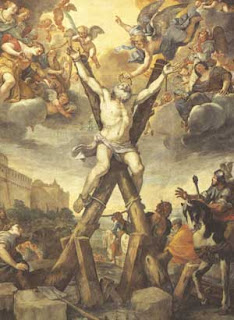
Andrew, like his brother, Simon Peter, was a fisherman. He became a disciple of St. John the Baptist. However, when John pointed to Jesus and said, “There is the Lamb of God,” Andrew left John at once to follow the Divine Master. Jesus knew that Andrew was walking behind him. Turning back, he asked, “What are you looking for?” Andrew answered that he would like to know where Jesus stayed. Our Lord replied, “Come and see.” Andrew had been with Jesus only a little while when he realized that this was truly the Messiah. From then on, he decided to follow Jesus. He became the first disciple of Christ.

Next Andrew brought his brother Simon (St. Peter) to Jesus. The Lord received him, too, as his disciple. At first the two brothers continued to carry on their fishing trade and family affairs. Later, the Lord called them to leave their way of life behind and be his full-time followers. He promised to make them fishers of men, and this time they left their nets for good. It is believed that after our Lord ascended into heaven, St. Andrew preached the Gospel in Greece. He is said to have been put to death on an X-shaped cross, to which he was tied not nailed. He lived two days in that state of suffering. Andrew still found enough strength to preach to the people who gathered around their beloved apostle.
Two countries have chosen St. Andrew as their patron—Russia and Scotland.

When St. Andrew saw the cross on which he was to die, he exclaimed: “Welcome, O good cross, made beautiful by Christ’s body!” We can ask St. Andrew to help us recognize our particular cross. He’ll strengthen us to accept that cross generously.

Tuesday, November 29, 2011

Nov. 29, 2011 Tuesday: Blessed Francis Anthony of Lucera

Blessed Francis Anthony of Lucera


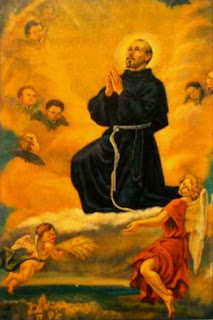
This saint, born in 1681, was nicknamed Johnny as a child. He was the son of an Italian farmer. His father died before he was ten. His mother’s second husband was good to him. He sent the boy to be educated by the Franciscans.
When he was fifteen, Johnny asked to be admitted to the Order. He became Brother Francis Anthony. He did very well in all his studies and became a priest. Father Francis Anthony became famous as a preacher and teacher. He also was elected superior. He tried his best to be of loving service to all the friars.
Father Francis Anthony had a special interest in helping prisoners. The prisons of his day were terrible places. He did his best to help the poor prisoners in every way. His love went out to everyone in need. It was he who began the custom of collecting gifts at Christmas time for poor families. In Lucera, the city in which he spent his life, it was said: “If you want to see St. Francis of Assisi, just look at Father Francis Anthony!”
Blessed Francis Anthony had a great devotion to Mary. He loved to pay special honor to her Immaculate Conception. It was at the beginning of the solemn novena for this feast that he died. Some time before, when he was in good health, he had said he would die soon. He had even suggested to a priest-friend that he come along. This good priest replied a bit excitedly, “Listen, Father, if you want to die, that is your affair, but I’m in no hurry!” To this the saint replied, “We must both make this journey, I first and you afterward.” And that is just what happened. The other priest lived only two months after Blessed Francis Anthony passed to his eternal reward. Father Francis Anthony died in 1742 and was proclaimed blessed by Pope Pius XII in 1951.

The saints were not afraid to die because they had a lively faith in heaven. Heaven is a real place where we’ll be happy forever with God. We can ask Blessed Francis Anthony to show us how to make each day a preparation for heaven.

-Daughters of St. Paul

Monday, November 28, 2011

Nov. 28, 2011 Monday: St. Catherine Laboure


St. Catherine Labouré


Zoe Labouré, born in 1806, was the daughter of a French farmer. Her mother died while she was still very young. Zoe had to run the house when her older sister became a nun. Because of this, she was the only one of her large family who did not go to school. She could not read or write.
Zoe, too, would have liked to enter the convent when she was in her early teens. However, because she was needed at home, she waited until she was twenty-four. Zoe became a Sister of Charity of St. Vincent de Paul, taking the name Catherine.
Shortly after she finished her training as a postulant, Sister Catherine received a special privilege. One night, she was awakened from sleep. A “shining child” led her to the chapel. There, our Lady came to talk to her. The Blessed Mother, in another vision, showed herself standing on a globe with streams of light coming from her hands. Underneath were the words: “O Mary, conceived without sin, pray for us who turn to you.” Mary told Sister Catherine that a medal was to be made of this picture. She was also told that all who wore it would receive many graces from Jesus through his Mother’s prayers.
Sister Catherine told her confessor and he later told the bishop. So it was that the medal, that we call the Miraculous Medal, was made. Soon many, many people all over the world were wearing it. Yet no one in the convent knew that humble Sister Catherine was the one to whom our Lady had appeared. She spent the remaining forty-five years of her life doing ordinary convent tasks. She answered the door. She looked after the hens that provided the nuns with eggs. She also took care of elderly and sick people. She was happy to keep her special privilege hidden, and she was only interested in serving God as best she could. Catherine died in 1876. She was proclaimed a saint by Pope Pius XII in 1947.

We can wear the Miraculous Medal and often repeat the prayer: “O Mary, conceived without sin, pray for us who turn to you with trust.”

-Daughters of St. Paul

Saturday, November 26, 2011

Nov. 27, 2011: 1st Sunday of Advent (B)


Some memories from childhood, even after decades,are as fresh and vivid in our minds today as are the events that occurred just yesterday.One such memory for me is from when I was 4 years old when mom took my sister and me on a bus ride so that she could register my sister for kindergarten. When we got off the bus, my sister held my mom’s hand and I trailed behind them as we walked down the sidewalk toward the school. To this then-4 year-old boy,everything in the sidewalk shops was fascinating and so I stopped periodically to get a glimpse of the toys in the shop. Mom would pause and holler at me to follow, but I continued to stop again and again to gaze at other fascinating things. After we had walked a while, I looked around and saw that my mom and my sister were gone.  Instead of being alarmed by that, I wandered around the neighborhood exploring all the little streets. For a while, exploring was fun, but then I began to worry and whimper. As tears fell down my face, I cried, “Um-ma” (Korean for mama). Somehow, I got back to the sidewalk shop where I had separated from them, and in the distance I saw them. Mom saw me and then she began to walk fast toward me. When she got closer to me, she grabbed a broomstick that one of shops was selling and she gave me a few good licks with that broom. I guess you could say that she was quite angry with me at that point, but I was so glad that she had come back for me. I must say that I learned a good lesson in life—don’t get lost or I’ll get more broomstick whacks.

As children, probably many of us were lost or separated from our families or groups. We cried hoping that our mom or dad would come back to find us, and so we learned early on that we belong to someone and that someone searches for us. Just because we grow older does not mean that there are not times when we feel as though we are lost and yearn to be found and brought back home to safety. Some adults experience what's called a Midlife Crisis, a period of dramatic self-doubt that is felt by some in the middle age of life as a result of sensing the passing of their own youth and the imminence of old age. The crisis can bring about a feeling of being lost,to the point that a person wants to make a significant change in his career,life, and even relationships. Do you feel that right now? Do you feel the desire to be found and be brought back home?

Advent is a perfect time to regain bearing and direction in our lives. We know that Advent is a time of expectant waiting and preparation for the celebration of the Nativity of Jesus at Christmas. A powerful image of Advent is three kings or Magis riding their camels in the dark of the night guided only by a bright star. Like Magis, we need to ask ourselves during Advent, why did Jesus come in to this world? And, more importantly, why did Jesus come into this world for me?We must come to know that Jesus came to bring us back to right-relationship with the Heavenly Father. Jesus, who is always faithful to the Father, longs for us to be forever with Him and the Father. Listen to what prophet Isaiah says in our First Reading:  "You, LORD, are our father, our redeemer you are named forever. Why do you let us wander, O LORD, from your ways, and harden our hearts so that we fear you not? Return for the sake of your servants..." As we grapple with feelings of being lost,this cry of Isaiah echoes from the depths of our hearts, but do we listen to our deepest desires? Do we take time to discern these feelings and desires?

Many of us on this Black Friday (including this priest) were out in the pitch-dark of the morning, waiting for the lights to shine. Of course, I'm talking about the lights to Target, Walmart, Best Buy,and the Mall. Many of us know how to make strategies and practice patience to get the best deal. Likewise, using that same ardent desire, we need to prepare and be ready for Jesus to come again. Jesus, who is and will forever be the light of this world, desires that we look for His light in each other. Jesus reminds us in the Gospel, "Be watchful! Be alert! You do not know when the time will come." Many of us who stayed home rather than fight the crowds at the stores this past Friday, watched on the TV News how this world draws us away from Jesus. Rather than being awe-struck by the reports of the unruly crowds, volume of sales or the hottest selling item, we should hope that our hearts are changed so as to reject all that does not give life. I’m not saying that we cannot own electronics or gadgets, but we cannot let theses items own us.

If you are feeling that sense of being lost, use these four weeks of Advent to deepen your prayer life by spending time with Jesus. He desires to find you and bring you back home to the Father.

Friday, November 25, 2011

Nov. 25, 2011 Friday: Audio Homily, St Catherine of Alexandria


Nov. 25, 2011 Friday: St Catherine of Alexandria

St. Catherine of Alexandria


Catherine lived in early Christian times. She was the daughter of a wealthy pagan couple of Alexandria, Egypt. She was a very beautiful girl whose great interest was in learning. Catherine loved to study deep questions of philosophy and religion. One day she began to read about Christianity. Soon she became a Christian.
St. Catherine was only eighteen when Emperor Maxentius began persecuting the Christians. Fearlessly, the lovely, young Christian woman went to tell him what she thought of his cruelty. When he spoke of the pagan gods, she very plainly showed him that they were false. Maxentius could not answer her arguments. Therefore, he sent for fifty of his best pagan philosophers. Once again, it was Catherine who proved the truth of her religion. All fifty philosophers were convinced that she was right. In a great fury, Maxentius had every one of them killed. Next, he tried to win her by offering her a queen’s crown. When Catherine absolutely refused it, he had her beaten and thrown into prison.

While Maxentius was away at camp, his wife and an officer were very curious to hear this amazing Christian girl speak. They went to her cell. The result was that they and 200 soldiers of the guard were converted. For this, they were all put to death. Catherine herself was placed on a wheel full of spikes to be tortured to death. When the wheel began to spin, it mysteriously snapped in two and fell apart. Finally, St. Catherine was beheaded. She is honored as the patroness of Christian philosophers.

St. Catherine of Alexandria appreciated the beauty of her Christian beliefs. That’s why she could so effectively convince others. We can ask St. Catherine to help us grow in love for the truths of our faith as she did.

-Daughters of St Paul

Tuesday, November 22, 2011

Nov. 22, 2011 Tuesday: St. Cecilia

St. Cecilia


This patroness of music lived in early times. What we know about her goes back to the fourth century. Cecilia was a Roman noblewoman who had given her heart to Christ. She wanted to be his bride, but Cecilia’s father gave her in marriage to a young pagan nobleman. It is said that during the wedding celebration, the lovely bride sat apart. She was singing to God in her heart and praying for his help. When she and Valerian, her husband, were alone, she gathered up her courage and said to him: “I have a secret to tell you. You must know that I have an angel of God watching over me. If you let me keep my promise to be Christ’s bride only, my angel will love you as he loves me.”
Valerian was convinced by Cecilia to honor her vow of virginity and to become a Christian. His brother, Tiburtius, also learned of the Christian faith from Cecilia. She spoke so beautifully of Jesus that before long he, too, was baptized. Together the two brothers performed many works of charity. When they were arrested for being Christians, they went bravely to death rather than give up their new faith in Jesus. St. Cecilia lovingly buried their bodies before she, too, was arrested. She converted the very officers who tried to make her sacrifice to false gods. When she was put into a fire, it did not harm her. At last, a man was sent to behead her. He struck her neck three times, but Cecilia did not die right away. She lay on the floor of her own home unable to move. Yet, by holding out three fingers of one hand and one of the other, she still professed her belief in the Blessed Trinity: that there is one God in three divine Persons.

St. Cecilia’s faith was strong enough to convince others to believe in Jesus. Her love was strong enough to make her remain faithful to Christ even in the face of danger. We can pray to St. Cecilia for the same faith and love that made her a saint.

- Daughters of St. Paul

Monday, November 21, 2011

Nov. 21, 2011 Monday: Why I Love You Mary - St Therese of Lisieux

Why I Love You, Mary
By St. Therese of Lisieux


Oh ! I would like to sing, Mary, why I love you,
Why your sweet name thrills my heart,
And why the thought of your supreme greatness
Could not bring fear to my soul.
If I gazed on you in your sublime glory,
Surpassing the splendor of all the blessed,
I could not believe that I am your child.
O Mary, before you I would lower my eyes !…

If a child is to cherish his mother,
She has to cry with him and share his sorrows.
O my dearest Mother, on this foreign shore
How many tears you shed to draw me to you !…
In pondering your life in the holy Gospels,
I dare look at you and come near you.
It’s not difficult for me to believe I’m your child,
For I see you human and suffering like me…

When an angel from Heaven bids you be the Mother
O the God who is to reign for all eternity,
I see you prefer, O Mary, what a mystery !
The ineffable treasure of virginity.
O Immaculate Virgin, I understand how your soul
Is dearer to the Lord than his heavenly dwelling.
I understand how your soul, Humble and Sweet Valley,
Can contain Jesus, the Ocean of Love !…

Oh ! I love you, Mary, saying you are the servant
Of the God whom you charm by your humility.
This hidden virtue makes you all-powerful.
It attracts the Holy Trinity into your heart.
Then the Spirit of Love covering you with his shadow,
The Son equal to the Father became incarnate in you,
There will be a great many of his sinner brothers,
Since he will be called : Jesus, your first-born !…

O beloved Mother, despite my littleness,
Like you I possess The All-Powerful within me.
But I don’t tremble in seeing my weakness ;
The treasures of a mother belong to her child,
And I am your child, O my dearest Mother.
Aren’t your virtues and your love mine too ?
So when the white Host comes into my heart,
Jesus, your Sweet Lamb, thinks he is resting in you !…

You make me feel that it’s not impossible
To follow in your footsteps, O Queen of the elect.
You made visible the narrow road to Heaven
While always practicing the humblest virtues.
Near you, Mary, I like to stay little.
I see the vanity of greatness here below.
At the home of Saint Elizabeth, receiving your visit,
I learn how to practice ardent charity.

There, Sweet Queen of angels, I listen, delighted,
To the sacred canticle springing forth from your heart.
You teach me to sing divine praises,
To glory in Jesus my Savior.
Your words of love are mystical roses
Destined to perfume the centuries to come.
In you the Almighty has done great things.
I want to ponder them to bless him for them.

When good Saint Joseph did not know of the miracle
That you wanted to hide in your humility,
You let him cry close by the Tabernacle
Veiling the Savior’s divine beauty !…
Oh Mary ! how I love your eloquent silence !
For me it is a sweet, melodious concert
That speaks to me of the greatness and power
Of a soul which looks only to Heaven for help…

Later in Bethlehem, O Joseph and Mary !
I see you rejected by all the villagers.
No one wants to take in poor foreigners.
There’s room for the great ones…
There’s room for the great ones, and it’s in a stable
That the Queen of Heaven must give birth to a God.
O my dearest Mother, how lovable I find you,
How great I find you in such a poor place !…

When I see the Eternal God wrapped in swaddling clothes,
When I hear the poor cry of the Divine Word,
O my dearest Mother, I no longer envy the angels,
For their Powerful Lord is my dearest Brother !…
How I love you, Mary, you who made
This Divine Flower blossom on our shores !…
How I love you listening to the shepherds and wisemen
And keeping it all in your heart with care !…

I love you mingling with the other women
Walking toward the holy temple.
I love you presenting the Savior of our souls
To the blessed Old Man who pressed Him to his heart.
At first I smile as I listen to his canticle,
But soon his tone makes me shed tears.
Plunging a prophetic glance into the future,
Simeon presents you with a sword of sorrows.

O Queen of martyrs, till the evening of your life
That sorrowful sword will pierce your heart.
Already you must leave your native land
To flee a king’s jealous fury.
Jesus sleeps in peace under the folds of your veil.
Joseph comes begging you to leave at once,
And at once your obedience is revealed.
You leave without delay or reasoning.

O Mary, it seems to me that in the land of Egypt
Your heart remains joyful in poverty,
For is not Jesus the fairest Homeland,
What does exile matter to you ? You hold Heaven…
But in Jerusalem a bitter sadness
Comes to flood your heart like a vast ocean.
For three days, Jesus hides from your tenderness.
That is indeed exile in all its harshness !…

At last you find him and you are overcome with joy,
You say to the fair Child captivating the doctors :
"O my Son, why have you done this ?
Your father and I have been searching for you in tears."
And the Child God replies (O what a deep mystery !)
To his dearest Mother holding out her arms to him :
"Why were you searching for me ?
I must be about My Father’s business. Didn’t you know ?"

The Gospel tells me that, growing in wisdom,
Jesus remains subject to Joseph and Mary,
And my heart reveals to me with what tenderness
He always obeys his dear parents.
Now I understand the mystery of the temple,
The hidden words of my Lovable King.
Mother, your sweet Child wants you to be the example
Of the soul searching for Him in the night of faith.

Since the King of Heaven wanted his Mother
To be plunged into the night, in anguish of heart,
Mary, is it thus a blessing to suffer on earth ?
Yes, to suffer while loving is the purest happiness !…
All that He has given me, Jesus can take back.
Tell him not to bother with me…
He can indeed hide from me, I’m willing to wait for him
Till the day without sunset when my faith will fade away…

Mother full of grace, I know that in Nazareth
You live in poverty, wanting nothing more.
No rapture, miracle, or ecstasy
Embellish your life, O Queen of the Elect !…
The number of little ones on earth is truly great.
They can raise their eyes to you without trembling.
It’s by the ordinary way, incomparable Mother,
That you like to walk to guide them to Heaven.

While waiting for Heaven, O my dear Mother,
I want to live with you, to follow you each day.
Mother, contemplating you, I joyfully immerse myself,
Discovering in your heart abysses of love.
Your motherly gaze banishes all my fears.
It teaches me to cry, it teaches me to rejoice.
Instead of scorning pure and simple joys,
You want to share in them, you deign to bless them.

At Cana, seeing the married couple’s anxiety
Which they cannot hide, for they have run out of wine,
In your concern you tell the Savior,
Hoping for the help of his divine power.
Jesus seems at first to reject your prayer :
« Woman, what does this matter, » he answers, « to you and to me ? »
But in the depths of his heart, He calls you his Mother,
And he works his first miracle for you…

One day when sinners are listening to the doctrine
Of Him who would like to welcome them in Heaven,
Mary, I find you with them on the hill.
Someone says to Jesus that you wish to see him.
Then, before the whole multitude, your Divine Son
Shows us the immensity of his love for us.
He says : "Who is my brother and my sister and my Mother,
If not the one who does my will ?"

O Immaculate Virgin, most tender of Mothers,
In listening to Jesus, you are not saddened.
But you rejoice that He makes us understand
How our souls become his family here below.
Yes, you rejoice that He gives us his life,
The infinite treasures of his divinity !…
How can we not love you, O my dear Mother,
On seeing so much love and so much humility ?

You love us, Mary, as Jesus loves us,
And for us you accept being separated from Him.
To love is to give everything. It’s to give oneself.
You wanted to prove this by remaining our support.
The Savior knew your immense tenderness.
He knew the secrets of your maternal heart.
Refuge of sinners, He leaves us to you
When He leaves the Cross to wait for us in Heaven.

Mary, at the top of Calvary standing beside the Cross
To me you seem like a priest at the altar,
Offering your beloved Jesus, the sweet Emmanuel,
To appease the Father’s justice…
A prophet said, O afflicted Mother,
"There is no sorrow like your sorrow !
" O Queen of Martyrs, while remaining in exile
You lavish on us all the blood of your heart !

Saint John’s home becomes your only refuge.
Zebedee’s son is to replace Jesus…
That is the last detail the Gospel gives.
It tells me nothing more of the Queen of Heaven.
But, O my dear Mother, doesn’t its profound silence
Reveal that The Eternal Word Himself
Wants to sing the secrets of your life
To charm your children, all the Elect of Heaven ?

Soon I’ll hear that sweet harmony.
Soon I’ll go to beautiful Heaven to see you.
You who came to smile at me in the morning of my life,
Come smile at me again … Mother… It’s evening now !…
I no longer fear the splendor of your supreme glory.
With you I’ve suffered and now I want
To sing on your lap, Mary, why I love you,
And to go on saying that I am your child !…

Nov. 21, 2011 Monday: Presentation of Mary

Presentation of Mary


The Bible does not tell us anything about the childhood of the Blessed Virgin Mary. But tradition tells us that she was the daughter of St. Joachim and St. Anne. (We celebrate their feast day on July 26.) While still a young child, Mary was brought by her parents to the Temple in Jerusalem and presented her to the Lord. Mary’s whole life was to belong to God. He had chosen her to be the Mother of his Son, Jesus. The Blessed Virgin was happy to begin serving God in the Temple. And St. Joachim and St. Anne were pleased to offer their saintly little girl to God. They knew that God had sent her to them.

In the Temple, the high priest received the child Mary. She was placed among the girls who were dedicated to prayer and Temple service. While Mary received an education at the Temple, she also must have been a wonderful example to her companions of goodness and joy.

St. Joachim and St. Anne went back home. They praised and thanked God for their blessed daughter. And Mary remained in the Temple, where she grew in holiness. She spent her days reading the Bible, praying, and serving the Temple priests. She made beautiful linens and splendid vestments. Mary tried to do each of her duties well to please God. She grew in grace and gave great glory to the Lord.

Mary lived her whole life to please God. She was always aware of his divine presence. We can ask our heavenly Mother Mary to teach us how to stay close to Jesus every day.

-Daughters of St. Paul

Saturday, November 19, 2011

Nov. 20, 2011: Our Lord Jesus, Christ the King


Early this year, eye-catching billboards in major U. S. cities drew attention from drivers as they passed the billboards. The signs read, “Save the Date: May 21, 2011.” Weeks before May 21, people were out in the streets with smaller signs with the same message, drawing much attention from passer-bys. May 21 passed, and then the billboard signs were changed slightly. The date, “May 21” was spray-painted over with “Oct. 21.” Again people were out in the streets weeks before the new date carrying signs, drawing much attention. Then, October 21 passed. Many people were disappointed and disillusioned. The pastor who set those two dates, May 21 and then October 21, made an on-air apology. Millions of dollars were spent on the signs, “Save the Date: May 21, 2011. The Return of Christ. The Judgment Day” and the event did not come to fruition. There are plenty of folks buzzing about with a new date in 2012 for when the world, as we know it, will end. Undoubtedly new signs will go up, and the businesses that specialize on judgment-day supplies will profit much. Specialty real estate brokers who sell abandoned US Military missile silos say that the market for converting such cement fortress into a judgment day home is booming. One broker was asked on TV whether he would buy one himself and he replied, "I would never buy one. But don't tell my customers." Yet, today’s scripture tells us that this is not how Jesus wanted us to prepare for his Second Coming.

When we think of the Judgment Day, we conjure up imagery of a courthouse, where the judge strikes his gavel to give the defendants the judgment of 'guilty' or 'not guilty.' In that courthouse, there is nothing that defendant can do other than to shudder in fear. I remember going to a parish courthouse for a hearing on a speeding ticket. I went there wearing my clerical collar secretly hoping that the ticket would be dismissed because of my status. Yet as I stood before the judge who asked me, "Do you plead guilty or not guilty for speeding 50 mph in 35 mph zone?", I had a flash of the final judgment day and I realized that not only was my title useless in traffic court but it would also not get me a free pass into heaven. I responded, "Guilty, your honor." He replied, "That will be $300 for speeding, plus the court fees."

Jesus shows us a very different scene of Judgment Day in the Gospel. The imagery is that of a King who asks whether we were compassionate and caring to him. "For I was hungry and you gave me food, I was thirsty and you gave me drink, a stranger and you welcomed me, naked and you clothed me, ill and you cared for me, in prison and you visited me." We ask, "Lord, when did we see you hungry and feed you, or thirsty and give you drink? When did we see you a stranger and welcome you, or naked and clothe you? When did we see you ill or in prison, and visit you?" The King simply replies, "... whatever you did for one of the least brothers of mine, you did for me.'' St. John of the Cross succinctly summarizes this passage into two simple sentences: "Love is repaid by love alone", and "In the evening of our lives, we will be judged by love alone."

Jesus tells us that somehow what we do for others is intimately connected with what we do for him. A parishioner told me that in the 'old days' when nuns were still teaching at the schools, a nun always said to the children, "There is Jesus walking by," pointing to some random person. It's a great mystery how the kindness, gentleness, compassion, and patience we show a person, is in fact showing our love for God himself. Yet how difficult it is, sometimes, to be kind, gentle, and patient with another person! Our capacity to love falls pitifully short of the love that Jesus showers upon us every day.

We get a glimpse of the love Our Lord showers upon us each day in today's First Reading. Our Lord said, "I myself will look after and tend my sheep. As a shepherd tends his flock...I will rescue them from every place where they were scattered when it was cloudy and dark. I myself will give them rest. The lost I will seek out, the strayed I will bring back, the injured I will bind up, the sick I will heal..." How great was Jesus' sacrifice on Calvary for all of us that we may live forever with Him and with the Father! We must look to Our Lord and see how he endured much pain and anguish out of love for the Father and for us. Our Lord was obedient to the Father, and he asks us to be obedient to the Father as well by living and loving as Jesus showed us. All of us struggle with accepting Our Father's will for us because we struggle with our own desires and worldly ways.

The folks who are preoccupied with the Judgment Day say that the next  date will be 12/12/12. Undoubtedly there will be people who will spend this coming year stockpiling food, provisions, and even weapons to give them a sense of security that they have prepared for the Judgment Day. Yet Our Lord remind us,  “If anyone desires to come after Me, let him deny himself, and take up his cross, and follow Me.  For whoever desires to save his life will lose it, but whoever loses his life for My sake will find it.” (Matthew 16:24-25) Our Lord shows us how to truly prepare: will you accept the Father's will for you? Will you be obedient to the Father's will by serving and loving those around you?

Friday, November 18, 2011

Nov. 18, 2011 Friday: St. Rose Duchesne

St. Rose Philippine Duchesne

This saint labored for Jesus in the United States. She was born into a wealthy French family on August 29, 1769. As a youngster, there was nothing especially holy about Rose. In fact, she often did her best to get her own way. She ordered everyone else to do what she wanted. In school, her favorite subject was history. She later became very interested in stories about Native Americans. At the age of seventeen, Rose entered the convent. She was not allowed to take her vows when the time came because of the French Revolution. All the professed sisters were forced by the revolutionaries to leave the country, and Rose had to return to her family. Still, she did not give up her desire to belong to Jesus. Several years later she joined the newly formed Religious of the Sacred Heart of Jesus.

Mother Rose Philippine Duchesne’s great desire was to be a missionary. However, she was fifty before she was sent to the United States. It was still a mission land at this time. In Mississippi, she and a small group of sisters started a free school for the children of poor families. The work was hard because of the different languages and ways of the people. Despite the many difficulties, Mother Duchesne never lost her youthful enthusiasm. As she grew older, she became less commanding and more gentle.

Mother Duchesne was a real heroine. She nearly died from yellow fever. She overcame all kinds of obstacles to open convents in the New World. Then, when she was seventy-one, she resigned her position as superior. She went to Kansas to open a school among her beloved Native Americans. She died at St. Charles, Missouri, on October 18, 1852, at the age of eighty-three. She was proclaimed a saint by Pope John Paul II in 1988.

Sometimes we can have a way of postponing hard duties. We can ask Mother Duchesne to inspire us to put energy and love of God into what we do.

The Church also celebrates the feast of the Dedication of the Basilicas of the Apostles Peter and Paul in Rome on this date.

- Daughters of St Paul

Thursday, November 17, 2011

Nov. 17, 2011 Thursday: St. Elizabeth of Hungary

St. Elizabeth of Hungary


This daughter of the king of Hungary was born in 1207. She married Louis, the ruler of Thuringia, while she was very young. Elizabeth was a beautiful bride who dearly loved her handsome husband. Louis re-turned her affection with all his heart. God sent them three children and they were very happy for six years.

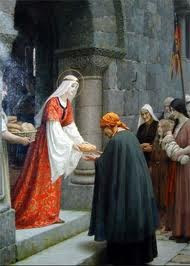
Then Elizabeth’s sorrows began. Louis died of the plague. She was so heartbroken that she cried, “The world is dead to me, and all that is joyous in the world!” Louis’ relatives had never liked Elizabeth because she had given so much food to the poor. While Louis was alive, they had not been able to do anything to her. Now, however, they could, and they did. Within a short time, this beautiful, gentle princess and her three children were sent away from the castle. They suffered hunger and cold. Yet Elizabeth did not complain about her terrible sufferings. Instead she blessed God and prayed with great fervor. She accepted the sorrows just as she had accepted the joys.

Elizabeth’s relatives came to her rescue. She and her children had a home once more. Her uncle wanted her to marry again, for she was still very young and attractive, but the saint had determined to give herself to God. She wanted to imitate the poverty of St. Francis of Assisi as a member of the Franciscan Third Order. She went to live in a poor cottage and spent the last few years of her life serving the sick and the poor. She even went fishing to try to earn more money for her beloved poor. St. Elizabeth was only twenty-four when she died. On her deathbed, she was heard to sing softly. She had great confidence that Jesus would take her to himself. Elizabeth passed away in 1231. She was proclaimed a saint by Pope Gregory IX in 1235. She is the patroness of the Franciscan Third Order.

St. Elizabeth of Hungary is a model of family love. Husbands, wives, parents, and children can learn from her that by loving God above all things, we’ll have a marvelous store of love and affection for the members of our family. It was this love that Elizabeth had for her husband and children that kept her going in spite of difficulties and loss.

-Daughters of St. Paul

Wednesday, November 16, 2011

Nov. 16, 2011 Wednesday: St. Margaret of Scotland

St. Margaret of Scotland

Margaret was an English princess born in 1045. She and her mother sailed to Scotland to escape the king who had conquered their land. King Malcolm of Scotland welcomed them. He fell in love with the beautiful princess. Margaret and Malcolm were married before long.

As queen, Margaret changed her husband and the country for the better. Malcolm was good, but he and his court were very rough. When he saw how wise his wife was, he willingly listened to her good advice. Margaret helped him control his temper and practice the Christian virtues. She made the court beautiful and civilized. The king and queen were wonderful examples because of the way they prayed together and treated each other. They fed crowds of poor people. They tried very hard to imitate Jesus in their own lives.

Margaret was a blessing for all the people of Scotland. Before she came, there was great ignorance. Many people had bad habits that kept them from growing closer to God. Margaret worked hard to obtain good teachers and she encouraged education. She and Malcolm had new churches built. She loved to make the churches beautiful to honor God. In fact, Queen Margaret embroidered some of the priests’ vestments herself.

Margaret and Malcolm had six sons and two daughters. They loved all their children very much. The youngest boy became St. David. But Margaret had sorrows, too. In her last illness, she learned that both her husband and her son, Edward, had been killed in battle. She died four days later, on November 16, 1093. Margaret was proclaimed a saint by Pope Innocent IV in 1250.

St. Margaret shows us the importance of doing the right things for the right reasons. Her good example was a genuine reflection of her faith in Jesus. Her good deeds weren’t done to win praise. She did what was right in order to please Jesus. We can ask her to help us do the same.

- Daughters of St Paul

Tuesday, November 15, 2011

Nov. 15, 2011 Tuesday: St. Albert the Great

St. Albert the Great

This saint was born in 1206 in southwest Germany. Albert went to the University of Padua in Italy. There he decided to become a Dominican. His uncle tried to persuade him not to follow his religious vocation. Albert did anyway. He felt that this was what God wanted. His father, the count of Bollstädt, was very angry. The Dominicans thought that he might make Albert come back home. They transferred the novice to a location farther away, but his father did not come after him.

St. Albert loved to study. The natural sciences, especially physics, astronomy, geography, and biology also interested him. He wrote a great number of books on these subjects. In one of his works, he proved that the earth was round. He also wrote on philosophy, mathematics, the Bible, and theology. He was a popular teacher in different schools.

One of St. Albert’s pupils was the great St. Thomas Aquinas. These two saints became lifelong friends. St. Albert had guided St. Thomas in beginning his great works in philosophy and theology. He also defended his teachings after Thomas died.

As St. Albert grew older, he became more holy. Before, he had expressed his deep thoughts in his writings. Now he expressed them in his whole way of living for God.

Two years before his death, St. Albert’s memory failed him. His end came very peacefully, as he sat in his chair talking with his fellow Dominicans. He is the patron saint of students and of the natural sciences. He was declared a saint in 1931 by Pope Pius XI.

We can learn from St. Albert to appreciate and use our minds. Let’s pray to St. Albert, asking him to help us acquire a healthy curiosity about the world around us, and especially about God, who created all things and set the laws that govern nature.

- Daughters of St. Paul

Monday, November 14, 2011

Nov. 14, 2011 Monday: St. Lawrence O'Toole

St. Lawrence O’Toole

Lawrence was born in Ireland in 1128. He was the son of a chief. When he was only ten years old, a neighboring king made a raid on his father’s territory and carried him away. The boy suffered for two years. Then his father forced the king to give him up to the care of a bishop. When he did, Lawrence’s father hurried to see his son. He gratefully brought him home.
The chief wanted one of his sons to enter the service of the Church. While he was wondering which one it might be, Lawrence told him with a laugh that he need not wonder anymore. “It is my desire,” said Lawrence, “to have for my inheritance the service of God in the Church.” So his father took him by the hand and gave him into the care of the bishop.

Lawrence became a priest and the abbot of a great monastery. When food became very scarce in the whole neighborhood of the monastery, the good abbot gave great quantities away to keep the people from starving. He had many problems to handle as head of the monastery, too. Some of the monks criticized him for being too strict. But Lawrence kept right on guiding the community in the way of self-sacrifice, despite the criticism. Then there was the problem of the robbers and outlaws who lived in the nearby hills. Yet nothing discouraged the fearless Lawrence O’Toole.

He became so famous that before long he was chosen to be archbishop of Dublin. In this new position, he lived as holy a life as ever. Every day, he invited many poor people to be his guests. He helped many others besides. Lawrence dearly loved his people and Ireland, his country, and he did all he could to keep it at peace. Once, an enemy attacked him as he was going up to the altar to say Mass. He was knocked to the floor unconscious, but he came to his senses right away. He had the wound washed at once, and then continued with the Mass.

After years of labor for the Church, St. Lawrence O’Toole became very ill. When he was asked if he wanted to make a will, the holy archbishop smiled. He answered, “God knows that I don’t have a penny in the world.” He had long ago given everything he had to others, just as he had given himself completely to God. St. Lawrence O’Toole died on November 14, 1180. He was proclaimed a saint by Pope Honorius III in 1225.

By the way he lived his life, St. Lawrence O’Toole reminds us that our main concern in all we do should be to please God. We can ask St. Lawrence to help us to do what’s right even if we’re criticized for it.

- Daughters of St. Paul

Saturday, November 12, 2011

Nov. 13, 2011: 33rd Sunday in Ordinary (A)


Earlier this week, I visited a priest friend in Breaux Bridge who graduated from the seminary with me. He spends his off-days with his parents who are retired. They have a very simple life and routine. We each sit in our own Lazyboy chair near a TV and talk about what has been going on as we watch Price Is Right, The Bold and the Beautiful, and The Talk. When Dr. Phil comes on, I say goodbye and drive back to town. On this occasion, my friend’s dad invited me out to his yard to give me Satsumas that were hanging on the trees. He has about nine Satsuma trees, each with branches hanging heavy with fruit. He said to me, “The other day a man drove up and said, ‘I see that you have Satsumas.’ I was going to give him some, and then he asked, ‘Are they sweet?’ I thought to myself, ‘Boy you are a particular fellow,’ so I answered him, ‘No, they’re not sweet.’ Then, he didn’t want any.” My friend’s dad continued to nip the fruits from the trees and place them in my Walmart bag. He went on to say, “I don’t keep these satsumas for me. I give most of them away. I visit my hunting buddy in the nursing home regularly, and I try to bring him something small, like satsumas, each time I go. That’s how our life should be, giving small things to someone each day. Now, Paul, you come back when it’s colder. Satsumas are sweeter when it’s colder.”

As I drove back to Donaldsonville, I thought about what this kind man had told me regarding the fellow who wanted only sweet satsumas. As the saying goes, ‘Beggars can’t be choosers.’ Meaning, if someone gives you something you asked for, you should not complain about what you get. We all have learned through life that not everything that comes our way as “gift” is sweet and pleasant. At times, the ‘gift’ is more bitter than sweet. Even the body that God has given us, the children that God has given us to raise, or the job that God has entrusted to us can give us bitter experiences. I imagine, though, that all of us have experienced what my friend’s dad wisely said, “Satsumas are sweeter when it’s colder.” Yes, even harsh, difficult struggles can create something good in our life.  We may not know it while we are in the middle of the difficult time, but we often realize the benefit or blessing much later.

In today’s Gospel parable, Our Lord shows us a man who entrusts his possessions to his three servants, each according to what he thought they could manage. Unlike the two servants who used their gifts to multiply the talents, the third servant, out of fear, buried the talent given to him. The servant assumed that his master was a demanding and harsh person so he did not want to lose his master’s money. His master scolds the third servant for that attitude. Was the master truly a demanding and harsh person? He must not have been, otherwise the other two servants would have had the same attitude. The third servant did not know or love his master, for the love would have cast out his fears.

We may have a similar reaction in our relationship with our Heavenly Father. If we do not know how generous, merciful, and compassionate Heavenly Father is, then we become like that third servant, unable or fearful to be faithful in even the small things entrusted to us. When we love the Father, we trust that what He asks us to do today will reap sweet fruits. The fruit may not ripen as quickly as we want, so we have to call upon the virtue of patience while the fruit progresses. The fruit may be bitter at the beginning, but if we wait patiently through the cold weather, we will taste the sweetness that Our Father has promised us.

Friday, November 11, 2011

Nov. 11, 2011 Friday: St. Martin of Tours

St. Martin of Tours


This soldier saint lived in the fourth century. He joined the Roman army in Italy when he was only fifteen. Although his parents were pagans, he began to study the Christian religion. Those who study the Christian religion are called catechumens until they are baptized.

One very cold winter day, Martin and his companions came upon a beggar at the gate of the city of Amiens. The man’s only clothes were rags, and he was shaking with cold. The other soldiers passed by him, but Martin felt that it was up to him to help the beggar. Having nothing with him, he drew his sword and cut his long cloak in half. Some laughed at his funny appearance as he gave one half to the beggar. Others felt ashamed of their own selfishness. That night, Jesus appeared to Martin. He was wearing the half of the cloak that Martin had given away.

“Martin, still a catechumen, has covered me with this garment,” Jesus said. Right after this wonderful event, St. Martin went to be baptized. Soon after, he left the army.

He became a disciple of St. Hilary, the bishop of Poitiers, France. Because of his strong opposition to the false Arian teaching in various cities, Martin had to go into exile. But he was happy to live in the wilderness with other monks. When the people of Tours asked for him as their bishop, he refused. The people would not give up, however. They got him to come to the city to visit a sick person. Once he was there, they took him to the church. He was named bishop of Tours in 371. As bishop, St. Martin did all he could to rid France of paganism. He prayed, worked, and preached everywhere.

Our Lord let Martin know when his death was near. As soon as his followers heard of it, they began to weep. They begged him not to leave them. So the saint prayed: “Lord, if your people need me yet, I will not refuse the work. Your will be done.” He was still laboring for the Divine Master in a far-off part of his diocese when death finally came on November 8, 397. St. Martin’s tomb became one of the most famous shrines in all of Europe.

It’s so easy to be concerned only about our own interests. But, like St. Martin, we want to be aware of the needs of others, too. We can ask St. Martin to help us notice when the people around us need our help and to do what we can to help them.
- Daughters of St. Paul

Thursday, November 10, 2011

Nov. 10, 2011 Thursday: Pope Leo the Great

St. Leo the Great, Pope and Doctor of the Church, memorial

What is a saint other than a soul conformed to Christ? Indeed, all Christians are called to this sanctity.

Leo bore the burden of the papacy at a trying time for the Church, threatened by numerous heresies and struggling amidst uncertain times for Roman civilization.
The book of Wisdom calls to mind that Wisdom is "firm, secure, tranquil." It is these traits that seem to be at stake in the Gospel reading, where Christ warns his disciples that, overwhelmed by desire for the Kingdom of God, many will lose patience and seek after what is more certain and more at hand: "There will be those who will say to you, 'Look, there he is,' or 'Look, here he is.'" To live a life based on faith is trying. It is easier to settle down upon what is closer at hand and what is more comfortable. Yet it is by faith alone that we are saved and elevated up beyond our fallen nature. We must have patience. We must be "firm, secure, tranquil" as we wait for the Lord.

Fr. Timothy Kieras, SJ

Wednesday, November 9, 2011

Nov. 10, 2011 Thursday: Our Lady's Message

“Dear children, the Father has not left you to yourselves. Immeasurable is His love, the love that is bringing me to you, to help you to come to know Him, so that, through my Son, all of you can call Him ‘Father’ with the fullness of heart; that you can be one people in God’s family. However, my children, do not forget that you are not in this world only for yourselves, and that I am not calling you here only for your sake. Those who follow my Son think of the brother in Christ as of their very selves and they do not know selfishness. That is why I desire that you be the light of my Son. That to all those who have not come to know the Father – to all those who wander in the darkness of sin, despair, pain and loneliness – you may illuminate the way and that, with your life, you may show them the love of God. I am with you. If you open your hearts, I will lead you. Again I am calling you: pray for your shepherds. Thank you. ” - Nov. 2, 2011 Our Lady of Medjugorje (to Mirjana)

Nov. 9, 2011 Wednesday: Dedication of St. John Lateran Basilica

Dedication of the Basilica of St. John Lateran


The Basilica of St. John Lateran in Rome is the pope’s own church. It is considered the head and mother of all the churches in the world. It is enriched with relics of Christ’s suffering and death and of many martyrs.

Originally, this basilica was the palace of a rich Roman senator named Plautius Lateranus. When he died, the emperor Constantine inherited the house. Constantine built a chapel in its walls, which he had dedicated to St. John the Baptist. There was a second altar dedicated to St. John the Evangelist.

The popes lived at the Lateran Basilica until the time of Pope Gregory XI. When this pope returned from Avignon, he took up residence in St. Peter’s Basilica, or the Vatican, and the popes have resided there ever since.

Today’s feast day reminds us to value the church buildings dedicated to the service and worship of God.


When we see a beautiful church, it should remind us of all the people called together to worship God. We, the People of God, are the living stones of Christ’s Church. It is our lives of holiness and service that make the Church most beautiful.

- Daughters of St. Paul

Tuesday, November 8, 2011

Nov. 8, 2011 Tuesday: 32nd Week in Ordinary Time (A)

When St. Ignatius wrote his directions on how to pray the "colloquy" -- a sort of back and forth conversational period of prayer at the end of a block of meditation time -- he advises that sometimes we speak to the Lord as we speak to a friend, and other times, as a servant speaks to his master. Experience with master-servant relations is significantly rarer for the average middle-class person in the western world today, so it can be difficult to relate to Ignatius' advice. Yet we shouldn't dismiss it. It is, after all, an integral part of how Jesus interacted with the Apostles. His parable today hits home: the master is not grateful to the servant for simply doing what he is told.

That's the servant's job. The servant, on the other hand, shouldn't expect the master to be brimming over with gratitude. Then Jesus tells us "When you have done all you have been commanded, say, 'We are unprofitable servants; we have done what we were obliged to do."

This is not the only way we have to relate to God, and friendship with God through Christ is a marvelous way to picture the spiritual life. Nevertheless, we should be able to consider ourselves to be servants, and so perform with grace those things we have been commanded to do by the master.

-Mr. Timothy Kieras, SJ

Monday, November 7, 2011

Nov. 7, 2011 Monday: Blessed Giuseppe Antonio Tovini

Blessed Giuseppe Antonio Tovini


Giuseppe was born on March 14, 1841, in Italy. His parents were loving and devout Catholics, who made sure their children received a good education and Christian upbringing. Giuseppe’s father died when he was eighteen, so he helped his mother financially in raising his younger brothers and sisters. In the meantime, he continued his education. He received a law degree at about the same time that his mother died.

Soon after he began practicing law, he took a position as assistant principal and teacher in a technical school. He was well known for bringing out the best in each of his students and in helping them realize and use their own special talents.

In 1867, he met a young woman named Emilia Corbolani. They soon fell in love and after a while they got married. In the meantime, Giuseppe had become the mayor of his hometown, devoting his political career to helping improve the living conditions of the people he was sworn to serve. As a Third Order Franciscan, he especially felt the need to give his attention to helping the poor and needy. He constructed railroads to link rural areas with the city, and improved people’s financial lives by founding banks and credit unions, which focused on people instead of money. He opened schools and supported the publication of several newspapers.

Giuseppe and Emilia started a family, which in time grew to include ten children. They were good parents and set an example of faith and mutual love and respect. Three of their children devoted themselves to the religious life when they grew up.

Giuseppe was unstoppable in his activities for social justice and service to the needy. But he received the strength for this demanding activity in prayer. He read the Bible every day, and drew inspiration for his life from the Word of God. He attended Mass each day and received Holy Communion with reverence and love. He was very devoted to the Eucharist and started the practice of perpetual adoration of the Blessed Sacrament in the parish church where he was later to be buried.

On January 16, 1897, worn out from his unceasing activity, Giuseppe Tovini died at the age of fifty-six. He was beatified on September 20, 1998, by Pope John Paul II.

Blessed Giuseppe Antonio Tovini had a talent for seeing the needs of others around him and thinking up practical solutions to help. Let’s pray to him and ask him to show us one small thing we can do today to make someone’s life a little better.
-Daughters of St. Paul

Saturday, November 5, 2011

Nov. 6, 2011: 32nd Sunday in Ordinary Time (A)


I have pondered about how the Gospel message of the wise and the foolish virgins applies to our lives. The message that Jesus wants us to draw from the parable is that we need to be vigilant and ready in our service to the Lord. What does it mean to be vigilant and ready? I think two women I encountered in the past describe just that.

A few days ago, I visited an elderly lady to anoint her and bring her communion. Previously, her relative had instructed me that when I arrived at the house I was to strike the wall near the window with the water hose because the lady had lost most of her hearing. As I approached the front door of her house, I saw a sign that read, 'Knock hard. Hard of Hearing. Knock on the side wall.' I walked around to side of the house near the water hose and I noticed there were dents on the wall and thought that they may have been made by the water hose. I did not want to hear from the owner that a priest damaged the wall, so I knocked with my knuckles instead. A diminutive elderly lady greeted me and we sat down to visit. She spoke at length and I listened. I tried to chat with her, but she could not understand me so she brought me a small dry-erase board to assist us in communicating. Amazingly, in this age of high technology gadgets, this low-tech tool worked beautifully.

She said to me, "Father, I had a good life. I also had a hard life. I was one of ten children, and when I was twelve years old, my dad left our family. At age twelve, I had to go out and work to help bring food to the table. We were poor, but we took care of each other. I married young at 19 years old. I married a man with three young children, whose mother had left them." At that point, her stepdaughter chimed in, "Technically, she is my stepmother, but for me, she is my mother because she took care of us like our real mother." The elderly lady continued, "I took care of my younger sister in my house until she met her husband." Looking around the house, I noticed that it was a very modest home with no signs of luxuries, and it had a very small kitchen. I recalled that her niece had mentioned to me that when her aunt was younger this very house was buzzing with people as her aunt cooked every day and fed whoever came to the house. I wondered how she could have fed so many people working in that small kitchen.

In Baptism and Confirmation we received all the gifts of the Holy Spirit necessary to serve the Lord and our neighbor. While we have been given everything we need, some choose not to use their gifts, and Our Lord grieves when we choose not to use our gifts. In the Gospel today, Jesus gives us the image of wise virgins and foolish virgins who were waiting for the arrival of the Bridegroom, and the wise virgins had filled their oil lamps and were ready him. The elderly lady I visited has used the gifts that she has been given--her kindness, generosity, and compassion—to care for her family and friends. These are the gifts with which she filled her oil lamp. As I spoke with her I noticed that she was not bitter about the hardship that she had experienced throughout her life and she did not complain about what she did not have.

For most of us when we face difficult moments, we have a tendency to complain. Mother Teresa had an interesting image to describe this--a walking stick. She said, "To complain is very easy, but to be happy to be anybody's walking stick is very difficult. What a lot we lose when we grumble; what a waste of energy. How foolish we are. We must all watch out because we are all inclined to it--let not our likes and dislikes be the measure of our actions. Remember, we have come to do the will of Him who called us. You must train yourselves to be happy by always saying "yes" to God. Try to give a hearty "yes" to God in your life and you will find yourself coming closer and closer to God."

A while back, I visited a lady who was in her eighties and who had plenty of reasons to grumble. She had been to the hospital more times than she could remember because of heart troubles. At one point, she could barely walk a few steps without getting tired and so she spent most of her time at home feeling trapped. For a while, she begged Jesus to take her home, but then the unexpected happened when she had a heart attack. Unfortunately, she had a second heart attack two years later. With both heart attacks, she coded (died) and had near-death experiences. She said that during her first near death experience she arrived at a beautiful place that she described as "paradise." She went on to say that she felt a great peace and joy that she had never experienced. While in this paradise, she was only too happy to see her deceased family members, but they all looked at her and shook their head as if to say to her, "It's not your time." Then Jesus appeared to her and said, "You need to go back", but she told him, "I don't want to go back. It feels so wonderful here." Nevertheless, she was sent back, only to come back to the same place two years later following the second heart attack. Again, Jesus told her that she needed go back. She pleaded with Him, "Why?" Jesus replied, "Your 13-yr. old granddaughter needs you."
      
When I met this lady, she was not bitter. Neither her heart condition nor the frequent trips to the hospital changed her. She knew, like the wise virgins who had their lamps filled with oil, that anytime of the day, Jesus was asking her to love her granddaughter the best way she could. It no longer mattered to her that it could be next month or the next 5 years that Jesus would call her home. What mattered to her was that she was prepared to say "yes" to Jesus. I am fortunate to have met two great examples of 'wise virgins' who are vigilant and ready in service to the Lord. We each need to look into our lives to see if we are using our gifts to be vigilant and ready in service to the Lord.


Friday, November 4, 2011

Nov. 4, 2011 Friday: St. Charles Borromeo

St. Charles Borromeo


Charles lived in the sixteenth century. He was the son of a rich Italian count and the nephew of Pope Pius IV. Like other wealthy young men, he went to the University of Pavia. Unlike many of them, however, he would have nothing to do with sinful activities. He seemed to be a slow student because he was not a good speaker, but he made good progress.

He was only twenty-three when his uncle, Pope Pius IV, gave him many important duties. Charles managed to handle all his affairs well. He was always afraid that he might stray from God because of the many temptations around him. For this reason, he was careful to focus his attention on prayer and his duties and to make the effort to be humble and patient.

As a priest and later as the cardinal archbishop of Milan, St. Charles was a model for his people. He gave away great amounts of money to the poor. He dressed as simply as he could, but with the respectability expected of a cardinal. He attended with great care to the dignity owed to Church ceremonies. In Milan the people had many bad practices and much superstition. By wise laws, by gentle kindness, and by his own marvelous example, St. Charles made his diocese a model for the whole Church. He was never a good speaker—people could barely hear him—yet his words took effect.

When a terrible disease caused many deaths in Milan, Cardinal Borromeo thought only of caring for his people. He prayed and did penance. He organized crews of attendants and went into debt to feed the hungry. He even had altars set up in the streets. This was for the benefit of the sick, who could assist at Mass from their windows.

This great man was never too busy to help simple people. He once stayed with a little shepherd boy until he had taught him the Our Father and the Hail Mary. As he lay dying at the age of forty-six, St. Charles said peacefully, “Behold, I come!” He died on November 3, 1584, and was proclaimed a saint by Pope Paul V in 1610.

If we are tempted to seek only comfort and fun in our lives, we can say a prayer to St. Charles Borromeo. We can ask him for a selfless generosity in doing our duties and in reaching out to those in need. Our lives will be more purposeful if we each aim at doing something to make the world a better place.

-Daughters of St. Paul

Wednesday, November 2, 2011

Nov. 2, 2011 Thursday: St Martin de Porres

St. Martin de Porres

Martin was born in Lima, Peru, in 1579. His father was a knight from Spain. His mother was a freed slave from Panama. At first, his father left Martin and his mother and sister without support. They were very, very poor.

Martin grew up devout and good. When he was twelve, he was sent to learn the trade of a barber. He also learned how to cure many diseases. Martin’s father finally decided to provide for his son’s education. However, Martin wanted to give himself to God as a Dominican brother. Brother Martin soon proved to be a wonderful religious. No one was kinder, holier, or more obedient.

He served his fellow religious as a barber and infirmarian. He was also in charge of giving food to the poor who came to the doors of the Dominican house. He founded an orphanage and a hospital, and he cared for the sick around the city of Lima. Before long, he became well known for his kindness to the poor and sick. People admired him for his holiness of life. Everyone in the city of Lima would send for Brother Martin when there was sickness. He loved all people as his brothers and sisters in Christ. Great sums of money were given to this good, lovable brother for his charities. People recognized how well he could organize works of charity.

Not even animals were forgotten by this kindhearted saint. He excused the comings and goings of rats and mice by saying, “The poor little things don’t have enough to eat.” In his sister’s house, he kept a “home for wandering cats and dogs.”

Despite his fame in Lima, St. Martin always had a very humble opinion of himself. His name for him-self was, in fact, “Brother Broom.” Martin died on November 3, 1639. When he died, this beloved saint was carried to his tomb by bishops and noble-men. They wanted to honor the humble and holy brother. He was proclaimed a saint by Pope John XXIII in 1962.

Our Heavenly Father has no preference when it comes to the color of a person’s skin. Instead, he looks into our hearts. We can ask St. Martin de Porres to give us his love for all people. He’ll help us to see people of all races, nationalities, and religions as children of God.
- Daughters of St Paul

Nov. 2, 2011: All Souls


Nov. 2, 2011 Wednesday: All Souls' Day

All Souls’ Day

This feast day is one of the most loving celebrations in the Church’s liturgy. It is the day that we especially remember all the faithful departed—those who have passed from this life into the next.

We don’t know how long a particular individual spends in purgatory. However, we do know that purgatory is real. Today we stop to remember all who have died. We especially pray for our own ancestors, relatives, and friends who have died. We pray for those who taught us good things. We pray for those who made sacrifices for us. We pray for those who prayed for us while they were on this earth. We pray for the most forgotten souls. We pray for those who had great responsibilities while they were on earth.

We think of those holy souls in purgatory and we realize that they are saved. Now they wait, being purified, until the moment when they can be with God, face to face.

We can pray for the souls in purgatory and hasten their journey to God: Eternal rest, grant to them, O Lord, and let perpetual light shine upon them. May they rest in peace. Amen.
- Daughters of St. Paul

Nov. 1, 2011 Tuesday: Audio Homily- All Saints


Tuesday, November 1, 2011

Nov. 1, 2011 Tuesday: All Saints

All Saints’ Day


On this day, we remember all the men, women, and children who followed Christ faithfully and heroically during their lives and who now enjoy the presence of God in heaven.

Some saints have been singled out for their own feast day. The Church offers their witness of heroic, joyful lives for Jesus. But there aren’t enough days of the year to fit all the countless saints who walked through this life witnessing to Jesus.

Some kept close to the Lord all their lives. Others found him along the way. Some led good lives without major difficulties. Others made big mistakes, but found the Lord on the road of repentance and genuine sorrow.

They made it! And we ask them to intercede for us so that we will live holy lives, too, and reach our heavenly homeland. We celebrate their journey that led to eternal happiness with God. We celebrate our own family members, relatives, neighbors, and friends whom we believe to be in heaven.

Today we can rejoice in our hearts with all the saints in heaven. We can speak to them, thanking them for the witness of their lives. We can thank them, too, for helping us overcome our difficulties and temptations. Let’s ask them to help us on our own journey through life.

-Daughters of St Paul