Saturday, December 31, 2011

Jan. 1, 2012: Solemnity of Mary, Holy Mother of God


How many moms have asked her children to either run errands for her or accompany her on errands? Children end up doing lots of errands for their moms. Some errands are simple and some are not. In Korea when I was in first grade, my mom dragged me out of bed at 4AM to accompany her to the fish market where we purchased several buckets of fish. After we returned home, around 6:30AM, mom asked me to take a bag of fresh fish to my first grade teacher who lived within walking distance from us. When I gave the bag of fish to my teacher, she stroked my head and thanked mom and me. I'm pretty sure I got extra points on conduct section of my report card for that kindness. Most of the time, children do whatever their mom asks them to do, trusting in her judgment and without questioning her. When I was in fifth grade and living in the Dallas area, I told my mom that the lady who drove our school bus would be celebrating her birthday that week. Mom wrapped a gift for me to take to her, and I presented it to her the next day as I got on the school bus. I stood there as she unwrapped the gift, and there they were--ladies underwear. My face got red from embarrassment.  

One day this week, someone at morning mass told me that a parishioner was in the hospital in Gonzales. I had several things on my to-do list that day and I did not know whether I had time to make a hospital visit.  I quickly prayed and asked Blessed Mother whether she would like for me to go to the hospital immediately, and she said 'yes.' When I arrived at the hospital, I was told that the parishioner was no longer there.  I wondered to myself, 'Why did Blessed Mother want me to come here when the parishioner isn't even here?' As I walked through the hospital hallway and turned a corner, there was a lady in the hallway, crying so I stopped and asked her what was the matter. She replied, "My mom and I just found out from the doctor that she cannot go back home. The doctor said that she needed to be in a nursing home where she can receive medical attention, but I don't want her to go to a nursing home. I've been taking care of her for the past 20 years." I asked, "How is your mom taking this news?" The daughter replied, "Much better than I am. She's okay with it, but I'm not." I went into the room and after chatting with the mom for awhile, she said, "Father, I told Jesus a number of times, 'my life is in the palm of your hands, Jesus. Do with me what you will.'" This elderly mother had complete trust in the Heavenly Father and in His will for her. She was sad that she could no longer be in her own home, but she did not feel as though this was the end of the world. The daughter told me that for more than 15 years, her mother had been going to that nursing home to help organize the rosary and mass for the residents. For many years, she was Jesus' presence to the residents and now she has the opportunity to be that presence even more so. I told the daughter and her mother the whole story about how I ended up at the hospital. Then I told them, "By sending me here to you, Blessed Mother wants you to know that she watches and cares about everything that's happening in your life and that she'll guide you and that you need not be afraid." As I left the hospital room, I reminded myself that this was one of those moments when I had to trust Heavenly Mother completely and promptly do what she asked me to do without questioning her.  

Just like this mother and daughter, all of us have faced moments that have left us sad and confused. We feel at that moment that we are not capable of overcoming the challenge before us. This is the kind of challenge that Mary and her husband Joseph had to face that night in Bethlehem with a child about to arrive amid most difficult of circumstances. The mystery for us is that Heavenly Father chose a weak human to bring His divine Son into this world. If He is the Almighty God wanting to accomplish His will through weak human beings why did He not provide a more comfortable and safe place for Mary and Joseph to give birth to His Divine Son?

On this Feast Day of Mary, the Holy Mother of God, Heavenly Father is telling us that He did provide the ideal place--the womb of a young woman who had complete trust in the Father. He gave Mary every grace necessary to fulfill Her role as Mother of God. For each of us, it's not the external things, such as monetary resources, circumstances, or timing, that determine whether we are capable of what God is asking us to do. Rather, it is our complete trust in the Father that allows us to do what He asks of us. But how do we know His will for us? It is through prayer that we know and understand the Father's will--that's how Blessed Mother knew the truth and trusted. We see in the Gospel that Blessed Mother always prayed, for she " kept all these things, reflecting on them in her heart." Father has given us every gift we need and continues to give the necessary grace to do His will. We allow the distractions of our world to keep us from our true calling--to be His Son's presence in the world. His mother and many angels and saints are ready to assist us, but we have to call upon them and trust.

Friday, December 30, 2011

Dec. 30, 2011 Friday: Holy Family

Pope Paul VI
"They returned to Galilee, to their own town of Nazareth"


The home of Nazareth is the school where we begin to understand the life of Jesus - the school of the Gospel. The first lesson we learn here is to look, to listen, to meditate and penetrate the meaning - at once so deep and so mysterious - of this very simple, very humble and very beautiful manifestation of the Son of God. Perhaps we learn, even imperceptibly, the lesson of imitation... How gladly would I become a child again, and go to school once more in this humble and sublime school of Nazareth: close to Mary, I wish I could make a fresh start at learning the true science of life and the higher wisdom of divine truths... First, then, a lesson of silence. May esteem for silence, that admirable and indispensable condition of mind, revive in us, besieged as we are by so many uplifted voices, the general noise and uproar, in our seething and oversensitized modern life. May the silence of Nazareth teach us recollection, inwardness, the disposition to listen to good inspirations and the teachings of true masters. May it teach us the need for and the value of preparation, of study, of meditation, of personal inner life, of the prayer which God alone sees in secret (Mt 6,6). Next, there is a lesson on family life. May Nazareth teach us what family life is, its communion of love, its austere and simple beauty, and its sacred and inviolable character. Let us learn from Nazareth that the formation received at home is gentle and irreplaceable. Let us learn me prime importance of the role of the family in the social order. Finally, there is a lesson of work. Nazareth, home of the 'Carpenter's Son' (Mt 13,55), in you I would choose to understand and proclaim the severe and redeeming law of human work; here I would restore the awareness of the nobility of work, and reaffirm that work cannot be an end in itself, but that its freedom and its excellence derive, over and above its economic worth, from the value of those for whose sake it is undertaken. And here at Nazareth I want to greet all the workers of the world, holding up to them their great pattern, their brother who is God. He is the prophet of all their just causes, Christ our Lord.

Homily by Pope Paul VI at Nazareth on 05/01/64 (breviary for the Holy Family)

Wednesday, December 28, 2011

Dec. 29, 2011 Thursday: St. Thomas Becket

St. Thomas Becket

Thomas Becket was born in 1118, in London, England. After his parents died, he accepted a position in the household of the archbishop of Canterbury. He began studying for the priesthood. He soon became a great favorite of King Henry II himself. People said that the king and Thomas had only one heart and one mind—they were such close friends.

When Thomas was thirty-six, King Henry made him his chancellor. As chancellor of England, Thomas had a large household and lived in splendor. When the archbishop of Canterbury died, Henry wanted the pope to give Thomas this position. It would require that Thomas be ordained a priest. But Thomas told him plainly that he did not want to be the archbishop of Canterbury. He realized that being in that position would put him in direct conflict with Henry II. Thomas knew that he would have to defend the Church against Henry, and that would mean trouble. “Your affection for me would turn into hatred,” he warned Henry. The king paid no attention and Thomas was made a priest and a bishop in 1162.

He immediately began to change his life. He lived more austerely and devoted much more time to prayer. At first, things went along as well as ever. All too soon, however, the king began to demand money, which Thomas felt he could not rightly take from the Church. The king grew more and more angry with his former friend. Finally, he began to treat Thomas harshly. For a while, Thomas was tempted to give in a bit. Then he began to realize just how much Henry hoped to control the Church. Thomas was very sorry that he had even thought of giving in to the king. He did penance for his weakness and ever after held firm.

One day, the king was very angry. “Will no one rid me of this archbishop?” Some of his knights took him seriously. They went off to murder the archbishop. They attacked him in his own cathedral. He died, saying, “For the name of Jesus and in defense of the Church, I am willing to die.” It was December 29, 1170. The entire Christian world was horrified at such a crime. Pope Alexander III held the king personally responsible for the murder. A year later, Henry II performed public penance. Miracles began to happen at Thomas’ tomb. He was proclaimed a saint by the same pope in 1173.

St. Thomas Becket teaches us that we must put our faith and loyalty to Christ ahead of our personal friendships. If a friend expects us to do something we know is displeasing to God, we must choose what we know to be the right thing. Hopefully, our courage and good example will help our friends grow closer to God as well.

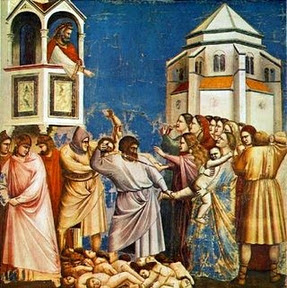
Dec. 28, 2011 Wednesday: Feast of Holy Innocents

« On this day, Lord, the Holy Innocents gave witness to your glory, not by speaking but by dying» (Collect)


By St. Peter Chrysologus

Where does this jealousy lead?... The crime committed today shows us. Fear of a rival to his earthly kingdom fills Herod with anxiety; he plots to suppress «the newborn King» (Mt 2,2), the eternal King; he fights against his Creator and puts innocent children to death... As for those children, what fault had they committed? Their tongues were dumb, their eyes had seen nothing, their ears heard nothing, their hands done nothing. They accepted death who had not known life... Christ reads the future and knows the secrets of the heart; he weighs our thoughts and probes our intentions (cf. Ps 139[138]): why did he forsake them?... Why did the newborn heavenly King abandon these companions in innocence, forget the sentinels watching around his crib to such an extent that the foe who wanted to get at the King ravaged his whole army? My brethren Christ did not forsake his soldiers but covered them with honor by granting them to conquer before they had lived and to carry away the prize without a fight... He wanted them to possess heaven rather than earth... He sent them before him as his heralds. He did not abandon them but saved those who went on ahead. He did not forget them... Blessed are they who have exchanged their travail for repose, their pains for ease, their suffering for joy. They are alive! Yes, they are alive; they live indeed who have undergone death for Christ's sake... Happy the tears their mothers shed for these infants: they have won them the grace of baptism... May he who deigned to rest in our stable be pleased to lead us also to the heavenly pastures.

Sermon 152 ; PL 52, 604

Tuesday, December 27, 2011

Dec. 27, 2011 Tuesday: St. John, Apostle

St. John the Apostle

St. John was a fisherman in Galilee. He was called to be an apostle with his brother, St. James. Jesus gave these sons of Zebedee the nickname “sons of thunder.” St. John was the youngest apostle and is believed to be the one called “the beloved disciple.”

At the Last Supper, it was John who was permitted to lean his head on the chest of Jesus. He was also the only apostle who stood at the foot of the cross. The dying Jesus gave the care of his Blessed Mother Mary to this beloved apostle. Looking at Mary, he said, “Behold your mother.”

On Easter morning, Mary Magdalene and the other women went with spices to Jesus’ tomb to anoint his body. They came running back to the apostles with disturbing news. The body of Jesus was gone from the tomb. Peter and John set out to investigate. John arrived first but waited for Peter to go in ahead of him. Then he went in and saw the neatly folded linen cloths, and he understood that Jesus had been raised from the dead. Later, that same week, the disciples were fishing on Lake Tiberias without success. A man standing on the beach suggested they let down their nets on the other side of the boat. When they pulled it up again it was full of large fish. Now John, who recognized this man, called to Peter, “It is the Lord!”

With the descent of the Holy Spirit the apostles were filled with new courage. After the ascension of Jesus, Peter, and John cured a crippled man by calling on the name of Jesus.

It is believed that John lived nearly a century and was the only apostle not to suffer martyrdom. He preached the Gospel and may have become bishop of Ephesus. It is said that in the last years of his life, when he could no longer preach, his disciples would carry him to the crowds of Christians. His simple message was, “My dear children, love one another.” St. John died in Ephesus around the year 100.

Monday, December 26, 2011

Dec. 26, 2011 Monday: St. Stephen

from
http://www.mysticsofthechurch.com/2011/12/miraculous-story-of-claude-newman-his.html


The remarkable true story of the miraculous intercession of the Virgin Mary in 1944 to prisoner Claude Newman of Mississippi

The Virgin Mary appears in a series of visions through the intercession of the Miraculous Medal and converts two men on death row.

By: Glenn Dallaire

Claude Newman was an African American man who was born on December 1, 1923 to Willie and Floretta (Young) Newman in Stuttgart, Arkansas. In 1928, Claude’s father Willie takes Claude and his older brother away from their mother for unknown reasons, and they are brought to their grandmother, Ellen Newman, of Bovina, Warren County, Mississippi.

In 1939, Claude's beloved grandmother, Ellen Newman, marries a man named Sid Cook. Soon Sid becomes sexually abusive toward Ellen, which deeply angers Claude. In 1940, Claude works as a farmhand on Ceres Plantation in Bovina, Mississippi. The plantation is owned by a wealthy landowner named U.G. Flowers, and Sid Cook was born and raised on this plantation. One biographer also has Claude getting married also in 1940 at age 17 to a young woman of the same age.

On Dec.19, 1942, Claude is apparently still very angered by Sid's abusive treatment towards his grandmother Ellen, and egged on by dominant friend named Elbert Harris, Claude lies in waiting at Sid Cook’s house (Sid Cook and Ellen Newman have since seperated). Claude shoots Sid as he enters, killing him, and takes his money, then flees to his mothers house in Little Rock, AR., arriving on Dec 20th.

Claude is arrested and sent to prison on death row
In January 1943, Claude is apprehended in Arizona and is returned to Vicksburg, Mississippi and makes a coerced confession on Jan. 13. Despite protests of Claude’s lawyer Harry K. Murray, his confession is admitted as evidence, and he is found guilty by jury, and is initially sentenced to die in the electric chair on May 14, 1943. Later an appeal to retry the case is rejected by State Attorney General and he is rescheduled to be executed on January 20, 1944.

Claude receives the Miraculous Medal of the Blessed Virgin Mary
While he was in jail awaiting execution, he shared a cell-block with four other prisoners. One night, the five men were sitting around talking and eventually the conversation ran out. During this time, Claude noticed a medal on a string around one of the other prisoner's neck. Curious, he asked the other prisoner what the medal was. The young prisoner was a Catholic, but he apparently did not know (or did not want to talk) about the medal, and seemingly embarrassed, he appeared angry and suddenly took the medal off from around his own neck and threw it on the floor at Claude's feet with a curse and a cuss, telling him to "take the thing". Claude picked up the medal, and after looking it over, he placed it around his own neck, although he had no idea who's image it was on the medal; to him it was simply a trinket, but for some reason he felt attracted to it, and wanted to wear it.


The Blessed Virgin Mary appears to Claude in a vision
(The Icon is of “Mary the Teacher” © Copyright 2004 by Brother Claude Lane, OSB, Mount Angel Abbey. This beautiful icon is a representation of the amazing facts below.

During the night while sleeping on top of his cot, he was awakened with a touch upon his wrist. Awakening with a start, there stood, as Claude told Father O’Leary afterwards, ‘the most beautiful Woman that God ever Created’.

At first he was quite frightened, not knowing what to make of this extraordinary beautiful glowing Woman. The Lady soon calmed Claude down, and then said to
him, "If you would like Me to be your Mother, and you would like to be My child, send for a priest of the Catholic Church."
And after saying these words She suddenly disappeared.

Excited, Claude immediately started to yell "a ghost, a ghost", and started screaming that he wanted a Catholic priest.

Father Robert O'Leary SVD (1911-1984), the priest who tells the story, was called first thing the next morning. Upon arrival he went to see Claude who told him of what had happened the night before. Deeply impressed by the events, Claude, along with the other four men in his cell-block, asked for religious instruction in the Catholic faith.

Claude and some of the other prisoners receive instruction in the Catholic faith
Father O'Leary returned to the prison the next day to begin instruction for the prisoners. It was then that the priest learned that Claude Newman could neither read nor write at all. The only way he could tell if a book was right-side-up was if the book contained a picture. Claude told him that he had never been to school, and Father O’Leary soon discovered that his ignorance of religion was even more profound. He knew practically nothing about religion or the Christian faith. He knew that there was a God, but he did not know that Jesus was God. And so Claude began receiving instructions, and the other prisoners helped him with his studies.

After a few days, two of the religious Sisters from Father O'Leary's parish-school obtained permission from the warden to come to the prison. They wanted to meet Claude and hear his remarkable story, and they also wanted to visit the women in the prison. Soon, on another floor of the prison, the Sisters began to teach some of the women-prisoners the catechism as well.

A heavenly lesson about Confession
Several weeks passed, and it came time when Father O'Leary was going to give instructions about the Sacrament of Confession. The Sisters too sat in on the class. The priest said to the prisoners, "Ok boys, today I'm going to teach you about the Sacrament of Confession."
Claude said, "Oh, I know about that! The Lady told me that when we go to confession we are kneeling down not before a priest, but we're kneeling down by the Cross of Her Son. And that when we are truly sorry for our sins, and we confess our sins, the Blood He shed flows down over us and washes us free from all sins."

Hearing Claude say this, Father O'Leary and the Sisters sat stunned with their mouths wide open. Claude thought they were angry and said, "Oh don't be angry, don't be angry, I didn't mean to blurt it out."
The priest said, "We're not angry Claude. We are just surprised. You have seen Her again?"

Claude replied, "Come around the cell-block away from the others."

Proof that the Blessed Virgin Mary was appearing to Claude
When they were alone, Claude said to the priest, "She told me that if you doubted me or
showed hesitancy, I was to remind you that lying in a ditch in Holland in 1940, you made a vow to Her which She's still waiting for you to keep."
And, Father O'Leary recalls, "Claude then told me precisely what the vow was."

Claude's revelation absolutely convinced Father O'Leary that Claude was telling the truth about his visions of Our Lady. The promise Fr. O’Leary made to Our Lady in 1940 from a ditch in Holland (the proof Claude gave the priest that Our Lady really was appearing to him) was this: that when he could, he would build a church in honor of Our Lady’s Immaculate Conception. He did just that in 1947. He had been transferred to Clarksdale, Mississippi in 1945 when a group African American Catholic laymen asked to have a church built there. The Bishop of Natchez, Mississippi had been sent $5000 by Archbishop Cushing of Boston for the “Negro missions.” The Bishop and Father O’Leary commissioned the church of the Immaculate Conception to be built, and it is still there today (photo left)

Father O’Leary and Clark then returned to the catechism class on Confession. And Claude kept telling the other prisoners, "You should not be afraid to go to confession. You're really telling God your sins, not the priest”
Then Claude said,
"You know, the Lady said that Confession is something like a telephone. We talk through the priest to God, and God talks back to us through the priest."

A heavenly lesson about Holy Communion
About a week later, Father O'Leary was preparing to teach the class about the Blessed
Sacrament. The Sisters were again present for this lesson too. Claude indicated that the Lady had also taught him about the Eucharist, and he asked if he could tell the priest what She said.

Fr. O’Leary agreed immediately. Claude related, "The Lady told me that in Communion, I will only see what looks like a piece of bread. But She told me that It is really and truly Her Son, and that He will be with me just as He was with Her before He was born in Bethlehem. She told me that I should spend my time like She did during Her lifetime with Him-- in loving Him, adoring Him, thanking Him, praising Him and asking Him for blessings. I shouldn't be distracted or bothered by anybody else or anything else, but I should spend those few minutes in my thoughts alone with Him."

Claude is received into the Catholic church and scheduled to be executed
As the weeks progressed, eventually they finished the catechism instructions and Claude and the other prisoners were received into the Catholic Church. Soon afterwards the time came for Claude to be executed. He was to be executed at five minutes after twelve, midnight, on January 20, 1944.

The sheriff, named Williamson, asked him, "Claude, you have the privilege of a last request. What do you want?"
"Well," said Claude, "all of my friends are all shook up. The jailer is all shook up. But you don't
understand. I'm not going to die; only this body. I'm going to be with Her. So, then I would like to have a party"

"What do you mean?” asked the sheriff.

"A party!" said Claude. "Will you give Father O’Leary permission to bring in some cakes and ice cream and will you allow the prisoners on the second floor to be freed in the main room so that we can all be together and have a party?"

"Somebody might attack Father," cautioned the warden.
Claude turned to the men who were standing by and said, "Oh no they won't, right fellas?"
The warden consented and posted additional guards for the party. So, Father O’Leary visited a wealthy patron of the parish, and she generously supplied the ice cream and cake, and everyone enjoyed the party.

Afterwards, because Claude had requested it, they made a Holy Hour, praying especially for Claude and for all of their souls. Fr. O’Leary brought prayer books from the Church, and they all said together the Stations of the Cross, and made a Holy Hour, without the Blessed Sacrament.

As the time neared for Claude’s execution, the men were put back in their cells. The priest then went to the chapel to get the Blessed Sacrament so that he could give Claude Holy Communion in the moment before his execution.
Father O'Leary returned to Claude's cell. Claude knelt on one side of the bars, the priest
knelt on the other, and they prayed together as the clock ticked toward Claude's execution.

A two week stay of execution is granted
Fifteen minutes before the execution, sheriff Williamson came running up the stairs shouting,
"Reprieve, Reprieve, the Governor has given a two-week reprieve!"
Claude had not been aware that the sheriff and the District Attorney were trying to get a stay of execution for Claude to save his life. But when Claude found out, he started to cry.

The priest and the sheriff assumed Claude’s reaction was that of joy because he was not going to be executed. However Claude said, "But you don't understand! If you ever saw Her face, and looked into Her eyes, you wouldn't want to live another day!"

Claude then continued, "What have I done wrong these past weeks that God would refuse me
my going home?"
Father O’Leary then testified that Claude sobbed as one who was completely brokenhearted.

Bewildered, the sheriff then left the room. The priest remained and Claude eventually quieted down, then Father O’Leary gave Claude Holy Communion. Afterwards Claude said,
"Why Father? Why must I still remain here for two weeks?"

Claude generously sacrifices himself in an offering for a fellow prisoner
Father O’Leary then had a sudden inspiration. He reminded Claude about James Hughs, a white prisoner in the same jail who hated Claude intensely. This prisoner had led a horribly immoral life, and like Claude he too was sentenced to be executed for murder. James was raised a Catholic, but now he was a reprobate, and rejected God and all things Christian.

Father O’Leary then said "Maybe Our Blessed Mother wants you to offer this denial of being with Her for his conversion." And the priest continued, "Why don't you offer to God every
moment that you are separated from your heavenly Mother for this prisoner, so that he will not be separated from God for all eternity."

Claude thought for a moment, then agreed, and he asked Father O’Leary to teach him the words to make the offering. Father O’Leary complied, and he later testified that from that moment on the only two people on earth who knew about this personal offering were Claude and himself, because it was a private matter between God, the Blessed Mother, Claude and himself.

A few hours later (still on the morning after his reprieve of execution) Fr. O’Leary came once again to visit Claude, and Claude said to the priest, "James hated me before, but oh Father, how he hates me now!" (This was because James had heard about Claude’s reprieve and was jealous) To encourage him the good priest said, "Well, perhaps that's a good sign."

Claude’s execution
During his two weeks reprieve, Claude generously offered his sacrifice and prayers for his fellow prisoner, the reprobate James Hughs . Two weeks later, Claude was finally put to death by the electric chair on Feb.4, 1944.

Concerning Claude’s holy death Father O'Leary testified: "I've never seen anyone go to his death as joyfully and happily. Even the official witnesses and the newspaper reporters were amazed. They said they couldn't understand how anyone could go and sit in the electric chair while at the same time actually beaming with happiness."

His last words to Father O'Leary were, "Father, I will remember you. And whenever you
have a request, ask me, and I will ask Her."

The miraculous conversion & execution of prisoner James Hughs
Three months later, on May 19, 1944, the white man named James Hughs--the who Claude had offered his sacrifice for, was to be executed. Father O'Leary said, "This man was the filthiest, most immoral person I had ever come across. His hatred for God and for everything spiritual defied description."

He would not allow a priest or any clergyman in his cell. Just before his execution, the county doctor pleaded with him to at least kneel down and say the "Our Father" before the sheriff would come for him. The prisoner spat in the doctor's face.

When he was strapped into the electric chair, the sheriff said to him, "If you have something to say, say it now."
The condemned man started to blaspheme.

All of a sudden he stopped speaking, and his eyes became fixed on the corner of
the room, and his face turned to one of absolute horror. Suddenly he screamed in terror--a horrible scream that shocked everyone present.

Turning to the sheriff, he then said, "Sheriff, get me a priest!"

Now, Father O'Leary had been in the room because Mississippi law at that time required a clergyman to be present at executions. The priest, however, had hidden himself behind some reporters because the condemned man had threatened to curse God if he saw a clergyman.

Upon calling for a priest, Father O'Leary immediately went to the condemned man. The room was cleared of everyone else, and the priest heard the man's confession. The man said he had been a Catholic, but turned away from his religion when he was 18 because of his immoral life. He confessed all of his sins with deep repentance and intense fervor.

While everyone was returning to the room, the sheriff asked the priest, "Father, what made him change his mind?"
"I don't know " said Father O'Leary, "I didn't ask him."
The sheriff said, "Well, I will never sleep tonight if I don't ask him."

The Sheriff went to the condemned man and asked, "Son, what changed your mind?"
The prisoner responded, "Remember that black man Claude – the one whom I hated so much? Well he's standing there [and he pointed], over in that corner. And behind him with one hand on each shoulder is the Blessed Virgin Mary. And Claude said to me, 'I offered my death in union with Christ on the Cross for your salvation. She has obtained for you this gift of seeing your place in Hell if you do not repent.'
I have been shown my place in Hell, and that's why I screamed."

James Hughs was executed as scheduled, but the heavenly appearence of our Blessed Mother with Claude Newman and the subsequent vision of hell had instantly converted his soul in the last moments of his life. With the help of the Blessed Virgin Mary, Father O'Leary had taught Claude to unite himself with the suffering of Jesus by offering his own sufferings to Him, just as we all can do for others, and Claude's suffering helped to pay the price for James' remarkable last minute conversion and repentance. Therefore we must never under-estimate the the value of our suffering joined with that of Jesus Christ’s, and also the power and loving intercession of Our Blessed Mother in heaven.

O’ Mary conceived without sin, pray for us who have recourse to Thee!
____________________________________________________________
I am very grateful to Brother Claude Lane OSB, of the Mount Angel Abbey, in St. Benedict, Oregon for the following information and chronology of the life of Claude Newman (Note: Br. Claude is the artist who created the beautiful icon of the Virgin Mary and Claude Newman in this article. Click here for more information about Brother Claude's iconography.)

Chronology of the Life of Claude Newman

1923- Dec.1, Claude Newman is born to Willie and Floretta Young Newman in Stuttgart, Arkansas.

1928- Claude and his older brother are removed from their mother by Willie, who takes them to be raised by their grandmother, Ellen Newman, in Bovina, Mississippi, east of Vicksburg.

1930- Six year old Claude appears in the Federal census, living with his Grandmother in Warren County. They reside on the Ike Henry place.

Late 1930s- Claude spends time in the CCC (Civilian Conservation Corp)

c.1939- Claude's grandmother, Ellen Newman, marries Sid Cook. Soon he becomes sexually abusive toward Ellen, which angers Claude.

c.1940-41- Claude works on Ceres Plantation in Bovina, owned by U. G. Flowers. Sid Cook was born and raised on this place. If Claude Newman has married, it was not registered in Warren Co. Perhaps he was married in another county, or parish of Louisiana. In any case, he is no longer with her by Dec. 19, 1942.

1942- Dec.19, Egged on by dominant friend Elbert Harris, Claude lies in waiting in Sid Cook’s house (Cook and Ellen Newman have since seperated). Claude shoots Sid as he enters, and takes his money, then flees to his mothers house in Little Rock, AR., arriving on the 20th. First time she has seen him since he was five. She is now re-married to a man named Rogers, who finds Claude a job. Claude now goes by the name ‘Ralph’.

Jan 1943- Claude is apprehended in Arizona and is returned to Vicksburg, Mississippi and makes a coerced confession on Jan. 13. Despite protests of Claude’s lawyer Harry K. Murray, confession is admitted as evidence. He is found guilty by an all white jury. He is sentenced to die in the electric chair on May 14, 1943. Appeal to re-try the case is rejected by State Attorney General. Sid Cook’s patron, U. G. Flowers, has too much influence.

Jan.20, 1944 is given as new date for execution.

1943-44 Sometime late in 1943, Claude puts on a miraculous medal, begins having visions of the Virgin Mary. She encourages him to find a priest and become a Catholic. Fr. Robert O’Leary, SVD of St. Mary’s for Colored, and Catholic County Doctor Augustine Podesta, minister to him.

1944- Jan.16, Fr. O’Leary baptizes Claude in jail with the name ‘Claude Jude’, with Sr. Benna Henken, SSpS standing as his sponsor. Just before Claude is to be executed on Jan. 20, a stay of execution of two weeks arrives. He is finally put to death on Feb.4, 1944. Claude has his favorite dessert, coconut pie, on the night before he dies. His body is buried in the historic African American “Beulah cemetary” in Vicksburg, MS.

A few months later on May 19, 1944, Claude appears in a vision along with the Blessed Mother, to his fellow inmate James Hughs – a white man who he had prayed and sacrificed for in the two weeks prior to his death, and who on this day is himself seated on the electric chair. Seeing the vision, the James immediately repents of his sins and is saved from eternal damnation, just moments before his execution.

1947- Fulfilling his previous promise to the Virgin Mary made in a ditch in Holland, Fr, O’Leary founds Immaculate Conception Parish (for African Americans) in Clarksville, Mississippi.

1960’s- Fr. O’Leary records a testimony of Claude Newman’s Story for a radio broadcast.

1984 –Death of Fr. Robert O’Leary, SVD (1911-1984)

2001- The March 2001 issue of The Catholic Family News publishes “The True Account of Prisoner Claude Newman (1944)” by John Vennari. This article is taken from the 1960’s radio broadcast testimony by Father Robert O’Leary.

2002- While looking for information on Cardinal Newman, Br. Claude Lane of Mount Angel Abbey, happens on the miraculous story of Claude Newman.

2003- In the early summer, Br. Claude is inspired to write the icon “Mary, the Teacher” and he begins the task of researching Claude Newman’s life with initial help from Catholic Family News, along with the research of John Sharpe Sr. of Phoenix, Arizona.

12/22/2011 -Additionally Brother Claude adds: “A historian by the name of Ralph Frasca has been working on a biography for Claude Newman. He did find the identity of the white reprobate for whom Claude offered his life. His name was James Hughs, and he was electrocuted in Vicksburg on May 19, 1944. That can be added to the chronology. Interestingly, a black woman was also executed (for murder) in Vicksburg on that same day, named Mildred Johnson. She, too, had become a Catholic through the ministrations of the nuns from the African American parish of St. Mary's. These last two findings were the work of Mr. Frasca, and can, as I said, be added to the chronology." –Brother Claude Lane, OSB

O’ Mary conceived without sin, pray for us who have recourse to Thee

Saturday, December 24, 2011

Dec. 25, 2011: Nativity of the Lord (Christmas)


These days, Santa has to keep up with the changing tastes of our children. Many children clamor for something that runs on batteries and something with a nice color screen. A vivid memory I have from when I arrived in United States back in 1984 is of a TV news report that showed people making a mad dash in Toys R Us stores for the Cabbage Patch Kids. (Do you remember?) When I was a kid, I preferred He-Man and Gi-Joe action figures.  They didn't speak or run on batteries and so I had to use my own imagination to make my own voice-overs and special sound effects. I remember one Christmas when we were still in Korea, anxiously watching my sister open the gifts that Santa had presented her at the kindergarten she attended. Most of the gifts didn't interest me such as some clothes and a jacket, but one present caught my attention--a bunch of bananas. Don't laugh. We Americans take for granted how cheap bananas are, but back then in Korea, they were really expensive! 

Like those ordinary bananas, some gifts are overlooked and taken for granted because they are too ordinary for us. Take for example, our mothers. Moms are truly a gift from our Heavenly Father; yet sometimes overlook them because we always expect them to be there for us. It's when we are deprived of their love, that we feel a great loss.

Last week, I had the privilege to join with a couple of other priests to hear the confessions of about forty inmates at the local jail.   Each time after an inmate finished listing his sins, I would ask him, "Have you considered how you are important to your mother, how she always worries about you and how she prays for you?" Without fail, the inmate would tear up because he missed his mom's cooking, her fussing over him, and her love. One thing missing in the jail cells is genuine and unconditional love, and the inmates feel the thirst and hunger for that love. I would then ask the inmate, "Have you considered how you are important to your Heavenly Mother, the Blessed Mother? Do you know that she always worries about you, prays for you, and stays so close to you because you are so dear to her?" Each one replied, "No, I never considered that." I then added, "Then have you considered how her Son, Jesus, worries about you, intercedes for you, because you are so dear to Him?" And some replied, "Oh yes. I tell myself that I shouldn't be alive because of what I got myself into so many times. Yet I knew God was protecting me, saving me from myself."    

Why did Heavenly Father send His Son as a tiny, helpless baby to a young married couple who were unable to find a suitable place to give birth? In many ways, what Blessed Mother and St. Joseph went through that night in Bethlehem is what we sometimes go through in life. Circumstances and events in our life are sometimes like that cold night in the unfamiliar Bethlehem town, where we find no one welcoming and things not going the way we expect. Yet the angel announces to us like he did to the shepherds, "Do not be afraid; for behold, I proclaim to you good news of great joy that will be for all the people. For today in the city of David a savior has been born for you who is Christ and Lord. And this will be a sign for you: you will find an infant wrapped in swaddling clothes and lying in a manger."     

How many of us have had the fear of the unknown grip us like the darkness shrouding the Magis and the shepherds? Prophet Isaiah announces to us in the First Reading, "The people who walked in darkness have seen a great light; upon those who dwelt in the land of gloom a light has shone. You have brought them abundant joy and great rejoicing." This Christ Child in the manger invites us with a disarming smile of an infant child. Are we the ones who have not been to church much, who do not pray much, or rely on God much? The Christ Child says to us that he cares about us, that he loves us, and that he hopes that we invite him into our hearts. This little child says to us that his love and salvation are available for everyone. This little child calls us to praise him and to make our heart as pure as that of a newborn child so that we may enter the Kingdom of God. 

On this seemingly ordinary day, when we can so easily overlook and take for granted the hidden gift from Heavenly Father, the little Christ Child reminds us through St. Paul:

"Beloved: The grace of God has appeared, saving all and training us to reject godless ways and worldly desires and to live temperately, justly, and devoutly in this age, as we await the blessed hope, the appearance of the glory of our great God and savior Jesus Christ, who gave himself for us to deliver us from all lawlessness and to cleanse for himself a people as his own, eager to do what is good."

We are not afraid of the infant child in the manger whose open arms invite us to pick him up and to love him. Let us not be afraid then, of our dear Jesus who opens His arms on the Cross, asking us to invite him into our hearts and to love Him. 

Wednesday, December 21, 2011

Dec. 22, 2011 Thursday: 4th Week in Advent (B)

Mary Did You Know?

Dec. 21, 2011 Wednesday: Padre Pio's Christmas Meditation, Part 3

Padre Pio's Christmas Meditation , Part 3

"Padre Pio da Pietrelcina: Epistolario IV," Edizioni Padre Pio, San Giovanni Rotondo, 2002, pages 1007-1009.

This celestial child, all meekness and sweetness, wishes to impress in our hearts by his example these sublime virtues, so that from a world that is torn and devastated an era of peace and love may spring forth. Even from the moment of his birth he reveals to us our mission, which is to scorn that which the world loves and seeks.

Oh let us prostrate ourselves before the manger, and along with the great St. Jerome, who was enflamed with the love of the infant Jesus, let us offer him all our hearts without reserve. Let us promise to follow the precepts which come to us from the grotto of Bethlehem, which teach us that everything here below is vanity of vanities, nothing but vanity.


Tuesday, December 20, 2011

Dec. 20, 2011 Tuesday: Padre Pio's Christmas Meditation, Part 2

Padre Pio's Christmas Meditation , Part 2

"Padre Pio da Pietrelcina: Epistolario IV," Edizioni Padre Pio, San Giovanni Rotondo, 2002, pages 1007-1009.

Glittering were the palaces of the proud Hebrews. Yet, the light of the world did not appear in one of them. Ostentatious with worldly grandeur, swimming in gold and in delights, were the great ones of the Hebrew nation; filled with vain knowledge and pride were the priests of the sanctuary. In opposition to the true meaning of Divine revelation, they awaited an officious savoir, who would come into the world with human renown and power.

But God, always ready to confound the wisdom of the world, shatters their plans. Contrary to the expectations of those lacking in Divine wisdom, he appears among us in the greatest abjection, renouncing even birth in St. Joseph’s humble home, denying himself a modest abode among relatives and friends in a city of Palestine. Refused lodging among men, he seeks refuge and comfort among mere animals, choosing their habitation as the place of his birth, allowing their breath to give warmth to his tender body. He permits simple and rustic shepherds to be the first to pay their respects to him, after he himself informed them, by means of his angels, of the wonderful mystery.

Oh wisdom and power of God, we are constrained to exclaim – enraptured along with your Apostle – how incomprehensible are your judgments and unsearchable your ways! Poverty, humility, abjection, contempt, all surround the Word made flesh. But we, out of the darkness that envelops the incarnate Word, understand one thing, hear one voice, perceive one sublime truth: you have done everything out of love, you invite us to nothing else but love, speak of nothing except love, give us naught except proofs of love.

The heavenly babe suffers and cries in the crib so that for us suffering would be sweet, meritorious and accepted. He deprives himself of everything, in order that we may learn from him the renunciation of worldly goods and comforts. He is satisfied with humble and poor adorers, to encourage us to love poverty, and to prefer the company of the little and simple rather than the great ones of the world.


Monday, December 19, 2011

Dec. 19, 2011 Monday: Padre Pio's Christmas Meditation -Part 1

Padre Pio's Christmas Meditation , Part 1

"Padre Pio da Pietrelcina: Epistolario IV," Edizioni Padre Pio, San Giovanni Rotondo, 2002, pages 1007-1009.

Far into the night, at the coldest time of the year, in a chilly grotto, more suitable for a flock of beasts than for humans, the promised Messiah – Jesus – the savior of mankind, comes into the world in the fullness of time. There are none who clamor around him: only an ox and an ass lending their warmth to the newborn infant; with a humble woman, and a poor and tired man, in adoration beside him.

Nothing can be heard except the sobs and whimpers of the infant God. And by means of his crying and weeping he offers to the Divine justice the first ransom for our redemption.
He had been expected for forty centuries; with longing sighs the ancient Fathers had implored his arrival. The sacred scriptures clearly prophesy the time and the place of his birth, and yet the world is silent and no one seems aware of the great event. Only some shepherds, who had been busy watching over their sheep in the meadows, come to visit him. Heavenly visitors had alerted them to the wondrous event, inviting them to approach his cave.

So plentiful, O Christians, are the lessons that shine forth from the grotto of Bethlehem! Oh how our hearts should be on fire with love for the one who with such tenderness was made flesh for our sakes! Oh how we should burn with desire to lead the whole world to this lowly cave, refuge of the King of kings, greater than any worldly palace, because it is the throne and dwelling place of God! Let us ask this Divine child to clothe us with humility, because only by means of this virtue can we taste the fullness of this mystery of Divine tenderness.

Saturday, December 17, 2011

Dec. 18, 2011: 4th Sunday of Advent (B)

This past Sunday, children from our two parishes gathered at St. Francis Church to put on the annual Live Nativity. The little ones dressed up as angels and shepherds and gathered on the side of the manger to sing Christmas carols. One of the littlest angels (aged 2 or 3) wandered away in the sanctuary from her Choir of Angels and approached the infant Jesus in the manger. One of the more mature angels then flew down to swoop up the little one back to the Choir. After the program, we went to the parish hall for a visit from a surprise guest, a portly fellow with a white beard, red suit and a heavy red velvet bag. The children lined up and told him all that they wanted for Christmas. He later told me, "Father, do you know what one child asked for? A new golf cart. I told her, 'Honey, look at my bag. It can't fit in there.'"

Many children are asked around this time of the year, "Have you been good or bad this year?" On the Santa's official website, I downloaded a questionnaire which helps determine whether we are on the "Good List" or the "Bad List." Being on the "Good List" comes with perks--gifts at Christmas! Some of the questions are:
Do you play nicely with others?
Do you keep your room clean?
Do you tell the truth, even if someone asks if you did something bad?
Do you obey your parents?
Do you pray?

This list sounds much like the Examination of Conscience for going to the Sacrament of Reconciliation. We teach our children about what it takes to be on Santa's "Good List" or "Bad List" by being kind to and patient with others, by putting another's needs before our own needs. By doing so, the children  receive the gifts for which they have so yearned. There is a connection between forgetting self and  receiving gifts. We have all heard the term "being full of yourself." We use this term when we think that someone is self-absorbed and believes that he is better than others. On the other hand, we have also heard the of term "emptying yourself"--emptying yourself of pride, anger, lust, gluttony, envy, jealousy, laziness, and greed. Somehow, the more we empty us of ourself, there is more capacity to be filled. Mother Teresa put it succinctly, "God cannot fill what is already full, He can fill only emptiness... We have to be completely empty to let God do what He wills, so that we can receive Him fully in our life and let Him live His life in us."


We read in our Gospel today that God found a young woman who was so empty of herself that she was capable of carrying Great Almighty God in her. How expansive and infinite God was, yet this teenager named Mary had a heart large and empty enough to contain God Himself. What a greater mystery then, that we are given this capacity to carry Jesus in us, like Blessed Mother. I know Santa's bag can't possibly fit a huge electric golf cart. But if that bag was large enough, it just might. Isn't it marvelous that just as Blessed Mother carried Jesus, we carry Jesus in us. And just as Blessed Mother gave birth to Jesus on Christmas, we give birth to Jesus by what we say and do. Again, Mother Teresa puts it beautifully and succinctly, "It is Christmas every time you let God love others through you...yes, it is Christmas every time you smile at your brother and offer him your hand."

Friday, December 16, 2011

Dec. 16, 2011 Friday: St. Adelaide

St. Adelaide

St. Adelaide was born in 931. At the age of sixteen, this Burgundian princess was married to King Lothair. Three years later, her husband died. The ruler who is believed to have poisoned him tried to get Adelaide to marry his son. She absolutely refused. In anger, he treated her with great cruelty. He even locked her up in a castle on a lake.
Adelaide was freed when King Otto the Great of Germany conquered this ruler. Although she was twenty years younger than he, Otto married the lovely Adelaide on Christmas Day. When he took his new queen back home, the German people loved her at once. She was as gentle and gracious as she was pretty. God sent five children to the royal couple. They lived happily for twenty-two years. When Otto died, Adelaide’s oldest son became the ruler. This son, Otto II, was good, but too quick to act without thinking. He allowed his wife to turn him against his own mother, and Adelaide was forced to leave the palace. But she had not been gone long when Otto realized how much he had relied on her valuable advice. The abbot of Cluny, St. Majolus, helped the mother and son to reconcile. Adelaide met her son in Italy and the king begged her forgiveness. She in turn prayed for her son, sending offerings to the great shrine of St. Martin of Tours.

In her old age, St. Adelaide was called on to rule the country while her grandson was still a child. She started many monasteries and convents and was an example of Christian faith for the Slavic people. All her life, this saintly woman had followed the advice of holy people. She had always been willing to forgive those who had hurt her. St. Addle of Cluny called her a “marvel of beauty and grace.” She died on December 16, 999, and was proclaimed a saint by Pope Urban II in 1097.

St. Adelaide was beautiful not just because of her physical features. She was a beautiful person because she was deeply Christian and a woman who lived her Catholic values. We can strive to be Christians true to our values, just as she was.

Thursday, December 15, 2011

Dec. 15, 2011 Thursday: St. Mary di Rosa

St. Mary di Rosa

This saint was born Paula di Rosa in 1813. She was from a large family in Brescia, Italy. Her father was the successful owner of a textile mill. Her mother died while she was still young, and she received her education from nearby sisters.

When she was seventeen, Paula left school to help her father at home. Her father thought she should get married, but Paula wanted to devote her life to helping others instead. She began by organizing a group of women who worked in her father’s mill. They prayed together and did charitable works. During a cholera epidemic, Paula took care of the sick in the hospital. When a shelter was opened up for poor and homeless girls, Paula was asked to operate it. She also provided work opportunities for the young women and started a school for the hearing-impaired.

But all these activities were leading up to her life’s work. When she was twenty-seven, Paula started a community of sisters called the Handmaids of Charity. Her sisters were dedicated to the bodily and spiritual care of the poor and sick. In wartime, Paula and her sisters took care of the wounded in military hospitals and on the battlefield.

The Handmaids of Charity received final approval in 1850. This was when Paula took the name Sister Mary of the Crucified. She died in 1855, worn out from her service to the sick. She was proclaimed a saint by Pope Pius XII in 1954.

St. Mary di Rosa can be a model of compassion for us. She can show us how to look at those around us with the eyes of Jesus, seeing those who are hurt or lonely and reaching out to them in friendship.

- Daughters of St Paul

Tuesday, December 13, 2011

Dec. 14, 2011 Wednesday: St John of the Cross

St. John of the Cross


John was born in Spain in 1542. He was the son of a weaver, who died when John was still a baby. He went to a school for poor children and became a servant to the director of a hospital. At the same time, he attended the Jesuit college. Even as a youth, he understood the value of offering up sufferings for the love of Jesus.

When he was twenty-one, his love of God prompted him to enter the Carmelite Order. With St. Teresa of Avila, St. John was chosen by God to bring a new spirit of fervor among religious. But his life was full of trials. Although he succeeded in opening new monasteries where his holy way of life was practiced, he himself was criticized. He was even thrown into prison and made to suffer terribly. It seemed that God had left him alone, and he suffered greatly. Yet when these storms of trouble passed, the Lord rewarded his faithful servant. He gave him deep peace and joy of heart. John was very close to God. After nine months, he managed to escape from his imprisonment.

St. John had a marvelous way with sinners. Once a beautiful but sinful woman tried to tempt him. He was able to bring her to a true sorrow for her sins and a complete change of life. Another lady, instead, had such a temper that she was nicknamed “the terrible.” Yet St. John knew how to calm her down by his kind manners.

St. John of the Cross asked God to accept his daily sufferings for love of Jesus. This saint is famous for his spiritual books, which show us how to grow close to God. He died on December 14, 1591. John of the Cross was proclaimed a Doctor of the Church by Pope Pius XI in 1926.

St. John of the Cross was able to overcome life’s obstacles and sufferings by remaining closely united to God. We can ask him to help us improve our life of prayer, our relationship with the Lord.
- Daughters of St. Paul

Where there is no love, pour love in and you will draw love out.
Live in the world as if only God and your soul were in it; then your heart will never be made captive by any earthly thing. -St John of the Cross

From a spiritual Canticle by Saint John of the Cross, priest
'The knowledge of the mystery hidden in Jesus Christ'

Though holy doctors have uncovered many mysteries and wonders, and devout souls have understood them in this earthly condition of ours, yet the greater part still remains to be unfolded by them, and even to be understood by them.

We must then dig deeply in Christ. He is like a rich mine with many pockets containing treasures: however deep we dig we will never find their end or their limit. Indeed, in every pocket new seams of fresh riches are discovered on all sides.

For this reason the apostle Paul said of Christ: In him are hidden all the treasures of the wisdom and knowledge of God. The soul cannot enter into these treasures, nor attain them, unless it first crosses into and enters the thicket of suffering, enduring interior and exterior labors, and unless it first receives from God very many blessings in the intellect and in the senses, and has undergone long spiritual training.

All these are lesser things, disposing the soul for the lofty sanctuary of the knowledge of the mysteries of Christ: this is the highest wisdom attainable in this life.

Would that men might come at last to see that it is quite impossible to reach the thicket of the riches and wisdom of God except by first entering the thicket of much suffering, in such a way that the soul finds there its consolation and desire. The soul that longs for divine wisdom chooses first, and in truth, to enter the thicket of the cross.

Saint Paul therefore urges the Ephesians not to grow weary in the midst of tribulations, but to be rooted and grounded in love, so that they may know with all the saints the breadth, the length, the height and the depth—to know what is beyond knowledge, the love of Christ, so as to be filled with all the fullness of God. The gate that gives entry into these riches of his wisdom is the cross; because it is a narrow gate, while many seek the joys that can be gained through it, it is given to few to desire to pass through it.

Dec. 13, 2011 Tuesday: St. Lucy

St. Lucy


It is believed that this beloved saint lived in Syracuse, Sicily. She was born toward the end of the third century, the daughter of noble and rich parents. Her father died when she was still young.

Lucy was a lovely girl, and more than one young noble sought her hand. Her mother arranged for her to marry one whom she thought would make a good husband for Lucy. But the girl would not consent. Lucy had secretly promised Jesus that instead of getting married, she would belong to him alone. She thought of a way to explain her wishes to her mother. She knew her mother was suffering from hemorrhages, which are bouts of bleeding. She convinced her to go with her to the shrine of St. Agatha and pray for her recovery. When God heard their prayers and cured her mother, Lucy told her of her vow to be a bride of Christ. Her mother was convinced and, out of gratitude for her cure let Lucy follow her vocation.

But the young pagan to whom she had promised Lucy was furious. In his bitter anger, he accused Lucy of being a Christian. He threatened her with the frightening torture of being blinded. But Lucy was even willing to lose both her eyes rather than belong to anyone but Jesus. St. Lucy is often shown holding her lovely eyes in the palm of her hand. Jesus rewarded her for her heroic love. He worked a miracle and restored her eyes, more beautiful than ever.

A pagan judge tried to send the saint to a house of sinful women. He hoped that Lucy might be tempted to give up her faith in Christ. But when her enemies tried to carry her away, God made her body so heavy that they could not budge her. In the end, she was stabbed to death, becoming a martyr for Jesus in the year 304.

St. Lucy’s beautiful eyes remind us of the wonderful faith that lit her soul. We can ask St. Lucy to help us grow in the kind of faith she had.

-Daughters of St Paul

Monday, December 12, 2011

Dec. 12, 2011 Monday: Our Lady of Guadalupe

Fr. Robert Baron at Basilica of Our Lady of Guadalupe


Apparition of Our Lady of Guadalupe to St. Juan Diego, Dec. 9, 1541

Saturday, December 10, 2011

Dec. 11, 2011: 3rd Sunday of Advent

Sometimes I wear regular clothes when I’m travelling through airports, and that's when I have interesting experiences. On one occasion, I was sitting next to a man on an airplane who started small talk with me. He asked me, "Where are you from?" He could see that I am an Asian, yet I have a southern accent. Believe me, sometimes I feel like a Texan trapped in a Korean body. I replied, "From Dallas, Texas." He continued, "Where are you really from?" I replied, "Originally from South Korea, but I have been in the States for 27 years." Noticing the ring on my ring finger, he then asked, "How many children do you have?" As we continued chatting, he shared about his life and family and eventually he said, "You are a good listener. What do you do for a living?" I had to blow my cover when I responded, "I'm a Catholic priest." "I knew it," he said. "Something is different about you." He told me that he was a Catholic, and I ended up hearing his confession.

We have all been asked at various points in our lives, "Who are you?" We respond to this question in variety of ways by answering with where we live, what we do for a living, or how many children we have. However, I like what Mother Teresa had to say about this question in a Time Magazine interview in December1989.

Time Magazine: [Mother Teresa], it must be an extraordinary thing to be a vehicle of God's grace in the world.

Mother Teresa: But it is His work. I think God wants to show His greatness by using nothingness.

Time Magazine: You are nothingness?

Mother Teresa: I'm very sure of that.

Time Magazine: You feel you have no special qualities?

Mother Teresa: I don't think so. I don't claim anything of the work. It's His work. I'm like a little pencil in His hand. That's all. He does the thinking. He does the writing. The pencil has nothing to do it. The pencil only has to allow to be used. In human terms, the success of our work should not have happened, no? That is a sign that it's His work, and that He is using others as instruments - all our Sisters. None of us could produce this. Yet see what He has done.

How true this is! When John the Baptist was asked who he was, he said, "I am the voice of one crying out in the desert, 'make straight the way of the Lord.'"  He said he was merely God’s instrument, an instrument to point the way to Christ. Each of us, like Mother Teresa and John the Baptist, are a pencil in God's hand. What God desires to write through each of us is His compassion, kindness, gentleness, and patience. As we continue to prepare ourselves during this Advent season, we need to look within ourselves to see if we are allowing God's hand to reveal His Son to the world through us. 

Thursday, December 8, 2011

Dec. 9, 2011 Friday: St. Juan Diego


(Article from http://www.followthissite.com/guadalupe.php)
Only 39 years after Columbus discovered the Americas, and 10 years after Hernán Cortés defeated Montezuma and the Aztec Empire for Spain, the Blessed Mother appeared to Juan Diego, a poor Indian, in 1531. 

Most of the interest in Mexico was gold, but since Spain was a Catholic country, there was also strong interest in converting the native population to the Catholic faith, but in 1531, few Indians had been converted to Catholicism. Even though the Aztec Nation was decimated, many Aztec indians were considering a general insurrection against the Spaniards. Many still practiced human sacrifice and polygamy behind the backs of the Friars [Catholic Missionaries]. 

Bishop-elect Fray Juan de Zumarraga prayed for peace, reconciliation, conversions, and for an end to human sacrifice and polygamy, and his prayers were answered by the Blessed Mother. The Bishop's special prayer to Mary was that she would grace him with Castilian Roses from his homeland in Spain, since he missed them dearly, and they didn't grow in Mexico. 

One of the early converts was Juan Diego, and on one of his long 10 mile walks to church through the Tepayac hill country in central Mexico, he encountered a miracle. On the Feast of the Immaculate Conception, December 8th, 1531, Juan was attracted to a hill-top by the sound of singing birds. Our Lady called out: 

"Juanito, Juanito".

There he encountered a beautiful woman surrounded by a ball of light as bright as the sun, at a spot known as Tepayac Hill. Juan Diego thought he was in Heaven. The rocks appeared as emeralds, in the transfigured environment. The beautiful Lady spoke in his native language, and identified Herself: 

"My dear little son, I love you. I desire you to know who I am. I am the ever-virgin Mary, Mother of the true God who gives life and maintains its existence. He created all things. He is in all places. He is Lord of Heaven and Earth. I desire a church in this place where your people may experience my compassion. All those who sincerely ask my help in their work and in their sorrows will know my Mother's Heart in this place. Here I will see their tears; I will console them and they will be at peace. So run now to Tenochtitlan and tell the Bishop all that you have seen and heard."

Juan Diego, age 57, and who had never been to Tenochtitlan, nonetheless immediately responded to Mary's request. He went to the palace of the Bishop-elect Fray Juan de Zumarraga and requested to meet immediately with the bishop. The bishop's servants, who were suspicious of the rural peasant, kept him waiting for hours. 

The bishop-elect told Juan that he would consider the request of the Lady and told him he could visit him again if he so desired. Juan was disappointed by the bishop's response and felt himself unworthy to persuade someone as important as a bishop. 

He returned to the hill where he had first met Mary and found Her there waiting for him. Imploring Her to send someone else, She responded: 

"My little son, there are many I could send. But you are the one I have chosen."

She then told him to return the next day to the bishop and repeat the request. On Sunday, after again waiting for hours, Juan Diego met with the bishop who, on re-hearing his story, told him to ask the Lady to provide a sign as a proof of who She was. Juan dutifully returned to the hill and told Mary, who was again waiting for him there, of the bishop's request. Mary responded: 

"My little son, am I not your Mother? Do not fear. The Bishop shall have his sign. Come back to this place tomorrow. Only peace, my little son."

Unfortunately, Juan Diego was not able to return to the hill the next day. His uncle had become mortally ill and Juan stayed with him to care for him. After two days, with his uncle near death, Juan left his side to find a priest. Juan had to pass Tepayac Hill to get to the priest. As he was passing, he found Mary waiting for him again. She spoke: 

"Do not be distressed, my littlest son. Am I not here with you who am your Mother? Are you not under my shadow and protection? Your uncle will not die at this time. There is no reason for you to engage a priest, for his health is restored at this moment. He is quite well. Go to the top of the hill and cut the flowers that are growing there. Bring them then, to me."

While it was freezing on the hillside, and no roses should be blooming in the freezing weather, out of season, Juan obeyed Mary's instructions and went to the top of the hill where he found a full bloom of Castilian roses. Removing his tilma, a poncho-like cape made of cactus fiber, he cut the roses and carried them back to Mary. Our Lady was not satisfied with the haphazard arrangement so She rearranged the cut Castilian roses into a nice bouquet and told him: 

"My little son, this is the sign I am sending to the Bishop. Tell him that with this sign I request his greatest efforts to complete the church I desire in this place. Show these flowers to no one else but the Bishop. You are my trusted ambassador. This time the Bishop will believe all you tell him."

At the Bishop's palace, Juan Diego once again came before the bishop and several of his advisors. He told the bishop his story and opened the tilma letting the flowers fall out. The Bishop recognized the flowers as the Castilian Roses sign that he had prayed for, but it wasn't the beautiful roses that caused the bishop and his advisors to fall to their knees; for there, on the tilma, was a picture of the Blessed Virgin Mary precisely as Juan had described her. The image developed before the eyes of the Bishop and an assembled court of approximately 13 people, as if it was an old-fashion Polaroid print! The Bishop was certain that the Image was not a painting or some trick by Juan Diego, because it was impossibly developing before his very eyes! 
The next day, after showing the Tilma at the Cathedral, Juan Diego took the bishop to the spot where he first met Mary. He then returned to his village where he met his uncle who was completely cured. His uncle told him he had met a young woman, surrounded by a soft light, who told him that she had just sent his nephew to Tenochtitlan with a picture of herself. She told his uncle: 

"Call me and call my image Santa Maria de Guadalupe".

It's believed that the word 'Guadalupe' was actually a Spanish mis-translation of the local Aztec dialect. The word that Mary probably used was 'Coatlallope' which means "one who treads on snakes", perhaps referring to her hatred of Satan, in 
Genesis 3:14-15: 

"And the Lord God said unto the serpent, 'I will put enmity between thee and the woman".

Bible scholars agree that the Blessed Mother is the 'woman' referred to in Genesis 3. 'Enmity' is a determined, enduring, and extreme hostility between enemies. Also, Our Lady of Guadalupe appears eerily similar to the description of Her when She is battling Satan, in Revelation 12:1: 

"A great sign appeared in the sky, a woman clothed with the sun, with the moon at her feet, and on her head a crown of twelve stars."

Within two weeks, the Bishop had a Church built on the miracle spot. The indians came together with the Spanish because the indians recognized Our Lady as one of them because of the design details of the Image. Now it wasn't just the white man's European religion, but the Indian’s own. 

In their celebration, they shot arrows into the air, and one came down and pierced an indian through the neck, killing him on the spot. Someone in the crowd was inspired to bring the tilma to him, so they did, and they prayed for him. He got up from the ground, and the arrow was pulled from his neck, that left two marks but no blood, and the dead indian was fine! This first miracle is depicted in a large mural at the museum in Mexico City. 

There were so many miracles after this first, that they stopped counting, and the Aztec Indians were overwhelmingly convinced of the authenticity of Our Lady's message. Within nine years of this apparition, nine million Aztecs had converted to Catholicism. This is the largest mass conversion in the history of the world, overwhelming the 3,000 in one day, in the Pentecost conversions in the Book of Acts. Nine Million in Nine Years is an average of over 2,700 per day, for nine years! 

Aztec Indians would come out of the wilderness and ask for the Waters of Baptism, in sign language, because Our Lady had said that She was 'your fountain of life'. 

Dec. 8, 2011 Thursday: Immaculate Conception

From Mother Teresa: In the Shadow of Our Lady by Fr. Joseph Langford MC (pp. 82-86)

It is Mary's role and her dignity to bring together the yearning of God and man, as she did first of all in her womb, as she did for John on Calvary, as she did for the disciples at Pentecost, as she did for Mother Teresa and Juan Diego, and as she will for each of us. She is the wedding place of God and man, the biblical "enclosed garden" (Song 4:12), the new Eden to welcome and shelter our meeting with God.

Mother Teresa would extend, two thousand years later, Our Lady's mission in the time and space. She would constantly beg of Our Lady, in her own name and in the name of her Sisters and co-workers, "Lend us your heart." What might this mean? Whether Mother Teresa realized it or not, this request has biblical roots going back to the prophet Elijah. Our Lady's heart is still hers, but in God's plan it is also to be ours. The prayer, "Lend us your heart," is not unlike Elisha's prayer as he begs the departing Elijah to lend him a "double portion" of his spirit, of her interior grace, her "heart," as she begins her new mission, carrying on the sacred task begun by Mary at the foot of the Cross. Mother Teresa's mission made Our Lady's presence and role visible before our eyes.

How is it possible for Our Lady to "lend us her heart"? The answer lies in Mary's privileged relationship to the Holy Spirit, in her Immaculate Conception. This mystery with its many benefits, was intended for all of God's children, as sung by the Fathers of the Church from the earliest centuries:

Today humanity, in all the radiance of [Our Lady's] immaculate nobility, receives its ancient beauty. The shame of sin had darkened the splendor and attraction of human nature; but when the Mother of the Fair One...is born, this nature regains in her person its ancient privileges and is fashioned according to a perfect model truly worthy of God...The reform of our nature begins today, and the aged world, subjected to a wholly divine transformation, receives the first fruits of the second creation.


The Church tells us that Our Lady's Immaculate Conception was in view of her becoming the mother of the Son of God, the God-bearer, gilded with the Holy Spirit, as the ancient Ark of the Covenant was gilded with precious gold...As Ark of the New Covenant, Our Lady not only has given us the One she carried in her womb; her presence remains forever a graced place of encounter between us and her Son. In the Old Testament, the Ark provided a sacred space where men could draw close to God, where grace flowed most freely, and where human foibles seemed somehow supplied for. It was a meeting place where man could contemplate the glory of God, where the cloud of glory bent down to touch the earth. Our Lady brings with her a sacred atmosphere filled with God's presence, offering a refuge that purifies and prepares us for the encounter with God. this was why Mother Teresa constantly asked Our Lady to keep her in her heart, to keep her within that sacred space, still pregnant with divinity.

I have twice had the privilege of entering the small room where the image of Our Lady of Guadalupe is kept. One side of the room is made of glass, through which the image is exposed for viewing. Once a month, at night, in order to clean the protective bullet-proof crystal, the image of Our Lady is swung on its hinges away from the glass. Certain people (such as writers, scholars, and scientists from NASA) have been given permission to examine the sacred image up close at such times, without the filter of thick leaded glass.
On that particular night, we were each given three minutes. As soon as I entered, I felt the overwhelming presence of Our Lady, a presence I can only name by what the Israelites called kabod, the weight of God's glory. My head dropped to the ground. After absorbing this living sense of God's glory that Our Lady was conveying through her invisible presence there, I told myself: "You only have three minutes; you had better look at her." I understood for the first time the connection between God's glory and the temple, his dwelling place. I understood also that Our Lady is the meeting tent. She is the true temple.

For this reason, according to tradition, Our Lady as a child entered the temple, in order to be formed by the temple to become the temple, to resume in herself the mystery of God's presence in the history of his people, Israel, his chosen dwelling place among the nations. As the Fathers of the Church have affirmed, Mary is the mystery of the Church. In her, the Church is prefigured, contained, and brought to fulfillment. She is God's true Israel. All that God wanted to accomplish is realized, fulfilled, and perfected in Our Lady.

Tuesday, December 6, 2011

Dec. 6, 2011 Tuesday: St. Nicholas

St. Nicholas


Nicholas is the great patron of children and of Christmas giving. He lived in the fourth century. Santa Claus is a Dutch form of the name St. Nicholas. This famous saint was born in Asia Minor, which is modern-day Turkey. After his parents died, he gave all his money to charity.

Once, a certain poor man was about to abandon his daughters to a life of sin because they did not have the money needed to get married. Nicholas heard about his problem. He went to the man’s house at night and tossed a little pouch of gold through a window. This was for the oldest daughter. He did the same thing for the second daughter. The grateful father kept watch to find out who was being so good to them. When St. Nicholas came a third time, the man recognized him. He thanked Nicholas over and over again.

Later St. Nicholas became bishop. He loved justice. It is said that once he saved three innocent men who had been falsely condemned to death. He then turned to their accuser. He made the man admit that he had been offered money to get rid of the three men.

St. Nicholas died in Myra, and a great basilica was built over his tomb. Many churches were dedicated in his name. When his relics were brought to Bari, Italy, this city became a famous shrine for pilgrims from all over Europe. Nicholas is the patron of sailors and prisoners, as well as children. With St. Andrew, he is the patron of Russia.

We can learn from St. Nicholas how to have generous, loving hearts. He went out of his way to do good for people. He’ll teach us how to be the same kind of person if we ask him.

-Daughters of St Paul