Tuesday, July 31, 2012

July 31, 2012 Tuesday: St. Ignatius of Loyola

St. Ignatius Loyola's Quotes and Prayers


"If God causes you to suffer much, it is a sign that He has great designs for you, and that He certainly intends to make you a saint. And if you wish to become a great saint, entreat Him yourself to give you much opportunity for suffering; for there is no wood better to kindle the fire of holy love than the wood of the cross, which Christ used for His own great sacrifice of boundless charity."

"Few souls understand what God would accomplish in them if they were to abandon themselves unreservedly to Him and if they were to allow His grace to mold them accordingly."

Prayers of St. Ignatius of Loyola
Soul of Christ, sanctify me. Body of Christ, save me. Blood of Christ, inebriate me. Water from the side of Christ, wash me. Passion of Christ, strengthen me. O good Jesus, hear me. Within Your wounds hide me. Permit me not to be separated from You. From the wicked foe defend me. At the hour of my death call me. And bid me come to You. That with Your saints I may praise You For ever and ever. Amen.

"Dearest Lord,
teach me to be generous.
teach me to serve You as You deserve;
to give and not to count the cost;
to fight, and not to heed the wounds;
to labor, and not to seek to rest;
to give of myself and not to ask for reward,
except the reward of knowing that I am doing Your will."

Take, Lord, and receive all my liberty, my memory, my understanding, and my entire will, all that I have and possess.You hast given all to me. To You, O Lord, I return it all. All is Yours; dispose of it wholly according to Your Will. Give me Your love and Your grace, for this is sufficient for me. For with these I am rich enough and desire nothing more. Amen.

Monday, July 30, 2012

July 30, 2012 Monday: 17th Week in Ordinary Time

The Kingdom of heaven is like a mustard seed...like yeast that a woman took and mixed with three measures of wheat flour


What can mustard seeds and leaven teach us about the kingdom of God? The tiny mustard seed literally grew to be a tree which attracted numerous birds because they loved the little black mustard seed it produced. God's kingdom works in a similar fashion. It starts from the smallest beginnings in the hearts of men and women who are receptive to God's word. And it works unseen and causes a transformation from within. Leaven is another powerful agent of change. A lump of dough left to itself remains just what it is, a lump of dough. But when the leaven is added to it a transformation takes place which produces rich and wholesome bread when heated the staple of life for humans. The kingdom of God produces a transformation in those who receive the new life which Jesus Christ offers. When we yield our lives to Jesus Christ and allow his word to take root in our heart, we are transformed and made holy by the power of the Holy Spirit who dwells in us. Paul the Apostle says, "we have this treasure in earthen vessels, to show that the transcendent power belongs to God and not to us" (2 Corinthians 4:7). Do you believe in the transforming power of the Holy Spirit? "Heavenly Father, fill me with your Holy Spirit and transform me into the Christ-like holiness you desire. Increase my zeal for your kingdom and instill in me a holy desire to live for your greater glory.
- by Don Schwager (c) 2012,
http://www.rc.net/wcc/readings

Saturday, July 28, 2012

July 29, 2012: 17th Sunday in Ordinary Time


A few weeks back, I was in the living room of a parishioner’s home and I was surrounded by 25 ladies who had come to hear a presentation on the spiritual devotion called “Total Consecration to Jesus through Mary.” I explained to the ladies that Mother Teresa and all her sisters practiced this total entrustment to Jesus through Mary. It is amazing what great fruits came forth from this diminutive nun’s life. She established her religious order—with familiar blue and white striped saris—with no money. Now there are over 4500 sisters in 133 countries. From our practical dollars and sense point of view, this was an impossible feat. How can this be explained? Today’s gospel will offer us a glimpse into this mystery.
In the Gospel passage, the Lord and his disciples had reclined on a mountainside and were surrounded by a crowd of a thousand people. The great crowd had followed the Lord there, not in faith, not in love, but out of curiosity and in the self-seeking expectation of further signs. They already had seen the wonders Jesus performed on those who were sick. They were there at the mountain as if they were detached spectators of an event that does not affect and concern them in their own internal lives. And yet by miracles they had seen previously, their curiosity was stirred that prompted them to ask, “Can this Jesus do something for me?” Jesus, sensing all this and also knowing that the crowd was hungry, asked Philip, "Where can we buy enough food for them to eat?"


Jesus said this to test Philip, because Jesus himself knew what he was going to do. And Philip seeing the impossibility of this question replied, "Two hundred days wages worth of food would not be enough for each of them to have a little.'" All they had among them was five barley loaves and two fish that a little boy had.
We face this kind of impossible tasks every day, where we see a problem but do not have resources to help. The other day, a lady called me to explain that in our neighborhood is a widow who is living in a trailer with a blue tarp on the roof.  The woman’s husband died right before completing their brick house across the street from their trailer. She asked if I could find a way to finish the brick house so that the widow could move in. In my mind, I was thinking like Philip. Where would I get thousands of dollars of labor and materials to accomplish that? Mother Teresa also faced this kind of impossible request personally from Jesus. She was living in a comfortable convent in Calcutta, teaching children of wealthy Indian families, but whenever she went outside the convent, she was saddened to see abject poverty and hunger that surrounded the whole city. She saw the need, but she was overwhelmed just as Philip was overwhelmed by a crowd of a thousand who could not be fed with what he had. And this is when Mother Teresa had a series of visions of Jesus that would change her life.
In the first vision, Mother Teresa saw the painful plight of the poor and yet greater inner poverty that was hidden beneath their material poverty. They were all reaching out to her. In the second vision, she saw the same crowd of the poor…Our Lady was there in the midst of them and Mother Teresa was kneeling at her side; she heard Blessed Mother say: "Take care of them…they are mine…bring them to Jesus…carry them to Jesus…fear not…teach them to say the rosary…the family rosary, and all will be well…fear not…Jesus and I will be with you and your children." In the third vision was the same crowd again and they were covered with darkness. There in the midst of an anguished crowd that seemed unaware of His presence, was Jesus on the Cross. Our Lady was before Him…and Jesus said to Mother Teresa: "I have asked you…she, My Mother has asked you. Will you refuse to do this for me…to take care of them, to bring them to Me?"


When Mother Teresa left her religious order to establish another religious order, she was alone and her hands were empty. She was given no money, no building, and no sisters. All she had was her heartfelt “Yes” to Jesus. She totally consecrated to God all of her gifts, talents, and her will. She entrusted her entire self to God. And somehow, God took her “yes” and multiplied it thousand fold, just as Jesus multiplied five barley loves and two fish to feed a crowd of a thousand. We may think that our “yes” to God is small, but to God, nothing is small. The moment we say “yes,” God makes it infinite. Our hands will become like Philip whose hands handed out countless number of bread and fish to those who are hungry for God; and we will be amazed as Philip was amazed, that our empty hands became God’s instrument to bring something beautiful for Him.

Friday, July 27, 2012

July 27, 2012 Friday: 16th Week in Ordinary Time

Bearing fruit, free from worldly anxiety


Advance with simplicity on the pathways of God, and do not worry. Hate your defects, yes, but quietly, without excitement, nor anxiety. We must be patient with them and benefit from them by means of a holy humility. For if you lack patience, your imperfections, instead of disappearing, will only grow. Because there is nothing that strengthens our defects so much as anxiety and an obsession to get rid of them.

Cultivate your vineyard together with Jesus. To you the task of removing stones and pulling up brambles. To Jesus, that of sowing, planting, cultivating and watering. But even in your work, it is still he who acts. Because, without Christ, you could do nothing at all.

St. Padre Pio of Pietrelcina

Thursday, July 26, 2012

July 26, 2012 Thursday: St. Anne and St. Joachim

http://www.freerepublic.com/focus/f-religion/723004/posts

The Life Of Saint Ann[and St.Joachim]

By Father Peter Grace, C.P.

"The Revelation of James"

Christians, from the earliest times had an interest in knowing more about Jesus' family, especially about his mother and his grandmother. Ann is the name of the Jewish woman who was Jesus' grandmother. Ann is the virgin Mary's mother. We know nothing about Ann from the Bible. A third century greek manuscript called "the revelation of James" tells a fictional story about Mary and her parents Joachim and Ann. The story was probably written around the year 160 a.d. by a non-Jewish Christian.

Simple Way of Life
Since history has not passed on anything extraordinary about the life of Saint Ann it is safe to assume that she led the life of a typical Jewish woman of her time. What we see in many present day third world countries perhaps gives us some insight into the simple way of life of the woman known today as Saint Ann. I myself suppose that she spent much of her time with household chores and the needs of her family. I spent a number of years in Africa and in India, and I noticed that even today in those countries women are very busy from morning to night. You see them early in the morning walking to get water from a river, a well, or some other water supply. You can see them washing their infants, combing a daughter's hair, gathering wood and sticks to make a fire for cooking. During the day, women will gather food from their gardens and go to the town market to buy and sell vegetables, fruits, and dried fish. They assemble at grinding mills with bags of corn or kernels of wheat to have them ground into flour. Often they will perform their daily routine with a child perched on their backs and a few more children at their side. Usually you see women walking along in a small procession of relatives or neighbors. They will prepare an afternoon meal and sometimes bring it to their husbands at work in the fields. They will help raise the chickens, rabbits and goats, will milk the cow, and in the late afternoon when it is cool will go out into the fields along with their husbands to spade and hoe the land, plant seeds, and pick the corn or harvest the rice. When passing a friend or neighbor's house, they'll often stop for tea, or buttermilk, or enjoy some home-made beer or alcoholic beverage.

Jewish Heritage
This daily routine is spiced with moments of great enjoyment and great sadness. There are celebrations for births and marriage, and sad gatherings for times of sickness and death. Nature brings days of hot sun and nights with cool breezes. There are seasons of torrential rain that make the land rich and green and then seemingly endless periods of drought that turn the whole earth into a parched, barren brown wasteland. There are no phones, no TV's, there is a lot of time to sit around as a family, walk over to your neighbor, tell stories, sing songs, and to pray to the God of earth and sky. We must also remember that St Ann was thoroughly Jewish and enjoyed all the cultural, political, and religious customs of Israel. She was a wife and mother and became the proud grandmother of the most beautiful grandson the world has ever known.

Ancient Story
According to the ancient story called the "Gospel of James", Ann the mother of Mary, was born in Bethlehem, where, years later, Jesus would be born. She married Joachim from Nazareth in Galilee. Their marriage was blessed in many ways. They loved each other very much and over the years their love only grew stronger. The couple prospered when they moved to Jerusalem. Joachim, a shepherd who owned a large herd of sheep, was given the task of supplying the temple in Jerusalem with sheep for its sacrifices from his flocks, which grazed in the hills nearby the city. Unfortunately, after twenty years of marriage Ann and Joachim had no children. They prayed and prayed, and even vowed to dedicate to God any child they would have. Year after year they entered the Temple to plead with God for help. But no child came. Once, when Joachim went to the Temple for the feast of Dedication, he overheard someone ridiculing him for not being able to father a child. Stung by the remark, he went out into the hill country near Jerusalem where shepherds tended his flocks and cried to God over his disappointment of so many years.

Angel's Message
After many days there alone, pouring out the sadness in his heart before God, an angel appeared to Joachim in dazzling light. The vision frightened him, but the angel said: "Don't be afraid. I have come to tell you the Lord has heard your prayers. He knows how good you are and he knows your many years of sorrow for having no child. God will give your wife a child just as he did Sarah, the wife of Abraham, and Anna, the mother of Samuel. Your wife Ann will bear you a daughter. You shall call her Mary and dedicate her to God, for she will be filled with the Holy Spirit from her mother's womb." "I will give you a sign", the angel continued. "Go back to Jerusalem. You will meet your wife at the Golden Gate, and your sorrow will be turned into joy." Meanwhile, Ann, not knowing where her husband had gone, grew anxious and afraid. She, too, was hurt that she had no children and felt as though she were being punished by God. Going into the garden, she noticed some sparrows building a nest in a laurel tree, for it was springtime, and she began to cry: "Why was I born, O Lord? The birds build nests for their young yet I have no child of my own. The animals of the earth, the fish of the sea are fruitful, yet I have nothing. The land produces fruit in due season, but I have no infant to hold in my arms." Suddenly, the angel of the Lord came to her and said, "Ann, the Lord has heard your prayer. You shall conceive a child whom the whole world will praise. Go to the Golden Gate in Jerusalem and meet your husband there." So she quickly went to the city gate. The two met there and embraced, and joyfully shared the news the angel had given them. Returning home, Ann conceived and bore a daughter, and called her Mary. Mary was a common name for Jewish women of the time. The name is derived from Miriam, who was the sister of Moses. Perhaps the Jewish people then, longing for someone like Moses to lead them from their long slavery to foreigners like the Greeks and the Romans, chose that name for so many of their daughters, hoping that a new Moses would come and find another Miriam at his side.

Dedication in the Temple
When Mary was three years old, her parents presented her in the Temple in Jerusalem as a gift to the Lord. Their family then lived close by that great center of Jewish life. Even from her first days, Mary as a child seemed to know that her life was to serve God. The temple of God so near her home was a place she loved and there was nowhere else she would rather be. So as a little girl just three years old, her parents watched her ascend the fifteen great steps to the temple courtyard and approach the altar of sacrifice. God was there and she wished to be near him. And that is what her parents, Ann and Joachim wished, that their daughter be near her God. The early story says that mary spent most of her childhood in that holy place.

Mary's Marriage to Joseph
When Mary was 14, the age Jewish girls married at that time, she wondered what her future would be. Her parents knew their child had a special place in God's plan, but what it was they did not know. They began to arrange for her marriage, as customary in those days, and sought advice from the Jewish high priest himself. After praying for guidance, the high priest called every unmarried man from the tribe of David to come to the temple with a branch from the fields and lay it on the altar. The one whose branch flowered, he decided, would marry Mary. Joseph was among those who came at the high priest's call, but he brought no branch with him. Yet God pointed him out as the one who should be Mary's husband. When Joseph finally placed a branch on the altar, it immediately flowered. The two were betrothed in marriage and Mary returned to her parent's home at Nazareth to wait some months and to prepare for the wedding. While she was there, the angel Gabriel appeared to her and announced that she was to be the mother of Jesus. By the power of the Holy Spirit she conceived the Child. After Jesus was born, Mary and Joseph returned to Nazareth where they would live and bring up their young son. Ann and Joachim visited them there and helped to care for the child. They told Jesus many stories about Adam and Eve, David and Goliath, Moses and the ten commandments. They watched Jesus play and walk, they fed him his favorite meals, bathed him, and gently rocked him to sleep. When Ann and Joachim died, or where, we do not know, none of the ancient stories tell us. But a later tradition says, and we can believe that it is true, that Jesus was with Ann and Joachim when they passed away. The story of Jesus' mother and grandmother as written in the Gospel of James was very popular among early Christians. It had a great influence on Christian worship, art and devotion. Around the year 550 a church in honor of Saint Ann was built in Jerusalem near the temple area on the site where Ann, Joachim and their daughter Mary were believed to have lived. In the 6th century the churches in the East celebrated two Feasts honoring Mary based on the story: Mary's birth and her presentation in the Temple. Since the 7th century the Greek and Russian Churches have celebrated feasts in honor of Saint Joachim and Ann, the conception of Saint Ann, and the feast of Saint Ann. The western churches have celebrated the feast of Saint Ann since the 16th century.

Devotion to Saint Ann
Devotion to Saint Ann grew in Europe through a popular French tradition. The French believed that Mary Magdalene, Lazarus, Martha, and other friends of Jesus crossed the Mediterranean Sea and landed at the southern French city of Marseilles where they spread the news about Jesus' death and resurrection. According to this tradition Mary Magdalene's group brought with them the remains of Saint Ann. According to the legend, the bishop, St Auspice, buried the body of St Ann in a cave under the church of St Mary in Apt. When barbarians invaded that area, the cave was filled with debris, almost to be forgotten until it was dug out by miners 600 years later during the reign of Charlemagne. The Sailors and miners of the region around Marseilles were very devoted to Saint Ann and their devotion spread to other parts of Europe and eventually to the New World. The ancient shrines of St. Ann in Jerusalem and in Apt, France still exist. Saint Ann is the patroness of Britanny in France, a land of sailors. The great shrine of Sainte Anne d'Auray, founded in the 17th century, is one of the largest pilgrimage centers in Europe and is especially popular with the Bretons of France. Settlers from that region brought their devotion to Canada where they established the shrine of Sainte Anne de Beaupre near Quebec in 1658. In 1905 American Passionist Priests and Brothers built a monastery in the mining center of Scranton, Pennsylvania and dedicated their foundation to Saint Ann. The monastery was built over a coal mine. On August 15, 1911 the monastery shook, cracked and split due to a severe mine subsidence. The community of priests moved out. But they had complete confidence that they would be able to come back again. In their words, "Saint Ann will take care of her own." In a short time, with repairs, all was safe and the Passionists returned. Again on July 28, 1913, an even more menacing disturbance took place. A gigantic "squeeze" threatened to slide the whole monastery and church down the hill. Immediately the Passionists and the neighbors prayed for help through the intercession of Saint Ann. The next morning, on an inspection of the mines that run under the monastery, it was found that the slide had suddenly stopped, turned back and settled solidly under the monastery. So started the history of devotion to Saint Ann at Saint Ann's Shrine in Scranton. The magnificent structure which is now Saint Ann's Monastery Church was dedicated on April 2nd, 1929. Here, the weekly Saint Ann's Novena has continued every Monday throughout the years. More than 10,000 people per day attend the annual ten day Saint Ann's Solemn Novena which begins July 17th and ends on July 26th, the feast of Saint Ann.

Wednesday, July 25, 2012

July 25, 2012 Wednesday: St. James the Greater, Apostle

St. James the Greater, Apostle

St. James the Greater was one of the twelve apostles of Jesus, a son of Zebedee. He and his older brother John were called by Jesus while fixing their nets at the Lake of Genesaret. They received from Christ the name "Boanerges," meaning "sons of thunder," for their impetuosity. The gospel relates that James was present for the miracle of Jairo's daughter, the Transfiguration, and later with Jesus during His Agony in the Garden of Gethsemane.

The Acts of the Apostles relates that the Apostles dispersed to different regions to take the Good News to the people of God. Sister Maria de Jesus de Agreda was a Franciscan religious who received revelations from Jesus. It was revealed to her that St. James the Greater went to Spain to evangelize. He went first to Galicia, where he established a Christian community and later to the Roman city of Cesar Augusto, today known as Zaragoza.

It is believed that on January 2nd, in the year 40 A.D., St. James and his disciples where resting on the shore side of the Egro river and started to hear sweet voices singing. They saw the sky fill up with light and many angels coming near them. The angels where carrying a throne on which the Queen of Heaven and earth was sitting. This was extraordinary, for Mary was living at that time in Jerusalem, making her appearance to them in Spain a bilocation. The Blessed Virgin told St. James to build a sanctuary where God would be honored and glorified, and gave him a pillar with her image to be placed in the sanctuary.

The Blessed Virgin also told St. James that the sanctuary would remain until the end of times and that she would bless all the prayers offered devoutly in this place. At the end of the apparition, Our Lady said to St. James that when the sanctuary was finished, he should return to Palestine where he would die.

St. James fulfilled the desires of the Blessed Virgin Mary and constructed the first Christian Church in the entire world. St. James returned to Palestine, where he was decapitated by order of Herod on the 25th of March during a persecution of the Church in Jerusalem. According to tradition, the accuser of St. James, who lead him to judgment, was so moved by St. James’ confession before death that he converted and was willingly beheaded with the Apostle. His disciples recovered his body and translated it to Galicia without anyone’s knowledge in a miraculous boat guided by God.

In the Old Testament Jacob constructed an altar for God naming it Bethel, which means "House of God" (Gen. 35:7). Jacob is a Greek name, and translated to Spanish, the name means James. Jacob constructed the "House of God,” and St. James parallels his namesake with the construction of the first "House of God” of the New Covenant.

St. James's tomb was forgotten for over 800 years. Under the rule of Alfonso II (789-842), a hermit named Pelagio received a vision revealing the tomb of St. James. On July 25th, 812, the spot where the tomb was revealed to be was filled with a bright light. Because of this, it has since been known as Compostela, which means "Field of Light." The bishop of Iria Flavia, Theodomir, after investigating, declared that these were truly the remains of St. James in the tomb. In 1884 Pope Leon XIII, in a Papal Bull, declared that the remains of St. James were at Compostela.

St. James the Greater is also known as "Matamoros," Spanish for “killer of the Moors.” It is known that his intercession helped the people in various occasions against the threat of the Moors, especially in 1492 when Spain was re-conquered.

From http://piercedhearts.org/theology_heart/life_saints/james_apostle.htm

Tuesday, July 24, 2012

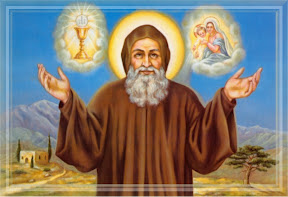
July 24, 2012 Tuesday: St. Sharbel Makhlouf

St. Sharbel Makhlouf


Joseph Makhlouf was born in Lebanon in 1828. He was from a poor family, and his father died when Joseph was very young. Joseph and his brothers and sisters were raised by their mother and an uncle. Their upbringing was very devout, and they learned to understand and love their faith. Joseph was an altar server, and he sang in the church choir. Joseph’s job was to take care of the sheep, and he spent his time alone in prayer and meditation.

Two of Joseph’s other uncles were monks, and he liked to visit them in order to imitate their way of life. When he was twenty-three, he entered a monastery himself, taking the name Sharbel (or Charbel). As a monk, he studied theology and philosophy. He was ordained a priest, and lived a life of prayer, penance, and hard work. This was just what he wanted, and he was very happy.

In 1866, Sharbel moved to a small hermitage in order to live a life of even greater solitude. He felt God was calling him closer by this type of life. He lived in his little room for twenty-three years, devoting most of his time to prayer, especially the Mass. Even though he hid himself away, many people were led to him to ask for spiritual advice and prayers.

In 1898, Sharbel had a stroke while he was celebrating Mass. He was brought back to his room without being able to finish the Mass. He died eight days later, on Christmas Eve. His grave became a place of pilgrimage, and in 1950 there were about 15,000 people coming to the spot every day! Sharbel was canonized by Pope Paul VI in 1977
-Daughters of St. Paul

Monday, July 23, 2012

July 23, 2012 Monday: St. Bridget of Sweden


St Bridget's Revelations have a very varied content and style. At times the revelations are presented in the form of dialogues between the divine Persons, the Virgin, the Saints and even demons; they are dialogues in which Bridget also takes part. At other times, instead, a specific vision is described; and in yet others what the Virgin Mary reveals to her concerning the life and mysteries of the Son. The value of St Bridget's Revelations, sometimes the object of criticism Venerable John Paul II explained in his Letter Spes Aedificandi: “The Church, which recognized Bridget's holiness without ever pronouncing on her individual revelations, has accepted the overall authenticity of her interior experience” (n. 5). Indeed, reading these Revelations challenges us on many important topics. For example, the description of Christ's Passion, with very realistic details, frequently recurs. Bridget always had a special devotion to Christ's Passion, contemplating in it God's infinite love for human beings. She boldly places these words on the lips of the Lord who speaks to her: “O my friends, I love my sheep so tenderly that were it possible I would die many other times for each one of them that same death I suffered for the redemption of all” (Revelationes, Book I, c. 59). The sorrowful motherhood of Mary, which made her Mediatrix and Mother of Mercy, is also a subject that recurs frequently in the Revelations.
-Pope Benedict XVI on St. Bridget of Sweden

From Revelation of St. Bridget of Sweden (Ch. 4)
“I showed you three things from which you could recognize the good spirit: I invited you to honor your God, who made you and gave you all the good things you have; your reason also tells you to honor him above all things. I further invited you to keep the true faith, that is, to believe that nothing has been created without God nor may be made without God. I also invited you to love reasonable work and continence in all things, for the world was created for man’s sake, in order that he may use it according to his reasonable needs, and not in excess.

In the same way, you may also recognize the unclean spirit, the devil, from three opposing things: He tempts and advises you to seek and desire your own praise, and to be proud of the things given you. He also tempts you into unbelief and intemperance in all your limbs and in all things, and makes your heart inflamed by them. Sometimes he also deceives men under the guise of a good spirit. This is why I commanded you to always examine your conscience and reveal it to spiritual men of wisdom!

Therefore, do not doubt that the good spirit of God is with you when you desire nothing but God and are completely inflamed by him! Only I can do this, and it is impossible for the devil to come near you then. He also cannot come near to any evil man unless I allow it, either because of his sins, or some secret judgment that is known only to me. For he is my creature like all other things - he was created good by me, but made himself evil by his own malice – therefore, I am Lord over him.

Saturday, July 21, 2012

Prayer to Heavenly Father amid recent violence

Heavenly Father, you have given us the gift of life and created all people in your image. These days we see many acts of violence and hatred that harm our brothers and sisters in Christ, acts of violence that often result in the loss of life.  We stand this day united in prayer with those families in Colorado who mourn the loss of family members. We know, Father, that you call for us to live in peace and love, and we cannot comprehend what occurred in Colorado.  We must confess that we often contribute to violence when we give into hatred, fear, indifference and self-satisfaction. Help us, Father, to overcome these actions as we grow in our love for you, so that we may always value life over possessions.  We desire to follow your son, our lord and savior, to bring your love to all whom we meet.  We ask this through Christ our Lord. Amen

Friday, July 20, 2012

July 22, 2012: 16th Sunday in Ordinary Time (B)


Most of us look forward to weekends, but how many of us are busier on weekends than on weekdays? If someone were to ask you this weekend, "Come away by yourself to a deserted place and rest awhile," would you say, “yes”? I asked a friend if he would be able to say yes, and his response was, ‘is there a 55-inch television and a Walmart?’ Sometimes our lives are so demanding and spread so thin that we barely have time to sit down and have a meal. At the rectory, Deacon Joe takes his time carefully slicing his food to cook it in a skillet. Meanwhile, I whip into the kitchen and put veggies and fruits in a blender and drink my breakfast, lunch, and dinner in less than 5 minutes. I’m guilty of not taking time to sit down and savor the food I drink.

In the Gospel today, Jesus asks his busy disciples to come away by themselves to a deserted place and rest awhile. I find this an interesting request. When I was working as an engineer, working past the normal 40-hour workweek was seen as a virtue. You would think that God would appreciate us more if we used all hours of the week to do His work, but that’s not how Jesus wants it. He wants us to be at a place, even if it is our own home, to withdraw from the world to enjoy special intimacy with Him. There, Jesus desires to give us rest.   

To be sure, the rhythm of our life dedicated to work, family, church, and community ought to alternate between periods of intense labor and periods of simply being with Jesus. We can imagine that at the time when Jesus was forming his disciples, he took time with each disciple to listen to the reports of their successes and failures, to encourage, counsel, and redirect them where necessary. The temptation for all of us is to get so caught up in the busyness of our lives that we repeatedly ignore the need for prayer, rest, and stillness in God’s presence. When that happens, it is all too easy to begin imperceptibly substituting our own agenda for Our Lord’s. We know that apart from Him we can do nothing.  We cannot carry out the Lord’s work except in His strength, and we cannot be renewed in that strength except by waiting in His presence.   

Mother Teresa explains Jesus’ instruction to us in this way.
We cannot put ourselves directly in the presence of God if we do not practice internal and external silence. In silence we will find new energy and true unity. Silence gives us a new outlook on everything. The essential thing is not what we say but what God says to us and through us. In that silence, He will listen to us; there He will speak to our soul, and there we will hear His voice. Listen in silence because if your heart is full of other things you cannot hear the voice of God. But when you have listened to the voice of God in the stillness of your heart, then your heart is filled with God.


When I visit Mother Teresa sisters at their convent at St. Agnes Church in Baton Rouge, I notice that they spend one hour in the morning for prayer, one hour in the evening for prayer, as well as praying the rosary all throughout their day. Seeing how much they pray, I feel guilty for not spending enough time away being with Jesus. I walk in the morning while praying the Rosary, Chaplet of Divine Mercy, and Morning Prayer, but I do not spend enough time during the day just simply sitting and listening for Jesus’ encouragements and desires for me. I wish that just like the people in the Gospel who hastened on foot from all the towns to follow Jesus wherever he traveled, I would have that same desire to be with Jesus especially at times when I offer excuses that I’m too busy for Him. Perhaps we should all long for that desire.

July 20, 2012 Friday: 15th Week in Ordinary Time

"You have folded up my life, like a weaver Who severs the last thread. Those live whom the LORD protects; Yours is the life of my spirit. You have given me health and life."


Father, you created me and put me on earth for a purpose.

Jesus you died for me and called me to complete your work.

Holy Spirit, you help me carry out the work for which I was created and called.

In your presence and name, Father, Son, and Holy Spirit, may all my thoughts and inspirations have their origin in you and be directed to your greater honor and glory.

Thursday, July 19, 2012

July 19, 2012 Thursday: 15th Week in Ordinary Week

"Learn from me, for I am meek and humble of heart"

To become holy we need humility and prayer. Jesus taught us how to pray, and He also told us to learn from Him to be meek and humble of heart.

Neither of these can we do unless we know what silence is. Both humility and prayer grow from an ear, mind, and tongue that have lived in silence with God, for in the silence of the heart God speaks. Let us really take the trouble to learn the lesson of holiness from Jesus, whose heart was meek and humble. The first lesson from this heart is an examination of our conscience, and the rest - love and service - follow at once. Examination is not our work alone, but a partnership between us and Jesus. We should not waste our time in useless looks at our own miseries, but should lift our hearts to God and let His light enlighten us. If you are humble, nothing will touch you, neither praise nor disgrace, because you know what you are. If you are blamed, you won't be discouraged; if anyone calls you a saint, you won't put yourself on a pedestal. If you are a saint, thank God; if you are a sinner, don't remain one. Christ tells us to aim very high, not to be like Abraham or David or any of the saints, but to be like our heavenly Father (Mt 5,48). “You did not choose me, but I chose you” (Jn 15,16).
-Mother Teresa

Wednesday, July 18, 2012

July 18, 2012 Wednesday: 15th Week in Ordinary Time

"You have revealed them to the childlike"

“I give praise to you,” Jesus says, “because you have hidden these things from the wise and learned.” What? Is he glad at the loss of those who don't believe in him? Certainly not. How wonderful are God's designs for people's salvation! When they turn away from the truth and refuse to accept it, God never forces them but lets them be. Their wandering away stimulates them to find the path again. Returning to their senses, they hastily seek out the
grace of the call to faith they had rejected before. As for those who had remained faithful, their devotion becomes even stronger like this. So Christ is glad these things are revealed to some but saddened they are hidden from others. This is made known when he weeps over the city (Lk 19,41). Saint Paul writes in the same spirit: “Thanks be to God! You were once slaves of sin but you have become obedient from the heart” to the Gospel (Rom 6,17)...Who are the wise Jesus is talking about here? The scribes and the Pharisees. He says this to hearten his disciples by showing
them of what privileges they have been accounted worthy. Simple fishermen that they are, they have received the illumination that the wise and learned despised. These latter are wise in name only; they think themselves wise but are false scholars. That is why Christ did not say: “You have revealed them to the ignorant” but to “the childlike”, that is to say, simple, honest people... In this way he teaches us to utterly renounce
important things and seek out simplicity. Saint Paul goes even further: “If anyone considers himself wise in this age, let him become a fool so as to
become wise” (1Cor 3,18).

- Saint John Chrysostom (c.345-407), priest at Antioch then Bishop of Constantinople, Doctor of the Church Sermons on Saint Matthew's Gospel, no.38, 1

From www.dailygospel.org


Monday, July 16, 2012

July 16, 2012 Monday: Our Lady of Mount Carmel


(Picture: Our Lady of Mt. Carmel in Stella Maris Carmelite Monastery, Israel)

The devotion to Our Lady of Mount Carmel means:
a special call to the interior life, which is preeminently a Marian life. Our Lady wants us to resemble her not only in our outward vesture but, far more, in heart and spirit. If we gaze into Mary's soul, we shall see that grace in her has flowered into a spiritual life of incalcuable wealth: a life of recollection, prayer, uninterrupted oblation to God, continual contact, and intimate union with him. Mary's soul is a sanctuary reserved for God alone, where no human creature has ever left its trace, where love and zeal for the glory of God and the salvation of mankind reign supreme. [...] Those who want to live their devotion to Our Lady of Mt. Carmel to the full must follow Mary into the depths of her interior life. Carmel is the symbol of the contemplative life, the life wholly dedicated to the quest for God, wholly orientated towards intimacy with God; and the one who has best realized this highest of ideals is Our Lady herself, 'Queen and Splendor of Carmel'." -Fr. Gabriel of St. Mary Magdalene de' Pazzi, OCD


(Picture: A view from Stella Maris Monastery, Haifa, Israel)


(Picture: Stella Maris Monastery, exterior)

Friday, July 13, 2012

July 15, 2012: 15th Sunday in Ordinary Time (B)

The other morning as I was driving toward St. Francis for 7AM mass, I noticed a guy walking along the street with his thumb out to get a ride somewhere. I’ve never hitchhiked, but it brought to mind what Jesuit novices are asked to do after they complete 8-months of religious life: a 30-day religious pilgrimage modeled after St. Ignatius of Loyola’s own pilgrimage to the Holy Land. Each novice is given a one-way bus ticket to a Catholic shrine and $35. Where the pilgrimage takes the novice after that is left up to God’s providence and the novice’s prayer. The novices are told to fend for themselves until they return a month later. St. Ignatius foresaw that this month-long pilgrimage without much money would require the novice to beg for food, lodging, and transportation in order to grow accustomed to discomfort in food and lodging. By abandoning all the reliance on money or other created things, the hope is that the novice will grow in his faith and intense love for God and place his reliance entirely in his Creator and Lord.
 
When Our Lord sends out his disciples two-by-two and instructs them “to take nothing for the journey...no food, no sack, no money, no second set of clothes,” it sounds difficult for us who have grown accustomed to air conditioned housing and well-stocked refrigerators. How many of us would travel away from home without at least one credit card, large suitcase, toiletries, electronic gadgets, and several days change of clothes? Beginning with this weekend, the youth groups from St. Aloysius and St. George parishes in Baton Rouge will practice exactly what Jesus commanded his disciples in today’s gospel. During the entire week, they will be living out of their backpacks in the parish hall of Our Lady of Peace Church in Vacherie for their annual mission experience. The students and chaperones will be bathing at parishioner’s homes, eating food cooked by local parishioners, and going out to jobsites where they will help paint or repair the homes of those who qualified for assistance.
    
Why does Jesus command such difficult instructions, to go about our life not seeking comfort or relying on created things? For one thing, Jesus is not asking us to do something that he himself had not already done. He arrived on this earth empty handed, he ministered empty handed, and he departed this Earth empty handed. His hands were empty, but his heart was full of love and trust in His Father. In the Second Reading, St. Paul tells us how truly blessed we are. He said, “Blessed be the God and Father of our Lord Jesus Christ, who has blessed us in Christ with every spiritual blessing in the heavens, as he chose us in him, before the foundation of the world... In him we have redemption by his blood, the forgiveness of transgressions, in accord with the riches of his grace that he lavished upon us.”

On that 30-day pilgrimage with $35 in their pockets, the Jesuit novices learn that they must turn their hearts in total commitment to the Father. As they beg for food, lodging, and transportation on their journey back over a thousand miles to their starting point, they realize that Heavenly Father has given them all that they have, beginning with life itself. Their short-term pilgrimage is a perfect metaphor for our life on earth. Each of us have been chosen by Heavenly Father and placed on this earth with all the blessings of heaven. Some of us may have more worldly means than others, but the blessings of heaven, which are priceless, are given equally to all. The Father’s plan for us is simple, that we, as His children and servants, must love and be love. We must empty our hands and hearts of all things that keep us from loving the Father first and foremost, and do what is His will for our lives. Many of us will say that this is not easy, just as a 30-day pilgrimage with $35 is not easy. But it will be easy, if love is at the center.

July 13, 2012 Friday: 14th Week in Ordinary Time


A Time to Receive and a Time to Give

It is important to know when we can give attention and when we need attention.  Often we are inclined to give, give, and give without ever asking anything in return.  We may think that this is a sign of generosity or even heroism.  But it might be little else than a proud attitude that says:  "I don't need help from others.  I only want to give."  When we keep giving without receiving we burn out quickly.  Only when we pay careful attention to our own physical, emotional, mental, and spiritual needs can we be, and remain, joyful givers.

There is a time to give and a time to receive.  We need equal time for both if we want to live healthy lives.
-Fr. Henri Nouwen

Thursday, July 12, 2012

July 12, 2012 Thursday: 14th Week in Ordinary Time


Becoming Food For the World

When Jesus took bread, blessed it, broke it, and gave it to his disciples, he summarized in these gestures his own life.  Jesus is chosen from all eternity, blessed at his baptism in the Jordan River, broken on the cross, and given as bread to the world.  Being chosen, blessed, broken, and given is the sacred journey of the Son of God, Jesus the Christ.

When we take bread, bless it, break it, and give it with the words "This is the Body of Christ," we express our commitment to make our lives conform to the life of  Christ.  We too want to live as people chosen, blessed, and broken, and thus become food for the world.
-Fr. Henri Nouwen

Wednesday, July 11, 2012

July 11, 2012 Wednesday: St. Benedict

As you go, make this announcement: 'The reign of God is at hand!'”

People today put more trust in witnesses than in teachers, in
experience than in teaching, and in life and action than in theories. The witness of a Christian life is the first and irreplaceable form of mission: Christ, whose mission we continue, is the "witness" par excellence (Rev 1:5; 3:14) and the model of all Christian witness...

The first form of witness is the very life of the missionary, of the
Christian family, and of the ecclesial community, which reveal a new way of living. The missionary who, despite all his or her human limitations and defects, lives a simple life, taking Christ as the model, is a sign of God and of transcendent realities. But everyone in the Church, striving to imitate the Divine Master, can and must bear this kind of witness; in many cases it is the only possible way of being a missionary.

The evangelical witness which the world finds most appealing is that of concern for people, and of charity toward the poor, the weak and those who suffer. The complete generosity underlying this attitude and these actions stands in marked contrast to human selfishness. It raises precisequestions which lead to God and to the Gospel. A commitment to peace,justice, human rights and human promotion is also a witness to the Gospel when it is a sign of concern for persons and is directed toward integral
human development.

-Blessed John-Paul II, Pope from 1978 to 2005
Redemptoris Missio, 42

Monday, July 9, 2012

July 10, 2012 Tuesday: St. Veronica Giuliani

Veronica Giuliani receives the Stigmata


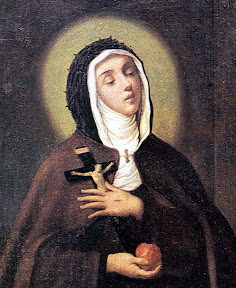
One day, while praying in her cell, Sister Veronica had a vision of Jesus. He was carrying His Cross on His Shoulder. He asked her, “What do you wish?” She replied, “That Cross and I wish it for You, for Your Love.” He took the Cross from His Shoulder and placed it on her shoulder. It was too heavy! She fell under the weight of it, and her Lord lifted her.
Still another time, Our Lord appeared to Veronica, covered with open sores, a Crown of Thorns on His Head. Blood spilled from His precious Body, as He said, “See what sinners have done to Me.” Veronica wrote in her Diary:
“Seeing the great agony that my Lord was in, I begged Him to give Me His Crown. He placed it on my head; I suffered so much, I thought I was dying.”
Another time, Jesus came and showed Veronica a Chalice full of liquid. She wrote that it seemed as if the liquid was on fire. The Lord told her, “If you want to be Mine, you must taste this liquid for My Love.” She later wrote that when He placed just a few drops of the liquid on her tongue, she was filled with such indescribable bitterness and sadness, she thought she would die. Her tongue became dry and from that day on, she could not taste anything.
On Christmas Day, the Infant Jesus appeared to Veronica. He sent an arrow deep into her heart. When she awakened, she found her heart bleeding. The burning flame roaring inside her heart was so painful, she could not rest day or night. He told her He wanted her heart to bear the marks of His Wound; He said, her heart had to feel the lance and her feet and hands, the nails He felt on the Cross.
Our Lord chose to make Veronica as much Himself as is possible, and what better way than to share His Passion with her. He had asked her many times what she wished, and she had replied, His Cross. Well on April 5, 1697, Veronica had a vision of Jesus Crucified, accompanied by His Mother Our Lady of Sorrows as she appeared at the foot of the Cross on Golgotha. Veronica’s heart, as with her Savior before her, was pierced. She experienced the crowning of thorns, the scourging, the crucifixion, her own death and that of Our Lord Jesus Christ.
Mother Abbess Mary Catherine told us that the other nuns could see the impressions of the crown of thorns on her head through her veil, the blood at times dripping from her eyes because of the deep wounds inflicted by the long sharp thorns. Sealed with this stigmata, Veronica's body became an indelible sign of the Lord’s total communion with her, one of everlasting unity and love. She wrote:
“In an instant, I saw five shining rays shooting out from His Wounds, coming towards me. I watched as they turned into little flames. Four of them (the flames) contained the nails, and the fifth one contained the lance, golden and all aflame, and it pierced my heart. The nails pierced my hands and feet.”
Veronica took the crucifix off the wall in her cell and embraced it saying:
“My Lord, pains with pains, thorns with thorns, sores with sores, here I am all Yours, crucified with You, crowned with thorns with You, wounded with You.”
Veronica takes up the Cross
Veronica received the stigmata. Now it was time for her to take up the Cross! She could not help Jesus carry His Cross, that dark and infamous day He walked to Calvary. He had told her, she would be the bride of the Crucified Savior. Now to be completely one with Him as His bride, in imitation of her Spouse, she would carry her cross each evening. At those times she would wear a robe, lined with sharp long thorns which pierced her body, especially doing damage to the shoulder upon which she carried the cross.13
Laden down by the weight of the cross, she staggered as she tried to maintain her balance. She would walk through the monastery’s orchard or within the monastery itself until she was to the point of collapse. When she completed her Way of the Cross, she would then climb up many steps to a painting, in the convent, of St. Francis receiving the stigmata, where she would flagellate herself. At other times, she would levitate up into the tree in the cloister gardens, the other nuns saying she looked like a little bird in flight.
At times Veronica would take a very heavy log and carry it across her shoulders as a cross beam to reenact more authentically Our Lord carrying the cross to Calvary. There are crosses there till today, which the nuns carry on Good Friday.
Our dear Lord asked Veronica to fast for three years. Upon receiving permission from her Superior, she fasted for the next three years on bread and water alone.

-Bob & Penny Lord

July 9, 2012 Monday: 14th Week in Ordinary Time


"Your faith has saved you"

Faith is that which makes us believe from the depths of our souls... all
the truths that our religion teaches us, all that the Gospel holds and all
that the Church sets before us. The just man lives truly by this faith (Rom
1,17), for it replaces for him the greater part of his natural senses. It
so transforms all things that the senses are of little use to the soul,
which through them is only deceived whilst faith shews it realities. Where
the eye sees but a poor man, faith sees Jesus (Mt 25,40). Where the ear
hears curses and persecution, faith sings: “Rejoice and be glad” (cf Mt
5,12). The touch feels only blows and stonings, but faith says: “Be glad
you are deemed worthy to suffer for the name of Christ” (cf. Acts 5,41)...
The smell perceives only incense; faith tells us that the true incense is
“the prayers of the saints” (Rv 8,4).The senses lead us astray to created
beauty; faith thinks of the eternal beauty and despises all created things,
for they are as nothing and as dust beside that beauty. The senses hold
pain in horror; faith blesses it as a marriage crown that unites it to its
Beloved, like a walk with her Bridegroom hand in divine hand. The senses
rebel against injuries, but faith blesses them: “Bless those that curse
you” (Lk 6,28)...; she finds them sweet, for in them she shares the lot of
Jesus. The senses are full of curiosity; faith is content to know nothing:
she thirsts to bury herself, and longs to pass her life motionless before
the Tabernacle.

By Blessed Charles de Foucauld (1858-1916), hermit and missionary in the Sahara
Retreat at Nazareth 1897 (trans. Charlotte Balfour, 1930 rev.)

From www.dailygospel.org

Saturday, July 7, 2012

July 8, 2012: 14th Sunday in Ordinary Time (B)


How many of you are comfortable speaking in front of a large group of people? It is said that one of the top fears that people have is public speaking. Many people who fear speaking in front of groups simply avoid it or spend sleepless nights ahead of the dreaded event. Those of you who watched the movie, “King’s Speech” will remember the scene when Prince Albert gives a closing speech at British Empire Exhibition at Wembley Stadium. As the crowd is expecting a smooth flow of words, Prince Albert’s speech is disrupted by involuntary repetitions and long awkward silent pauses. For Prince Albert and later King George VI, the fear of public speaking and his stuttering were his ‘thorn in the flesh’ that St. Paul talks about today in the Second Reading. This thorn however, had deeper roots, as his speech therapist Lionel Logue discovered; the King had many painful thorns from his childhood suffering that contributed to his lack of confidence, self-imposed isolation, shame, and anxiety.
How many of us can identify with a thorn in the flesh that causes in us suffering? It can be a physical, mental, or emotional kind. A thorn could also be a habit or addiction that keeps us from living a full, joyful life. Many of us do what St. Paul did in the Second Reading; he said, “Three times I begged the Lord about this, that it might leave me.” I wonder if St. Paul asked God only three times, or constantly as we do when pleading. St. Paul received an enigmatic answer from God; "My grace is sufficient for you, for power is made perfect in weakness." How can God leave us in our suffering and say that His power is made perfect in our weakness? Why would God allow us to suffer in our state instead of taking the thorn away so that we may have a more pleasant time? Perhaps in the prayer that Jesus made to the Father in the Garden of Gethsemane offers us an insight.
Right before he was arrested, Jesus took Peter, James, and John along with him to the Garden and he began to be sorrowful and troubled. Then he said to them, “My soul is overwhelmed with sorrow to the point of death. Stay here and keep watch with me.” We disciples are privileged in a certain sense to be invited by Jesus to accompany Him to the Garden of Agony. When we go through suffering because of our “thorn in the flesh,” we are placed right there in that Garden, where Jesus personally asks us to watch and pray. Why does he ask that of us? He says because we may fall into temptation without watching and praying. Right before our eyes, Jesus falls to the ground and prays, “My Father, if it is possible, may this cup be taken from me. Yet not as I will, but as you will.” When Jesus returns to the disciples after praying, he finds them sleeping. And he asks them, “Could you not keep watch with me for one hour?” How many of us in the face of suffering tell God, “God, why me and how long is this going to last?” That hour that Jesus asks of us is the hour where we will learn how Jesus in the midst of suffering placed all his trust in his Father, no matter the outcome. In that hour, we will learn that somehow our suffering is alleviating the suffering of our loved ones, just as Jesus’ suffering alleviated all the sufferings of his Father’s children.

St. Paul learned this secret through his “thorn in the flesh.” That’s why he said, “I will rather boast most gladly of my weaknesses, in order that the power of Christ may dwell with me. Therefore, I am content with weaknesses, insults, hardships, persecutions, and constraints, for the sake of Christ; for when I am weak, then I am strong.” What would have happened had Prince Albert decided that he could not become the King of England because his stuttering and fear of public speaking would have caused too much suffering? He would not have been there for his nation as a king to lead England through Hitler’s aggression during World War II. The temptation during suffering is to give up our vocation or the path that God sets out for us. That’s why Jesus teaches us, lest we fall into temptation, to watch and to pray with him during our suffering. If we follow the Father’s will, we emerge with greater trust in the Heavenly Father and greater appreciation of how our suffering mystically alleviates the suffering of our loved ones.

Friday, July 6, 2012

July 6, 2012 Friday: 13th Week in Ordinary Time

Jesus' mission? to us losers


Jesus said, "People who are well don't need a doctor; but the sick do. So too I came to call sinners. " Matthew 9:12-13

Presidential aide, Charles Colson, was imprisoned for his role in the Watergate scandal. Speaking to
900 prisoners in Atlanta, he said:

"Jesus Christ came into this world for the poor, the sick, the hungry, the homeless, the imprisoned. He is the Prophet of the loser. And all of us here are losers. I am a loser just like all of you. The miracle is that God's message is specifically for all of us who have failed." Once out of prison, Colson set up the Prison Fellowship Program, that involves 1200 volunteers who reach out to help prisoners and their families.

How might I help Jesus reach out to those for whom he came.

-Fr. Mark Link, www.staygreat.com

I am truly poor, not when I have nothing, but when I do nothing. Anonymous

Thursday, July 5, 2012

July 5, 2012 Thursday: 13th Week in Ordinary Time


On all sides the crowd is pressing him yet he is in no hurry to work a visible miracle by healing the external paralysis of this man... He begins with an invisible miracle by healing the
man's soul. This kind of healing is far more beneficial for him and,
outwardly speaking, less glorious for Christ. -St. John Chrysostom

The perfect love of our heavenly Father includes as well as transcends all the love that a father and mother can have for their children. We may think about the two hands of God embracing us as a mother's hand and a father's hand: one caressing, consoling, and comforting, the other supporting, encouraging, and empowering. We too are called to be father and mother to those who want to come home.
-Fr. Henri Nouwen

Wednesday, July 4, 2012

July 4, 2012 Wednesday: Independence Day

Declaration of Independence


"We hold these truths to be self-evident, that all men are created equal, that they are endowed by their Creator with certain unalienable Rights, that among these are Life, Liberty and the pursuit of Happiness." - Thomas Jefferson & Declaration of Independence, 1776

As Christians we are called to analyze culture, and, aided by the Spirit, heal, elevate and purify those elements within it which run contrary to the Gospel. Given how far adrift America is, the restoration of her proper course is a daunting task. But regardless of the strength, duration and outcome of the storm in which we are immersed, as Christians, as men and women informed by the light of faith, we will not lose hope. As St. Teresa of Avila said, God alone suffices. Our hope does not rest on the passing form of this world (1 Cor. 7:31), but on the promises of Christ and the glorious future that awaits us, for "God is faithful, by whom you were called into the fellowship of his Son, Jesus Christ our Lord" (1 Cor. 1:9).

We are called to become, by faith in Christ, members of the divine family and thus enter into the invisible and other-worldly (Jn 18:36) fellowship of the kingdom of God. Jesus, as the door to eternal life (Jn 10:7-9), has opened the way to that divine kingdom. Life in Christ is a participation in God's own life and is therefore a substantially and qualitatively new way of living. Speaking of his salvific mission for humankind, Jesus said: "The thief comes only to steal and kill and destroy; I came that they may have life and have it abundantly" (Jn 10:10).

Abundant life! While Thomas Jefferson wrote of life, liberty and the pursuit of happiness in the context of throwing off a despotic British government in favor of an independent nation, Christ speaks of eternal realities which travel inconceivably beyond the temporal, and which will continue with an unending permanency guaranteed by God himself. We are brought forth from nothingness to life by Christ, sustained by Christ, and gifted with the potential to enjoy everlasting, divinely infused supernatural bliss by Christ's redemptive sacrifice on the cross. So long as we remain in Christ, we no longer simply pursue happiness, but rather it becomes an inalienable and eternal reality -- and this wondrous state of existence is available as God's gift to us here, right now, although its fullest dimension is attained only in the next life.

St. Paul wrote that "Eye has not seen, ear has not heard, nor has it so much as dawned on man what God has prepared for those who love him" (1 Cor. 2:9). Since the glorious state of our future as Christians far exceeds our understanding, there is little that can be definitively said about what awaits those who love God. The temptation, however, is to project our experience of the often meager happiness tasted here through contact with created objects onto the eternal "now" of heaven. That is, since the normal experience of earthly happiness is often so fleeting and unsatisfying, we tend to view the happiness of heaven through an unsatisfactory, temporal lens. Given that, we might not even be too sure we want to live forever!

"All you who are thirsty, come to the water! You who have no money, come, receive grain and eat; come, without paying and without cost, drink wine and milk!" ( Isaiah 55:1 ). The journey toward human fulfillment is found in Christ, whose love supplies both our strength and our thirst, for the Lamb is our shepherd who leads us to springs of living waters (Revelation 7:17 ).

-F. K. Bartels, www.catholic.org

Tuesday, July 3, 2012

July 3, 2012 Tuesday: St. Thomas, Apostle

Put your finger into the mark of the nails”,


Jesus said to Thomas. “You
were looking for me when I was not there; take advantage of it now that I am. I know what you are wanting to do in spite of your silence. Even before you tell me, I know what you are thinking. I heard what you said and, even though unseen, I was beside you, close to your doubts, and without
revealing myself I made you wait so that I could witness your impatience all the better. Put your finger into the mark of the nails; put your hand into my side; and do not be unbelieving, but believe.”Then Thomas touched
him. All his defiance fell away and, filled with sincere faith and all the love owing to God, he cried out: “My Lord and my God!” And the Lord said to him: “You have believed because you have seen me. Blessed are those who
have not seen and yet believe! Thomas, take the new of my resurrection to those who have not seen. Lead the whole world to belief, not at the evidence of its eyes but at your word. Go through peoples and pagan cities. Teach them to the carry the cross on their shoulders, not weapons... Tell them they are called by grace and, as for you, consider their faith: truly,
happy are those who have not seen and yet believe!”Such is the army the Lord has raised; these are the children of the baptismal pool, the works of grace, the harvest of the Spirit. They have followed Christ without having
seen him; they sought and they believed. They recognised with the eyes of faith, not of the body. They have not placed their fingers in the marks of the nails but have been fastened to his cross and embraced his sufferings.
They have not seen the Lord's side but, through grace, have been made one with his members and have made their own these words of the Lord: “Happy
are those who have not seen and have believed!”
-Saint Basil of Seleucia (?-c.468), bishop
Sermon for the Resurrection, 1-4
From www.dailygospel.org

Monday, July 2, 2012

July 2, 2012 Monday: 13th week in ordinary time

"The Son of Man has nowhere to rest his head"


Just as Jesus Christ was born poor so has he continued to live in poverty all his life – and not just poor but destitute, a “beggar”, according to the expression of Saint Paul (cf. 2Cor 8,9)... Jesus lived in poverty at Nazareth: “poor in dwelling, his furnishings few, such was the lodging of the world's Creator”. There he lived frugally, earning his bread by the sweat of his brow and at the cost of great weariness, just like a workman and the sons of workmen. For the rest, did not the Jews believe him to be, and call him “a carpenter, a carpenter's son”? (Mk 6,3; Mt 13,55). Afterwards he appeared publicly to preach the Gospel. During these last three years of his life, far from improving his means of support, he practiced an even more severe form of poverty, living only on donations. To one man, who wanted to follow him in the hope of living more comfortably, he replied: “Understand it well: foxes have holes and the birds of the air have their nests, but the Son of man has nowhere to lay his head”. Man, he was trying to say, if you count on finding a leisurely way of life by following after me, you are mistaken, for I have come on earth to teach poverty. With this intention I have become poorer than the foxes and the birds which, at the very least, have some shelter. But I haven't the least plot of ground belonging to me as my own where I might take my rest and it is my wish that my disciples should be like me...“A servant of Jesus Christ possesses nothing beyond Jesus Christ”, states Saint Jerome. He doesn't even desire to possess anything beyond Jesus. In a word, Jesus always lived
as a poor man, he also died poor. Wasn't it necessary for Joseph of
Arimathea to give him a tomb and for others to make him the gift of a linen shroud to wrap his body?
- Saint Alphonsus Maria de Liguori (1696-1787), Bishop and Doctor of the Church
8th Address for the Octave of Christmas

From www.dailygospel.org

July 1, 2012: 13th Sunday in Ordinary Time (B)