I marvel sometimes when I visit families with a son or a daughter who has a severe handicap. The parents are living each day, and sometimes the whole day, with little help or times of rest. They are not admired or honoured for what they are doing; sometimes they are even criticised for not having aborted their child or put him or her into an institution, outside the general run of society. We in l'Arche have days off; we get help and encouragement from professionals and clergy. We even receive salaries. And often people see us as wonderful and generous people. And yet, isn't it those families who are living love and truth and humility and abandonment to God in a special way? Isn't it all those families in the ghettos of large cities struggling to feed their children who are radiating a truth bout our humanity? People who have chosen to live in community have much to learn from all those people throughout the world who are living love in a simple hidden way, and who are there welcoming and forgiving.
We are all so impatient. We want everything and we want it now! We want happiness, fulfilment and life. It is normal to want such things. But we have to learn to respect the rhythm of our being. Look at the plants and animals, look at the vegetables and the fruit trees. It takes time to grow and to bear fruit. There are the summers of rich harvests, the autumns with rain and falling leaves, the grey and cold winters where life seems to have stopped and then there are springtimes when life is reborn.
It is the same with human life. We are like the fruit trees. We have been planted in the earth of our mother's being and we have grown. We are born, we developed in the sometimes rugged earth of our families. During our life, just as in the cycle of nature, seasons follow one another.
We can give people the gift of their dignity. We can help others just by the way we listen to them and speak with them. We can show them by our own trust that what they have to say is important and good. Community is caring for people, but of course as soon as we start caring for people, we know that there are some people who will just drive us up the wall. Some we will really like, because they think like us. Then we risk falling into a world of mutual flattery. We are all so much in need of affection that when somebody gives it to us we want to hold onto it.
...But flattery doesn't help anyone to grow. It doesn't bring freedom but rather closes people up in themselves. We are attracted to certain people, and others put us off. We don't get on well with them. They trigger off our anguish....Some people threaten us, others flatter us. Some meetings are joyful, and others are painful. When we begin talking about caring for people, then we begin to see how difficult it can be. In community we are called to care for each member of the community. We can choose our friends but we do not choose our brothers and sisters; they are given to us whether in family or in community.
-Jean Vanier, From Brokeness to Community, pp 37-38
To look forward, to want life, means we have to be willing to look backwards and become more conscious of all those who have hurt us, all that is broken in us and that has brought us inner deaths, hurts that we may have hidden and stifled. It means that we acknowledge the story of our origins, of our own lives, see and accept our brokenness and the times we also have hurt others. When we have accepted who we are and what we need in order to grow in compassion and peacemaking, we can move forward to give life. To forgive is a gift of God that permits us to let go of our past hurts.
Happiness is accepting and choosing life, not just submitting grudgingly to it. It comes when we choose to be who we are, to be ourselves, at this present moment of our lives; we choose life as it is, with all its joys, pain, and conflicts. Happiness is living and seeking the truth, together with others in community, and assuming responsibility for our lives and the lives of others. It is accepting the fact that we are not infinite, but can enter into a personal relationship with the Infinite, discovering the universal truth and justice that transcends all cultures: each person is unique and sacred. We are not just seeking to be what others want us to be or to conform to the expectations of family, friends, or local ways of being. We have chosen to be who we are, with all that is beautiful and broken in us. We do not slip away from life and live in a world of illusions, dreams, or nightmares. We become present to reality and to life so that we are free to live according to our personal conscience, our sacred sanctuary, where love resides within us and we see others as they are in the depth of their being. We are not letting the light of life within us be crushed, and we are not crushing it in others. On the contrary, all we want is for the light of others to shine.
I consider myself somewhat behind the times as far as keeping up with the latest movies. I have not been in theaters in a while, so I do not know how much the popcorn costs these days. Instead, I catch the movies through DVDs. The other day, I picked up a movie produced in 2004 called, "Five People You Meet in Heaven," that is based on the novel by Mitch Albom by the same title. The introduction was intriguing. It said, "This is a story about a man named Eddie and it begins at the end, with Eddie dying in the sun. It might seem strange to start a story with an ending. But all endings are also beginnings. We just don't know it at the time."
It is after Eddie dies and goes to 'Heaven' that he begins to understand what truly happened to him in his life on earth. One of the five persons Eddie meets says to him, "Each of us was in your life for a reason. You may not have known the reason at the time...there are no random acts...that we are all connected. That you can no more separate one life from another than you can separate a breeze from the wind."
Can you think of one person in your life that you have forgotten about, whom only later in your life you began to appreciate? I can think of my history teacher in high school. 21 years ago as a high school sophomore, I had crazy hair and crazy ideas. My history teacher was one person who remained after class to listen to my wild ideas, and she did so with patience and compassion. She listened as if I was important to her, as if what I had to say was important. Her kindness and gentleness opened my heart to her. I learned a great lesson from her: If you discover that somebody really loves you, really appreciates you, understands you, listens to you, then you begin to change. You come out from behind the barriers of fear you have constructed around your heart.(Jean Vanier)
The person who has touched us does not have to be that far from us in distance or in time. That person could be living right in our home, and somehow we could now have a wall between us that prevents us from being present or speaking to each other. We probably all agree that conflict can easily arise in our families. When we have conflict, we begin to shut off and find ourselves unable to encounter each other. Harboring anger inside is like a tall, impenetrable wall between two persons. On this wall is graffiti that reads, "You have nothing to bring me. I don't need you." In the movie, Eddie harbors a lot of anger, especially for his dad who was verbally and physically abusive. Eddie blamed most of the unhappy moments in his life on his dad. How many of us can think of a person in our life whom we blame for many of our miseries and sufferings? We all have a person or two. In the movie, Eddie encounters a person in Heaven who helps to open his eyes to the strong anger and hatred he nurtured inside for many years. She said, "Eddie, holding anger is a poison...It eats you from inside...We think that by hating someone we hurt them...But hatred is a curved blade...and the harm we do to others...we also do to ourselves."
The wall we construct can be also between God and our self. I have encountered many people who are angry with God and blame God for the sufferings in their life. We may find ourselves like the Samaritan woman who Jesus encounters at the well. She has been through many broken relationships and she knows that the town folk do not look upon her favorably. She may even believe that God is the same way with her. Yet, she finds it puzzling that this man named Jesus sits and listens to her and says something about giving her the kind of water that she will no longer thirst anymore. His kindness opens her heart to the possibility that God could care about even a woman like her, that God could love her. This same God chooses to sit here in this church among us to listen with compassion.
Once we begin to see that Jesus is the patient, kind, gentle, and compassionate One who is always listening, then our hearts open up to God, and we begin to understand what St. Paul said to the Romans today. "And hope does not disappoint, because the love of God has been poured out into our hearts through the Holy Spirit who has been given to us. For Christ, while we were still helpless, died at the appointed time for the ungodly. Indeed, only with difficulty does one die for a just person, though perhaps for a good person one might even find courage to die. But God proves his love for us in that while we were still sinners Christ died for us." (Romans 5:5-8) How can we be angry with God who proves his love by the most loving act of sacrifice of Jesus? The wall that we build between God and ourselves, Jesus takes away by his love. When you discover that God really loves you, really appreciates you, understands you, listens to you, then you begin to change, and you come out from behind the barriers of fear that you have constructed around your heart.
"It was an accident." I hear some couples say about an 'unplanned pregnancy'. We know that there can never be a conception and birth without love. Without that profound embrace between a father and a mother, there can never result a beautiful child who is the "flesh of my flesh, bone of my bone" of his parents. Love begets love, and once arrived this little 'love' smiles back and cries after mommy and daddy. The parents may not have directly planned for a child, but the child is eventually accepted and loved by the parents.
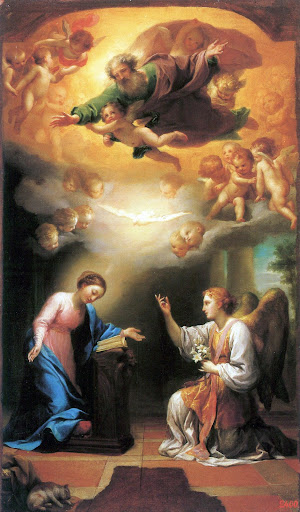
In the Annunciation of Our Lord where Archangel Gabriel announced to Blessed Virgin Mary that she will conceive a child by the power of the Holy Spirit, it took love to beget love. It wasn't the limited embrace of a human father and a human mother, but an infinite Love embracing a frail human woman; yet this frail woman was different. She trusted like no other human person did in the history of mankind, trusting the God who was embracing her. Heaven knew that she was different. Archangel Gabriel addressed her not by her name, but by whom she was, "Hail, full of grace." She fully embraced the infinite Love who not only willed this child Jesus, but also the plans for her life to be a gift to the rest of humanity. People throughout history would cry out to her, "Hail Holy Queen, Mother of Mercy, our life, our sweetness, and our hope." She, being embraced by this infinite Love, shares with others this Love she has received.
Mother Teresa states it beautifully. She said, "Mary, in the mystery of her annunciation and visitation, is the very model of the way we should live, because first she received Jesus in her life; then what she had received, she had to share. In every Holy Communion, Jesus the Word becomes flesh in our life--a special, delicate, beautiful gift of God."
We, who are embraced by this same infinite Love at every Communion, are asked to do the same, to share with others this Love we have received.
from Show Me the Way: Daily Lenten Readings by Fr. Henri Nouwen
It is not so difficult to see that, in our particular world, we all have a strong desire to accomplish something. When we start being too impressed by the results of our work, we slowly come to the erroneous conviction that life is one large scoreboard where someone is listing the points to measure our worth. And before we are fully aware it, we have sold our soul to the many grade-givers. That means we are not only in the world, but also of the world. Then we become what the world makes us. We are intelligent because someone gives us a high grade. We are helpful because someone says thanks. We are likable because someone likes us. And we are important because someone considers us indispensable. In short, we are worthwhile because we have successes.
When we cling to the results of our actions as our only way of self-identification, then we become possessive and defensive and tend to look at our fellow human beings more as enemies to be kept at a distance than as friends with whom we share the gifts of life.
In solitude we can slowly unmask the illusion of our possessiveness and discover in the center of our own self that we are not what we can conquer, but what is given to us. In solitude we can listen to the voice of him who spoke to us before we could speak a word, who healed us before we could make any gesture to help, and who loved us long before we could give love to anyone. It is in this solitude that we discover that being is more important than having, and that we are worth more than the result of our efforts. In solitude we discover that our life is not a possession to be defended, but a gift to be shared.
In solitude we become aware that our worth is not the same as our usefulness.
Do you know what sin is? It's when there is a barrier between you and me. Between me and God, between me and myself. It is a wall, a wall so that we cannot speak to each other. We don't encounter others, because we are so certain that we are right; 'You have nothing to bring me. I don't need you.'
John the Baptist sees Jesus and says here is the Lamb of God who takes away this terrible barrier, which prevents us meeting ourselves, meeting the other, meeting truth and meeting God. And the first words of Jesus in this Gospel, as he turns around are, 'What are you looking for? What do you want?' (John 1:38) 'What is deepest within you? Where is your desire, your thirst, your hope? Jesus doesn't tell people what to do. He asks them a question. 'What are you seeking as you follow me?'
We have to begin to look at the places of conflict, but that isn't easy. Think how quickly conflict can arise inside a family and how people just shut off, living together without any communication, frightened of communication, frightened of announcing, even frightened of speaking to children!
We must listen to each other because that's where it all begins. We are losing what I would call the 'sacred space of listening.' To be people of peace we have to be at peace in ourselves and to be at peace in ourselves is not just being quiet, it is finding that unity in ourselves between head and heart.
Forgiveness is a long road. It is based on the knowledge that each person is important, that each person is precious, that each person can change, that I can change and you can change.
If you discover that somebody really loves you, really appreciates you, understands you, listens to you, then you begin to change. You come out from behind the barriers of fear you have constructed around your heart.
While I was greeting people after one of the weekend masses, a couple with a tiny newborn baby boy stopped to speak with me. The little boy’s name is Andrew, and he was sleeping contently, embraced securely in loving arms. At that time, this infant did not have a permanent home. This baby had been taken in by the state's adoption agency and it was in the process of seeking a family for the baby. Meanwhile, this couple had become his temporary family, and he was staying in a home that was rich in mercy. For the past few years, this couple has volunteered to be temporary surrogates for the State and they have taken care of more than ten children like Andrew. Their hearts are filled with compassion for these children. They understand through their experiences what Pope John Paul II wrote in his encyclical Rich in Mercy: As Jesus taught in the Beatitudes, "Blessed are the merciful, for they shall obtain mercy," he demanded of the people the same love and mercy as a condition of mercy.
How can we grasp what mercy is? In the Old Testament, mercy is described as the tender love of a mother and also as the heart's womb. Mercy is described as more powerful and more profound than justice. Jesus powerfully describes this tender love of a mother through a Parable of a Prodigal Son. Many have said that this is really a Parable of the Prodigal Sons' (plural) Father. The younger son had no love for his father, alienated himself from the father, and fell into deep sin. The older son had no love for his father but stayed at home with the proper appearances of obedience, yet without love. Yet their father was rich in mercy for both sons. The father's heart was moved with tenderness and patience for the younger son who in his selfishness squandered all his inheritance, as well as for the older son who demanded merit and reward. As the Pope John Paul points out, each of us in each age is the prodigal son. How many people have I encountered in my office or in the confessional who have said to me, how can God love me when I did such horrible things? The lesson of the Prodigal Son for all of us is that we are the beloved of the Father, and the Father is always waiting; His love for us is transformed into mercy, to restore us to value, and to draw good from evil.
The other day, I went to the church early in the morning, genuflected, and sat down in a pew. As I was hurrying to say my morning prayer, I noticed the face of agony on the Jesus on the cross. I asked, "Jesus, why do you suffer so much on the cross?" Really, the question was, "Jesus, why do you love me so much?" John Paul said in the Encyclical, "The Cross is the final word of Christ’s messianic mission, speaking unceasingly of God the Father as merciful...Believing in the crucified Son is believing in love present in the world." I wondered to myself, how long did it take for me to see the Cross and realize that God was expressing His total love for me? Certainly it was not when I was in high school or college when I abandoned all the rich treasures and grace of my Catholic faith. I can identify with the younger prodigal son who squandered all the wealth, for I did the same with my faith. The treasure I had before throwing it away were the words that Heavenly Father spoke to me, "You are the Beloved, on you my favor rests." Once that treasure was thrown away, the trash of the world began to fill the void.
This trash reeked of darkness, and while in this darkness I heard, "You are no good, you are ugly; you are worthless; you are despicable, you are no body--unless you can prove the opposite." The great temptation of self-rejection takes hold--"Prove that you are worth something; do something relevant, spectacular, or powerful, and then you will earn the love you so desire." Yet John Paul wrote, "The Cross is the radical revelation of mercy." It is from the Cross that Heavenly Father speaks tenderly, "I have called you by name, from the very beginning. You are mine and I am yours. You are my Beloved. I have molded you in the depths of the earth and knitted you together in your mother's womb. I have carved you in the palms of my hands and hidden you in the shadow of my embrace. I look at you with infinite tenderness and care for you with a care more intimate than that of a mother for her child. I have counted every hair on your head and guided you at every step...I have offered my very life for you so that you may have life and have it abundantly." This is the Father whom I encountered when I rediscovered my faith -- a Father rich in mercy.
Little baby Andrew who greeted me after mass may not know for a long time anything about his biological father or mother. However, what he knows now through the loving arms of the couple that cares for him is that he is a Beloved child of God -- a beloved child from the very moment of his creation. That is the power of God's mercy.
"Hear the word of the Lord...'Wash, make yourselves clean...cease to do evil, learn
to do good, search for justice, help the oppressed, be just to the orphan, plead
for the widow.'" (Isaiah 1)
Discipline follows from being a disciple. It is our effort to do as our Master does.
Jesus gave space for the Father to give him what he needed. When you and I are fearful
and anxious, we want to take control of our lives...When we follow Jesus we practice
a discipline that gives space to let the Father touch us, forgive us and receive us.
A couple of days ago, I was in the DVD aisle at WalMart, and I noticed a DVD with a red cover entitled The Robe. On the cover, it was noted that it was a movie made in 1953 that won Academy Awards Best Picture. The cover description noted, "This inspiring story stars Richard Burton as Marcellus Gallio, a Roman centurion whose life is forever changed when he wins Christ's robe in a gambling game at the foot of the cross." My interest was piqued, so I purchased the DVD and began to watch it that afternoon.
Richard Burton, playing the role of a Roman military tribune named Marcellus, is assigned to the post in Jerusalem and he commands the unit that ultimately crucifies Jesus. His slave, Demetrius, encounters Jesus for the first time when he sees Jesus riding on a donkey into Jerusalem. Jesus stops and looks at Demetrius amid the crowds praising his entry into Jerusalem. Demetrius says to his fellow slave, "Did you see him? He stopped and looked at me. He looked at my eyes. Only his eyes spoke...I think he wants me to follow him." Later in the movie, Demetrius and his master are at Calvary. There Jesus is crucified, and the Roman soldiers gamble over Jesus' robe. Marcellus, wins the robe. As the thunder and earthquake shakes Calvary hill, Marcellus gets near Jesus on the cross, looks at him and hears, "Father, forgive them. They know not what they are doing." As Marcellus leans his hand on the cross, Jesus' blood drips onto his fingers. The blood causes Marcellus to have deep pangs of guilt and haunts him for a long period of time. Marcellus does not know why he is so troubled, but his slave Demetrius, who later becomes a Christian, pinpoints the problem for his master: "You're afraid, but you really don't know the reason why. You think it's his robe that made you ill. But it's your own conscience, your own decent shame. Even when you crucified him you felt it."
It is said that when you look into someone's eyes, you can see their soul. Most of the time, when I give Last Rites to people who are dying, they are at the edge of death. Their eyes are closed, their breaths are short, and they are usually unconscious. Earlier this week, though, I gave Last Rites to a woman in her 40's who was wide-awake and was able to communicate with me. She listened intently at my retelling of the accounts of persons who go through near-death experiences. I recounted how they saw Jesus, how He embraced them, and how they experienced the most profound unconditional love and peace. As I looked into her eyes as I was telling her this, I saw in her eyes awe, marvel, and great expectations. She was yearning to see the glory that awaited her when she was to see Jesus, eye to eye.
As I reflected on the account of the Transfiguration of Jesus in today's Gospel, I recalled her eyes, the eyes that were filled with awe and wonder. I know that for those who are about to die, the veil that separates them between this world and the next is thin. I wonder if she in some way saw the same glory that Peter, John, and James saw on that Mount of Transfiguration when they beheld Jesus, "And he was transfigured before them; his face shone like the sun and his clothes became white as light." I wonder if she heard the same words that the three heard from Heavenly Father, "This is my beloved Son, with whom I am well pleased; listen to him.” The look in her eyes told me that she was, in some mystical, way beholding the eyes of Jesus and hearing the loving words of Heavenly Father.
Later that day, I wondered, 'what keeps us from seeing those loving eyes and hearing the loving voice of the Father?' The answer was fear! Upon hearing the voice of the Father, Peter, James, and John were crouched in fear, with their eyes shielded away. It was Jesus who then touched them and said, “Rise, and do not be afraid.” And when the disciples raised their eyes, they saw no one else but Jesus alone. Our deepest fear is that our sins and failures are unforgivable. In the movie The Robe, Marcellus the Roman Tribune, encounters St. Peter. Peter invites Marcellus to join him and Demetrius as missionaries. Marcellus hesitates, and the following dialogue ensues:
Peter: Let me tell you of the burden I bear. Justus told the others I was steadfast. He didn't know. The night Jesus needed me most, I denied him... not once... but 3 times. I swore I never knew him. Now... Marcellus: [stammering, pointing to himself] I... crucified him. Peter: I know. Demetrius told me. Marcellus: [shocked] And you can forgive me? Peter:He forgave you from the cross. Can I do less? Now, is there anything stopping you? Can you become one of us? Marcellus: [new strength in his voice] From this day forward, I am enlisted in His service. I offer Him my fortune, my sword, and my life. And this I pledge to you on my honor as a Roman.
What sins and failures do we burden ourselves with, ones that we are afraid that they are unforgivable? Jesus spoke the words not just to the disciples up in the Mount of Transfiguration but to all of us as well. "Rise, and do not be afraid."
Gospel Portrait of St. Joseph
Throughout the first chapters of the Gospels of Luke and of Matthew, we come to know St. Joseph through his actions and through his silence. He is the just man chosen by God to care for the only two sinless humans in all of history: the Blessed Virgin Mary and her Divine Son, Jesus. The mere fact of his constant proximity to Jesus and Mary draws us to contemplate his virtues and to ask him to teach us how we can also keep our gaze always "on Jesus and Mary, on Mary and Jesus."
St. Joseph in the Liturgy of the Church and the Writings of the Popes
The feast of St. Joseph on March 19, which appears around the year 800 in a French Calendar, did not become widespread until the fourteenth or fifteenth century. There was a feast in honor of St. Joseph in the Roman Breviary published in 1482, but the first Mass celebrated in his honor at Rome was in 1505... In the East, however, the feast was celebrated as early as the fifth century according to the Coptic Calendar, but on a different date. In 1621 Pope Gregory XV made the feast of St. Joseph a holy day of obligation, but that is no longer universally observed.
Patron of the Universal Church
On December 8, 1870, by virtue of the decision of Blessed Pope Pius IX, the Sacred Congregation of Rites promulgated the decree Quemadmodum Deus, declaring St. Joseph the Patron of the Universal Church. In the following year, the Holy Father expanded on the meaning of this proclamation in his document Inclytum Patriarcham (1871). His successor, Pope Leo XIII, further developed the Church's understanding of the protection that St. Joseph could afford to the Church during times of great attack in Quamquam Pluries (1889) (English/Spanish). Redemptoris Custos (English/Spanish) was written on the occasion of the centenary of Pope Leo XIII's document.
Saints Devoted to Saint Joseph
Many saints and spiritual writers have been especially devoted to St. Joseph, those who first promoted the devotion include: St. Margaret of Cortona (1247-1297), St. Bridget of Sweden (1303-1373), St. Vincent Ferrer (1350-1419), and St. Bernardine of Siena (1380-1444)—whose sermon is used for the Office of Readings for March 19 (available on the Vatican website). Finally, the Carmelite friars recognized his feast and included it in the calendar of their Order in 1498. (Lodi, p.75) One of the greatest Carmelite saints, St. Teresa of Avila had great influence in further promoting the devotion to St. Joseph.
"I wish I could persuade everyone to be devoted to this glorious saint [St. Joseph], for I have great experience of the blessings which he can obtain from God." -St. Teresa of Avila, (Autobiography, Chapter 6)
During a period of great illness in her young adult life, she turned her focus to the "heavenly doctors." Through the intercession of St. Joseph, she was "delivered...both from this trouble and also from other and greater troubles concerning my honor and the loss of my soul, and that he gave me greater blessings than I could ask of him. " Her devotion to glorious St. Joseph was promulgated throughout the many Carmels she established as part of the reform.
In Louisiana
St. Joseph's Day altars began as a custom brought to New Orleans by Sicilian immigrants. The tradition of building the altar to St. Joseph began as far back as the Middle Ages in gratitude to St. Joseph for answering prayers for deliverance from famine. The families of farmers and fisherman built altars in their homes to share their good fortune with others in need. The tradition grew to a more public event on St. Joseph's Feast Day on March 19. Today the individuals who work on the altars are fulfilling their own promises to St. Joseph "to share their blessings with those in need." Without exception, the altar workers explained that they contributed to the altars not for their own purposes but 'for St. Joseph' or for a family member or friend.
One tradition entails begging for the supplies to build the altar. The altar must not incur "any expense nor any personal financial gain." As an act of devotion to St. Joseph, supplicants would promise to build an altar should their sons return home from war safely. Part of the personal sacrifice involved was the act of begging for food. (Picture below: St. Joseph Altar, March 19, 2011, Immaculate Conception Catholic Church, Denham Springs, LA)
All of the items on the altar -- food, candles, medals, holy cards and fava beans -- are blessed by a priest in a special ceremony the afternoon before an altar is 'broken.'" That evening people may visit to pray and leave petitions. Donations are collected for the poor.
To be holy and to be whole. To find one's own unity inside of oneself, to find unity so that we're not just in the head or just in the flesh, not just in the heart; that inner wholeness is a type of peace and wisdom. And we need wisdom.
For me the whole question of peace-making is centered on trust. Trust that you are important, that you are precious, that you have something important to give to the world, to give to me. If we don't believe we are precious, what happens? We have anguish.
For me, the message of the Gospel is that each one of us has a gift to give; each one is precious; each one needs to be loved and to belong.
The fundamental principle of peace is a belief that each person is important. Even if you cannot speak, even if you cannot walk, even if you've been abandoned, you have a gift to give to the other. Do you believe you are important?
Sometimes those of us who have more power, more money, more time or more knowledge bend down to those who have less power, less knowledge or less wealth; there is a movement from the 'superior' to the 'inferior'. When people are generous they are in control. You can imagine someone in the street falling down and you going to help that person to get up. Then something happens. As you listen to that person you become friends. Perhaps you discover that he or she is living in squalor and has little money. You are not just being generous, you are entering into a relationship, which will change your life. You are no longer in control. You have become vulnerable; you have come to love that person. You have listened to her story. You have been touched by that incredible, beautiful person who has lived something incredibly difficult. You are no longer in control, you are no longer just the generous one, you have become vulnerable. You have become a friend.
In the heart of Christ there is a yearning to bring people together to meet as friends. To make that move from generosity to communion of hearts will imply a new way of living. It will imply a transformation, because we will have lost power.
I would like to introduce to you Jean Vanier whose writings I will be posting during Lent for spiritual nourishment. Fr. Henri Nouwen was deeply affected by his friendship with Jean Vanier. -Fr. Paul
Jean Vanier’s Gift for Living
By CAROLYN WHITNEY-BROWN
I n August 1964, Jean Vanier was a 36-year-old former naval officer seeking to follow Jesus and the Gospels in a new way. He invited two men who had been living in an institution for people with intellectual disabilities to share a house with him in a French village. Since then, more than 132 similar communities, called L’Arche (the Ark), have developed in over 34 countries, welcoming people of all faiths and traditions. Its related network, called Faith and Light, includes more than 1,500 communities. Jean Vanier has become internationally recognized for his profound reflections on social inclusion, peace, forgiveness and what it means to be human.
A celibate spiritual leader who is not a priest, a philosopher with a doctoral degree who is not a professor, Vanier is not easily categorized. When he turned 80 in the fall, the Canadian Globe and Mail newspaper commended his peacemaking, ecumenism and humanitarianism. The editorial endorsed Vanier as a worthy candidate for the Nobel Peace Prize, created to honor those who have “greatly contributed to fraternity among human beings across the world.”
Jean Vanier was born into a distinguished Canadian family. His family was the last of Canada’s diplomats to flee Nazi-occupied France when he was 11. At age 13, Vanier decided to join the British Navy and again crossed the dangerous North Atlantic. In his early 20s, after reading Thomas Merton, getting to know Daniel Berrigan, S.J., visiting Friendship House and the Catholic Worker in New York City, and completing a 30-day Ignatian retreat, Vanier resigned from the Navy. For the next 14 years, he studied and prayed, became leader of an innovative community of international students near Paris, wrote a well-received doctoral thesis on Aristotle’s understanding of happiness and was invited to teach at the University of Toronto.
In 1964 his long search to follow Jesus came into focus in a new way, when with Philippe Seux and Raphaël Simi, he moved into the small house in Trosly, France. Within a year the community had grown, because Vanier was asked to take on the directorship of a local institution. A trip to India in 1969 deepened Vanier’s understanding of the spirituality and vision of Gandhi and expanded his critical understanding of poverty and community. Around that time L’Arche communities began to grow rapidly around the world, including 16 in the United States.
If Vanier had any tendency to romanticize handicaps or spiritualize weakness, that changed when he himself became weak and dependent from a prolonged tropical infection in 1976 and endured a long recovery. He wrote to friends, “After twelve years at L’Arche as an ‘assistant,’ I am now experiencing what it is like to be on the other side.”
His self-understanding deepened in 1980, when he spent a year living with people with more severe handicaps, whose pain touched his own anguish and even hatred. In learning to recognize his own hidden places of pain, Vanier learned to befriend weakness not just in others but in himself. “Let’s stop running away from ourselves and from the deepest parts of our beings,” he encouraged people on retreat. “Let us simply stop and start listening to our own hearts. There we will touch a lot of pain. We will possibly touch a lot of anger. We will possibly touch a lot of loneliness and anguish. Then we will hear something deeper. We will hear the voice of Jesus; we will hear the voice of God. ‘I love you. You are precious to my eyes and I love you.’”
For Vanier, movements inward and outward follow naturally like tides. He learned not to be an enemy of his inner contradictions and pain and began to speak more about “the teaching of Jesus, that, if it had been followed, would have changed the history of the world—Love your enemies.” Love is about coming out from behind barriers, he observed. “Do we want to win, or do we want to be in solidarity with others?” he asked a Harvard audience in 1988.
After Sept. 11, 2001, Vanier participated in gatherings where people reaffirmed their vision of mutual acceptance, but he found that those evenings of prayer left him uneasy. “I felt as though people were not praying for a new just order between people and nations, but, motivated by fear, were praying to keep the status quo—no change, no insecurity….” In words that sound especially resonant now as the economy dominates headlines, Vanier wrote that perhaps “certitudes will crumble, and stock exchanges will wobble again before more of us truly begin to search for new ways of living.”
Vanier’s life offers one example of a new way of living. For him, life’s work is not simply internal growth or accepting one’s humanness. We each have something to offer. “The fundamental principle of peace is a belief that each person is important,” writes Vanier. “Even if you cannot speak, even if you cannot walk, even if you’ve been abandoned, you have a gift to give.”
Have a sense of compassion for your own journey, for your own leaving and returning;
a sense of, 'yes, yes, I'm loved when I take a risk. I'm loved even when I make
a mistake because somehow, it's an expression of my desire to claim myself. I did
it in a wrong way, but I didn't have any other way to do it at that moment'....Our
God awaits us with compassion and tenderness.
The love of the Father embraces not just the return of the son but also the leaving
of his child...In a very deep way we are, in our lives, often leaving and returning.
This isn't just a one-time event; it's an ongoing experience. Today, get in touch
with your own leavings and returnings. I believe that in a very deep sense, one
has to be convinced of God's love in order to take the risk of leaving once in a
while...It's important to understand that God's love fills you and surrounds you
whether you are leaving or returning, and that God waits with longing to welcome
you on your return.
Lent is the most important time of the year to nurture our inner life. It is the time
during which we not only prepare ourselves to celebrate the mystery of the death
and resurrection of Jesus, but also the death and resurrection that constantly takes
place within us. Life is a continuing process of the death of the old and the familiar,
and being reborn again into a new hope, a new trust, and a new love. The death and
resurrection of Jesus therefore is not just an historical event that took place
a long time ago, but an inner event that takes place in our heart when we are willing
to be attentive to it....
Lent offers a beautiful opportunity to discover the mystery of Christ within us.
It is a gentle but also demanding time. It is a time of solitude but also community,
it is a time of listening to the voice within, but also a time of paying attention
to other people's needs. It is a time to continuously make the passage to new inner
life as well as to life with those around us.
When we live Lent attentively and gently, then Easter can truly be a celebration
during which the full proclamation of the risen Christ will reverberate into the
deepest place of our being.
This week I was invited to a local elementary school to bless the classrooms. The teacher said that the children were about to take national and state competency exams, and both the kids and teachers were anxious. I arrived at the school about the time when the car pool lines were long and the busses were all lined up to pick up the kids. I sat in the front office, watching the children line up in a single file before the double exit doors leading to the busses. Many children were pointing at me as if I was a novelty. They must not have seen a Catholic priest before, I thought to myself. A couple of First Graders came near me. There was a huge lost and found bin next to me, and a teacher approached them. "What are you trying to find, honey," the teacher asked. "Ummm, a jacket," the kid said. "What does the jacket look like?" The child shrugged his shoulders indicating he didn't know. As the teacher rummaged through the pile of clothes and held each one up for his inspection, she got a blank stare from the child. I thought to myself, 'You won't find it unless you know what you lost.'
A guidance counselor went with me to each classroom and asked the teacher, "Is there anything that you would like Father Paul to pray for especially?" One of the teachers replied, "For many kids, this classroom is the only safe haven they know. This is the most structure they'll experience all day. Many of them go back home to lots of conflict. Some are even neglected. When their parents are not at peace, these kids are not at peace. They can't take these stressful exams when they come from a home without love and without peace." I went around each room sprinkling the Holy Water and prayed, "Heavenly Father, shower down your love and mercy upon all the children of this classroom and their parents. May their moms and dads be filled with Your love so that they may be able to be kind, patient, compassionate, and gentle with each other. May they give that same love to their children. May their homes be filled with Your peace. And please bless the teachers of these children. Fill them with wisdom, prudence, and patience."
These children are not so much lacking in material things. I remember volunteers from St. Vincent de Paul Society telling me about their home visits to folks who request food, utility, or rent assistance. Many of these folks have large screen TV, all the cable channels, and cell phones. What they do lack is love; children do not often get to see kindness, gentleness, patience, compassion, and understanding. The same could be said for middle class and wealthier families as well. They may have all the material needs satisfied, yet in their homes, there is little warmth between mom and dad, little concern for what truly matters the most--love for each other.
The three temptations that Satan presents to Jesus in the desert are the very temptations that all of our families face today--the temptation to replace Heavenly Father's love with things that are worthless and empty before Him--gluttony (when Jesus was tempted to turn a rock into a bread), arrogance (when Jesus was tempted to jump and rely on angels to break his fall), and greed (when Jesus was tempted to seek earthly power). These are all temptations to selfishness. Children soak up like a sponge what their parents say and do. Parents can model for their children what is truly important in life--how to love and serve Heavenly Father and neighbor. Children can also soak up bad vices of their parents. When children witness their parents filling their house with material things, but not love, they soak up the desire to seek material things. How many young people have I encountered whose appetite for things led them to steal because they had the desire but not the money? When children witness their parents fighting, arguing, and cursing in front of them, they will express their anger or stress in the classrooms, not with patience and kindness, but with cursing and outbursts of anger. How can we blame the school or the teachers when our children express what they learned in the home?
Mother Teresa was often asked about advice for families. She said: People ask me what advice I have for a married couple struggling in their relationship. I always answer "Pray and forgive"; and to young people who come from violent homes, "Pray and forgive"; and to the single mother with no family support, "Pray and forgive." Prayer is needed for children and in families. Love begins at home and that it is why it is important to pray together. If you pray together you will stay together and love each other as God loves each one of you."
During this Lent, I hope we'll take Mother Teresa's advice and make our home a place of prayer and love. Take advantage of evening masses that are offered here at our parish, along with Reconciliation on Wednesday evenings from 6PM to 7:30PM. Reconciling with God through confession will lead to peace with self and with our loved ones.
This, rather, is the fasting that I wish: releasing those bound unjustly, untying the thongs of the yoke; Setting free the oppressed, breaking every yoke; Sharing your bread with the hungry, sheltering the oppressed and the homeless; Clothing the naked when you see them, and not turning your back on your own. (Isaiah 58:1-9)
from Fasting, by Fr. Slavko Barbaric
THROUGH FASTING OUR HEART BECOMES PURE
Through fasting, our hearts become more pure. We see reality in a better way. We find it easier to see what we have, what we need and what we don't need. We become free from the inner pressure of wanting and needing to have more and at the same time forgetting what we have already. Everything is relative in life. That means, things are not as important as we think sometimes. We live in a situation of believing that material things are very important. We forget the dimension of being pilgrims in this world. There are many people who would be happy if they had a roof over their heads and just a little bit of bread every day. And how much happier would they be if they had as much as we have. And yet, we often are unhappy and not content, although we have so much. The reason for the discontent lies in the fact that we don't see the essential anymore. We have become blind to the essential. Therefore, we are convinced that we need to have many things. With fasting, we find it easier to see the essential things of life. Therefore, fasting is so important. In making us interiorly free, fastng makes it easier for us to move towards God and towards people.
FASTING IS THE PRAYER OF THE ENTIRE BODY
Fasting is the prayer of the entire body. In prayer we attach ourselves to God, and by fasting we detach ourselves from the things that tie us to the world. We find it easier to pray when we fast, and we fast better when we pray. Prayer will increase in quality when combined with fasting. Fasting can greatly amplify the power of prayer, even to working the miraculous. Fasting also helps us to realize our spiritual emptiness and need. We come to know and experience our dependency on God and not on the things of the world. The entire purpose of fasting is to reinforce the spirit and put it in control of the flesh. As a result, fasting along with prayer deepens our relationship with God and neighbor. It makes us more receptive to the Word of God and to the Eucharist. Good works and peace are the fruits of prayer and fasting.
PRAYER FOR FASTING
Loving Father, today I have decided to fast. I can remember that your prophets of old fasted, that Jesus Our Lord fasted, as did His disciples. The Blessed Virgin also fasted and has called me as well. Eternal Father, I offer this day of fasting to You. May it draw me closer to You, teach me Your ways, and open my eyes to see Your many gifts. May love for You and for my neighbor fill my heart to overflowing. Lord, may this fast help me to grow in understanding the hungry, the deprived, the poor. Let me see my possessions as gifts for the journey meant to be shared. Grant also to me the grace of humility and the strength to do Your will. Lord, may this fast cleanse me of bad habits, calm my passions, and increase Your virtues within me. And my You, Mother Mary, obtain for me the grace of a joyful fast, that my heart may sing with You a song of thanksgiving. I place my decision to fast firmly in Your hands. Teach me through fasting to be more and more like Your Son, Jesus Christ, through the Holy Spirit. Amen. (Fr. Slavko Barbaric)
Click to hear audio homily "I have set before you life and death, the blessing and curse. Choose life, then, that you and your descendants may live, by loving the Lord, your God, heeding his voice, and holding fast to him." (Deuteronomy 30:15-20)
Yesterday about 40 or so of our pre-Kindergarten children received their ashes on their foreheads. How would you explain to 3-year olds the black "stuff" they are receiving on their foreheads? Would it be as easy to explain to adults what Jesus said in the Gospel today? "If anyone wishes to come after me, he must deny himself and take up his cross daily and follow me. For whoever wishes to save his life will lose it, but whoever loses his life for my sake will save it." (Luke 9:22-25) It's not easy, is it? Why should I come after Jesus if doing so only led to suffering? Why would giving up something that I enjoy, give me joy? What good will it do?
In some way, Lent is about seeing what we cannot see. Jesus tells the disciples today something that seems impractical and pointless. He says, “The Son of Man must suffer greatly and be rejected by the elders, the chief priests, and the scribes, and be killed and on the third day be raised.” What is Jesus trying to help us see? He's waiting for us to see and understand why he was willing to go through suffering, rejection, and death. The same is being asked of us. Denial of self during Lent is not so much what we are giving up, as it is why we are giving up. Mother Teresa often said, "It's not how much we give, but how much love put in giving." Jesus put His love for us in action by going through suffering, rejection, and death. With our little acts of self-denial during this Lent, we are putting into action our love for Jesus.
While I was in the seminary for six years, I had a bad habit of stopping by the cafeteria between classes to get a squirt of diet coke from the soda fountain machine. One Lent during my seminary days, I decided to fast from diet coke. After awhile, my subconscious began to crave for it. While taking showers, I would hum the tune, "Just for the taste of it, Diet Coke!"
Those of you who typically choose to fast from something during Lent know how the first week is difficult. Those who fasted from TV, for example, know how often you reached for the remote without even thinking. It's amazing how the mind craves for the flashes of images that bedazzle us. One seminarian showed me a rubber band that he was wearing on his wrist. I asked what it was, and he replied, "I snap it every time I have an unkind thought or a bad thought. I'm trying to fast from them."
When we ask ourselves what is at the heart of Lent, we think of self-control, self-discipline, and self-denial. Yet what is really at the heart of Lent is that which prevents me from loving. Heavenly Father has placed in every human heart a basic moral code to direct each person to do good and to reject evil. Unfortunately, we discover within ourselves many obstacles to loving and thus struggle to overcome them. Mother Teresa stated it this way, "When I choose evil, I sin. That's where my will comes in. When I seek something for myself at the cost of everything else, I deliberately choose sin. Say, for example, that I am tempted to tell a lie, and then I accept to tell the lie. Well, my mind is impure. I have burdened myself. I have put an obstacle between me and God. That lie has won. I preferred the lie to God." To attain the happiness for which we have been created, we must constantly use our will to act against any sinful inclinations, and reject all sin, for it distances us from God and enslaves us to our inordinate desires. (Fr. Brian Kolodiejchuk, M.C Mother Teresa: Where There is Love, There is God).
As we come to receive ashes this morning, some of you will hear, "Remember, O man, that you are dust, and unto dust you shall return." (Genesis 3:19) It is always helpful to remind us that out of great love, God lovingly created us with elements of dirt, breathed His life into us, and has sustained us daily with His Fatherly love. And when the Father desires us to be with Him in heaven, we leave behind our earthly bodies to return to dust. While the hardships and sufferings of this earth tempt us to believe that we are not loved, a priest traces on our foreheads with ashes, the sign of the cross, as a sign of love from the Heavenly Father that we are so precious to Him that He purchased us at a great price, the price of His only Son's life. The sign of the cross that Our Heavenly Father places on us is also a reminder that our worth as His sons and daughters is beyond what we can ever imagine. Therefore, Heavenly Father, seeing this great dignity in us says through the priest, "Turn away from sin, and be faithful to the Gospel." (Mark 1:15) We are made for greatness, to be holy as Our Heavenly Father is holy.
The season of Lent is then the rediscovery of our calling to know, to love, and to serve Our Heavenly Father in holiness on this earth, and to be happy with Him forever in Heaven. Mother Teresa reminds us that holiness is not difficult, for the foundation of holiness is Jesus. She said,
"Am I convinced of Christ's love for me and mine for Him? This conviction is the rock on which sanctity is built. What must we do to get this conviction? We must know Jesus, love Jesus, serve Jesus...
Love Jesus trustfully without looking back, without fear. Give yourself fully to Jesus. He will use you to accomplish great things on the condition that you believe much more in His love, than in your weakness. We must not be afraid to proclaim Jesus' love and to love as he loved. In the work we have to do, no matter how small, we must make it Christ's love in action. Jesus wants us to be holy as His Father is holy. Holiness is not the luxury of the few, but a simple duty for you and for me. Holiness - very great holiness - becomes very simple if we belong fully to Our Lady. May the Immaculate Heart of our Queen and Mother be more and more our way to Jesus and may she obtain the light of Jesus, the love of Jesus and the life of Jesus for each one of us."
A week ago I was asked to teach religion lessons to Tenth Grade boys on the 6th and 9th Commandments of the Ten Commandments; the religion coordinator said it was difficult to get volunteers to teach this topic, so I was it. For those of you who do not remember the 6th and 9th Commandments, they are: ‘Thou shalt not commit adultery,’ and ‘Thou shalt not covet thy neighbor’s wife.’ (You see why it was difficult to get volunteers?) First I asked the boys, “Do you know of friends whose family was affected by adultery?” The boy on my right said, “My family. My dad cheated on my mom. Why did he do that when he has three children? He then left us, and we had to go on welfare for a couple of years.” My heart sank upon hearing that. I asked, “How did you feel?” He said, “It really hurt me. I didn’t even want to acknowledge that my dad existed. I was so ashamed to have a father like that.” I felt from this young man, a cry for his father. As much as he was hurt by his father’s failures, he was crying out for the love of his own father.
Pope John Paul II pointed out in his Encyclical Rich in Mercy, that this generation has tremendous potential but there is a lack of peace and a sense of powerlessness. As I spoke to the boys about their own struggles to temptations of and challenges to purity, I got the sense that our generation is acutely dealing with what St. Paul spoke about in his Letter to the Romans:
“We know that the law is spiritual; but I am carnal, sold into slavery to sin.
What I do, I do not understand. For I do not do what I want, but I do what I hate.” (Romans 7:14-15) What is the answer to this sense of powerlessness and lack of internal peace? Pope John Paul gives us this insight: “Man cannot be manifested in the full dignity of his nature without reference to God. Man and man’s lofty calling are revealed in Christ through the revelation of the mystery of the Father and His love.” What are we worth? How valuable are we before the eyes of God? Christ reveals to us what we are worth. St. Paul wrote to the Ephesians:
“All of us once lived among them in the desires of our flesh, following the wishes of the flesh and the impulses, and we were by nature children of wrath, like the rest. But God, who is rich in mercy, because of the great love he had for us, even when we were dead in our transgressions, brought us to life with Christ (by grace you have been saved), raised us up with him, and seated us with him in the heavens in Christ Jesus, that in the ages to come he might show the immeasurable riches of his grace in his kindness to us in Christ Jesus.” (Ephesians 2:3-7)
When we encounter Jesus, we encounter Heavenly Father’s Mercy made flesh. Christ is mercy incarnate, the visible Mercy of the Father. Wherever Jesus went conversion of hearts occurred because of his tender mercy. The Church and the disciples of Jesus are called likewise to be this tender mercy made flesh. Mother Teresa understood this call.
At the height of the war between Lebanon and Israel in 1982, Mother Teresa ventured to Israel to bring God’s mercy to the conflict. She made a request to the American Ambassador to Israel that she would be allowed to go into Beirut to rescue 38 children who were mentally handicapped. The request was refused because the bombing was still going on. Yet, Mother Teresa confidently told the Ambassador that Blessed Mother was going to grant her a cease-fire the next day because it was her feast day. Mother Teresa wrote in a letter, “I brought a big Easter candle with the image of Our Lady with child on it. On Thursday the bombing was terrible. I lit the candle that evening about 4PM. At 5PM all stopped all of a sudden.” Taking advantage of the cease-fire, Mother Teresa and UN Peace Keepers brought 38 crippled and mentally handicapped children to her convent on Israel’s side. A documentary captured a moment shared between one of these children and one of Mother Teresa’s sisters. The child suffered frequent epileptic seizures. For an entire week this child had no one to look after him while suffering seizures. Without food or water, this child was left with only skin and bones. As the child was undergoing yet another seizure, one of Mother Teresa’s sisters began to stroke his face and his body. That tender touch woke him out of the seizure. He gazed at the sister, as would a child who had missed his mother for a long time. At a press conference later that day, Mother Teresa told the press: “This is what Jesus came to teach us. How to love; how to love one another. Not to look at the color; not to look at nationality; not to look at rich or poor. My brother, my sister. These are sad days here in Lebanon. We need lots of love to forgive. We need much more humility to ask for forgiveness. I want you to share the joy of loving.”
John Paul II wrote in the Encyclical that mercy restores the value of human dignity, promotes good, and draws good from evil. He said that mercy is the fundamental content and power of Christ’s mission. We too, like Mother Teresa, have the mission to bring mercy into our families and into our lives. Jesus who is mercy made flesh becomes part of us as we take Him in Communion so that we may be merciful to others. Let us ask Him during communion today to make flesh His mercy through us—through our hands, through our kindness, gentleness, patience, compassion, and understanding for others.
One of the hardest spiritual tasks is to live without
prejudices. Sometimes we aren't even aware how deeply
rooted our prejudices are. We may think that we relate to
people who are different from us in colour, religion, sexual
orientation, or lifestyle as equals, but in concrete
circumstances our spontaneous thoughts, uncensored words,
and knee-jerk reactions often reveal that our prejudices are
still there.
Strangers, people different than we are, stir up fear,
discomfort, suspicion, and hostility. They make us lose our
sense of security just by being "other." Only when we fully
claim that God loves us in an unconditional way and look at
"those other persons" as equally loved can we begin to
discover that the great variety in being human is an
expression of the immense richness of God's heart. Then the
need to prejudge people can gradually disappear.
Children are their parents' guests. They come into the space that has been created for them, stay for a while - fifteen, twenty, or twenty-five years - and leave again to create their own space. Although parents speak about "our son" and "our daughter," their children are not their property. In many ways children are strangers. Parents have to come to know them, discover their strengths and their weaknesses, and guide them to maturity, allowing them to make their own decisions.
The greatest gift parents can give their children is their love for each other. Through that love they create an anxiety-free place for their children to grow, encouraging them to develop confidence in themselves and find the freedom to choose their own ways in life.