Friday, July 30, 2010

Aug. 1, 2010: 18th Sunday Ordinary (C)


Click to preview 8-1-10Sunday-v1.mp3.mp3 Click to hear audio homily
A couple of weeks ago, a man called the office asking for a priest to come out to where he was and give him the Last Rites. I knew he meant the Sacrament of the Anointing of the Sick which is given to those who are ill. So I asked where he was, and he said he's at a detox center for alcohol. A couple of days later, I visited him there. I entered the building, and it had the look of a old hospital with the old hospital smell. It looked like a place where if you checked in, you won't get out. It must have taken him quite a courage to self-check himself in. As I waited for him to come out, I had some scenes from the reality TV show on A&E channel come to my mind. Many of you have seen or heard about the show Intervention on A&E channel. One scene from that show I remember was a mother of three children, who seemed to be in her forty's, was passed out in the front lawn of her house and her two children all under 12 were playing frisbee around her. It was a surreal scene. The children said in front of the camera, "I hate it when she drinks. I'm so embarrassed. I want my mom back." And that's the irony. The mother of these children, when she was sober said on camera, "I want to become the best mom for them. I hate it when I drink." Back at the waiting room, the man came out about 10 minutes later, and we had a good chat. What he wanted to be was the best husband and the best father, but his habit kept him from being one. After chatting, I asked him, "Would you like a tour of your end of life?" He was interested.

Recently, I purchased a couple of books on the experiences of the end of life. One book was written by a oncology radiologist who compiled a survey from people all around the world who had near-death experiences. Another book was written by a nurse who compiled deathbed visions of patients. Both of the books confirmed experiences that I gained as a priest the past two years, giving Last Rites to many folks. Some weeks I give as many as 4 or 5 Last Rites, especially when I visit hospitals, nursing homes, and hospices. The tour that I was about to share with that man in the detox was a based on my experiences, experiences of folks who have either deathbed visions and near-death experiences, the teachings of the Church on the afterlife, and teachings of our canonized saints. And reason I give "the tour" is, when we know what happens to us at the end of our life, we will live our life differently because of our renewed awareness. Isn't it a tragedy that we live our life as though we don't know what happens in the end? It's so tempting to live our life as though God has nothing to do with each moment of our lives. So God reminds us through the First Reading:
 "Vanity of vanities!  All things are vanity!
Here is one who has labored with wisdom and knowledge and skill, and yet to another who has not labored over it, he must leave property. This also is vanity and a great misfortune. For what profit comes to man from all the toil and anxiety of heart with which he has labored under the sun? All his days sorrow and grief are his occupation; even at night his mind is not at rest. This also is vanity." 
Likewise, Our Lord exhorts us to not to fall into temptation of treasuring things of the earth. 


“Take care to guard against all greed, for though one may be rich, one’s life does not consist of possessions.”

I told him at the end of his life, on his death bed, that he’ll experience several things. These are the common elements that oncology radiologist found from over 1,500 near-death surveys. First, there is a out-of-body experience where soul experiences being apart from his body. Second, the soul passes through a tunnel. And coming out of that tunnel, the soul encounters mystical and bright light. Many encounter the Lord himself. Some recognize him as Jesus; some who were not Christian recognize that the being in front of them is one who created them. Lord then shows them the movie or the review of their life. As I was telling all this to the man at detox, he let out a big sigh when I mentioned the review of the movie of his life. I said to him, “As many near-death folks described, they reviewed the movie not from their own perspective, but from the Lord’s. And as they saw the movie, they also felt the hurt and pain that they have inflicted on others. I told him, “Each moment of our life is a call. Our Lord calls us to be his love in action, to make flesh his love, to make him incarnate through us by our action. So, each moment of our lives is about serving Our Lord.” I noticed that man put his head down and sensed a great regret. I finished hearing his confession and gave him absolution, along with the Anointing of the Sick. He got up and said, “Father, you gave me much to think about while I’m here. Thanks.” As I left the detox center, I could not help wonder how many men and women are here at the detox center, hoping for a change from the way of life they have led so far. 

Now with this in mind, St. Paul's message to us in the Second Reading really makes sense: 
"Brothers and sisters: If you were raised with Christ, seek what is above, where Christ is seated at the right hand of God. Think of what is above, not of what is on earth. For you have died, and your life is hidden with Christ in God...Put to death, then, the parts of you that are earthly: immorality, impurity, passion, evil desire, and the greed that is idolatry. Stop lying to one another, since you have taken off the old self with its practices
and have put on the new self, which is being renewed, for knowledge, in the image of its creator."

Wednesday, July 28, 2010

July 29, 2010: St. Martha (Mary Magdalene and Lazarus' sister)

Many of you know that different professions have different patron saints. I would like for you to guess groups of folks who would likely ask St. Martha to be their patron saint. Does it surprise you that she is the patron saint to cooks, domestic servants, homemakers, housewives, hotel-keepers, and housemaids? We know her sister, St. Mary Magdalene, well for her devotion to Jesus; the image of Mary Magdalene is that of a woman who sits by the feet of Jesus, listens and contemplates what he says. On the other hand, the image of Martha is that of a woman who is making sure that guests like Jesus feels comfortable and well cared for by going back and forth between kitchen and the living room. Yet like her sister, Mary Magdalene, Martha, too, is devoted to Jesus.

When Jesus arrived near her house when her brother Lazarus died, Jesus asked her, "I am the resurrection and the life; whoever believes in me, even if he dies, will live, and anyone who lives and believes in me will never die. Do you believe this?" And Martha replied, "Yes, Lord. I have come to believe that you are the Christ, the Son of God, the one who is coming into the world." Although we often think of Martha as an active busybody who does not have time to pray contemplatively, she somehow gets it--she gets who Jesus really is. And this would be possible because she is a friend of Jesus. There is a difference between being a friend and being a disciple. You can be a disciple who memorized all the words that Jesus spoke, yet you have no love, no courage to stand by your friend when he is nailed on the Cross. How many of his disciples were with him on Calvary? But how many of his friends were with him on the Calvary? To get to the heart of our faith, is to become his friend--a friend who is willing to stand up for him, a friend who sacrifices for him, a friend who can say, I love him because he is my friend. And to get to that point, is to spend time with Jesus to grow to love him. 

July 28, 2010: Wednesday, "Pearl of Great Price"

 Click to preview 7-28-10-Wed.mp3 Click to hear audio homily

Today Jesus talks about the Parable of Buried Treasure and the Pearl of Great Price. How do these apply to our life?

Friday, July 23, 2010

July 25, 2010: 17th Sunday Ordinary (C)


(No Audio Homily This Sunday)


At this newly assigned parish, everyday is an adventure for this priest. I arrived at a nursing home to celebrate mass, and upon arriving at the multi-purpose room where the mass was to be celebrated for the residents, I was forewarned that there was a little accident that I needed to walk around. Before even someone told me about the accident, I could smell it. And off to the right side of my eyes, I could see that there was a spillage of some kind. I was told that a resident got sick just a minute ago. Otherwise, there were around 25 residents gathered around a beautifully appointed altar with candles and altar cloths. As I celebrated mass, I began to hear someone humming a song immediately followed by someone else shushing the person. Throughout the whole mass this went back and forth--between the humming person and a shushing person. Yet the humming stopped when we got to the Lord's Prayer. "Our Father who art in heaven, hallowed be Thy name..." All the residents, even the ones dozing off and even the one humming, as if by a synchronized clock, all reached out for each other's hands and prayed reverently "Our Father..." I chuckled inside, marveling at the power of the Lord's Prayer over dementia and drowsiness.


That brought back a memory of bringing communion to an elderly lady at another nursing home. This particular lady suffered from multiple physical ailments, not just aging. She was non-responsive to most of my chit-chats. But the moment I began, "Our Father," she loudly chimed in all the way up to, "on earth as it is in heaven." Then she goes back to repeat "Our Father" all over again. There was something very powerful about the words of "Our Father." It awakens us from our slumber, physical and spiritual. It is as if "Our Father" is not just mere words, but innate vocabulary built into us, like "mama" and "dada." After Sunday mass, I have some parents of young children who come up to tell me how their little 4 year olds are fascinated with the prayer 'Our Father.' One day when I was praying inside the church, I saw a 4-year old leading his mother by hand to different statues (you would think that it's the other way around) and stood mesmerized by the statues of the saints. His mother tells me that he does not leave out stopping at the large crucifix and the statue of the Blessed Mother. And I still vividly recall on Good Friday, a 40-ish man with Down Syndrome approach the large cross to lay his cheeks on the Relic of the True Cross with a big smile. I remember his genuine love for the Lord who died on that Cross moved all the parishioners witnessing this affectionate gesture, to tears. I wonder what this child-like man saw that most of us didn't recognize.


In the gospel today when Our Lord wanted to teach us how to pray, he taught us the words to "Our Father." As often I hear people confessing in the confessional using Jesus' name and God's name in vain, I have yet to hear people confess for saying "Our Father" in vain. One occasion where "Father" was used inappropriately was when I was still in college, at a college prayer group, a young woman all of the sudden in the middle of the silent prayer yelled out, "I hate you Father!" I learned later that she was a recent convert who led a rather shameful life. She lapsed into that life recently, and during that prayer meeting, her soul, torn between the sinful life that beckoned her and the new relationship that Heavenly Father was calling her to, she yelled out her defiant 'no' to the Father. It was the first time that I realized what defiant yell that Lucifer must have made to his Creator saying, "I hate you Father! I will not serve! My will be done!" Many of us recognize traces of Lucifer's defiance in us. How many of us have said, in one fashion or another, "My kingdom come. My will be done. On my earth as it is in my heaven."


The simple, yet profound prayer of "Our Father" daily molds us to say "Thy kingdom come. Thy will be done. On earth as it is in heaven." Our Responsorial Psalm beautifully shows us this right attitude we should have daily in our heart:


"I will give thanks to you, O LORD, with all my heart,
for you have heard the words of my mouth;
in the presence of the angels I will sing your praise;
I will worship at your holy temple
and give thanks to your name.
Because of your kindness and your truth;
for you have made great above all things
your name and your promise.
When I called you answered me;
you built up strength within me."


July 23, 2010: St. Bridget of Sweden

The following homily was given on the Feast of St. Bridget of Sweden (July 23).

Click to preview 7-23-01-BridgetSweden.mp3.mp3 Click here for audio homily


We know her well by the "15 Prayers of St. Bridget" contained in the little blue prayer book called "Pieta" that many of us pray. 

Wednesday, July 21, 2010

July 22, 2010: Feast of St. Mary Magdalene

Click to preview 7-22-10-MaryMagdalen.mp3.mp3 Click to listen to the audio homily
Can you think of a disciple mentioned in the Gospel who follows Jesus after being saved from a mob who was ready to kill the person because of their sin; a disciple who was so grateful for the forgiveness of her sin that out of love, goes out and giving her all, buys very expensive oil to anoint the feet of Jesus and to bathes his feet with her tears and her hair; a disciple who was so grateful and full of love of Jesus that no fear shook her at the threat of being put in jail like her Teacher; a disciple who was so grateful that she was one of the only few who stayed with Jesus at the Cross when the rest fled for the fear for their lives; a disciple who became the 'apostle to the apostles' when Jesus appeared to her at the empty tomb, witnessing to the rest of the apostles that Jesus has risen? That's St. Mary Magdalene.

Last year, St. Mary Magdalene's relic of her bone came to Mandeville, Louisiana, and thousands flocked to see her relic. What draws us to Mary Magdalene? What happened to Mary Magdalene--how she experienced healing and forgiveness from her sins, how she turned her life around after her encounter with Jesus, and how she stayed faithful to Him through the uncertain and dark time--speak to our own experience with Jesus. I can tell you I encounter many Mary Magdalenes in confessional. They come in weighed down with the guilt and shame of their sins and ready for God to condemn them. Yet instead of stones thrown at them, they encounter Jesus who raises them from the dirt ground and says, "Woman, where are they? Has no one condemned you?   ... neither do I condemn you, Go now and leave your life of sin."

What can make us a faithful disciple like Mary Magdalen? It is always to be grateful for what Jesus has done in our lives. As many opportunities I am given on the pulpit, in giving talks, and talking privately, I tell people about what Jesus has done for me--how I led a life of a prodigal son, living a life of sin, and how Jesus welcomed me back with compassion, and even appointed me as his disciple to tell about God's love for all. As Our Lord has told about Mary Magdalene, "She loves much because she was forgiven much." When we live daily with that attitude of humility--that Jesus is so compassionate that he welcomes us despite our unworthiness--we will kneel at the feet of Jesus like Mary Magdalene, to bathe his feet with tears of gratefulness and love.

Saturday, July 17, 2010

July 18, 2010: 16th Sunday Ordinary (C)

Click to preview Sunday7-18-10.mp3.mp3 Click here to hear audio homily

The other day I was at the Women's Hospital making a visit to a young mother who just gave birth to her first son. He arrived a little early, so he had to be placed in the Neonatal Intensive Care Unit (NICU). First I visited the mother of the baby, and she was doing okay. Then I went over to the NICU to see the baby. The previous two times that I have been into the NICU at Women's Hospital, I was baptizing the babies as they were dying. So I had a flash back to those moments as I washed my hands to go and see the baby. This time, though, the baby was healthy and was breathing on his own. And the prognosis was good. Surrounding him were numerous screens that beeped and chirped and showed the vital signs. The nurses were lovingly looking over the babies in the incubators. The father of the baby was beaming with a smile, proud being a dad for the first time. He was hoping that his son will soon join him at home rather than living in an incubator.

Most of us don't remember much of our time spent in the maternity ward with our moms after our birth. We don't remember being held, 'coo'ed, fed, and we especially don't remember all the agonies that our mom and dad went through when our vital signs weren't so good. My sister's latest baby, Pio, probably do not remember the few days that he spent with his mom alone in hospital in Washington DC during 'Snowpocalypse' last year when snow stopped everything in DC. It's the hope of the parents many times when their kids are acting up or being unappreciative, that the kids would some how remember all the things that parents did for them. But that would have to wait until they themselves grow up, marry, and have their own kids to experience the forgotten memories for which they should be grateful for.

In today's First Reading, we read about Abraham and Sarah who had to wait many years of agony for the birth of their very first son, Isaac. How many years do you think Abraham and Sarah had to wait before God gave them Isaac? Around 25 years! How many of us would have given up on God if we had to wait for a prayer to be answered 25 years. These days I text on my phone frequently. And I've been accustomed to receiving a reply in less than 15 minutes. And many of us have been accustomed to expect an answer for our prayer to God in minutes--if it prolongs beyond few days or several weeks we get antsy. But if the delay goes beyond weeks or even a year, forget it. We'll look somewhere else for business. Many people who visit United States marvel at the orderliness of the checkout lines at groceries and banks. Believe me, I have stood in line at Walmart at 11PM at night, and beyond 5 minutes wait, we Americans become impatient and irate just as any other person in the world.

But let's look at this another way. We often complain that God is not answering our prayers promptly, and that we have the right to be impatient with Him. Yet how many times has He asked us for something, and we have not replied back. When was the last time that He asked us to spend some time with Him in silence and we actually did that. When was the last time He asked us to get cleaned up in Confession and we have actually did that. Believe me, I have plenty of people telling me, "Bless me Father for I have sinned, it's been 10 years since my last Confession."

Sometimes we can be impatient with the Lord like Martha who complained to Jesus for showing up at her house and causing her anxiety and worry in fixing up the house and preparing a meal for Him. She said, ""Lord, do you not care that my sister has left me by myself to do the serving?" I wonder if Martha is grumbling about Jesus even showing up at her house! Yet to Mary who sat by His feet and listened intently at his words Jesus said, "There is need of only one thing. Mary has chosen the better part and it will not be taken from her."

A premature baby at NICU will not remember all the agony that his parents went through worrying about his health and vital signs. While he was in the incubator sleeping, his parents stood by many hours with hope and desperation that he will grow to be a healthy boy one day to be able to say "daddy" and "mommy". That's what Heavenly Father hopes for us. He provides everything, unbeknownst to our awareness, and He hopes that one day we will say to him "Abba", "Father," and "daddy." For us, 25 years that Abraham waited for his prayer to be answered seems long. But the number of years that Heavenly Father waited for us to recognize Him and to love Him has been even longer. It really speaks of God's incredible patience with us, doesn't it? How do we answer Father's prayer for us? It is to sit before Jesus in the Eucharist like Mary, for Jesus said, "If you have seen Me, you have seen the Father."

Thursday, July 15, 2010

July 15, 2010: Memorial of St. Bonaventure

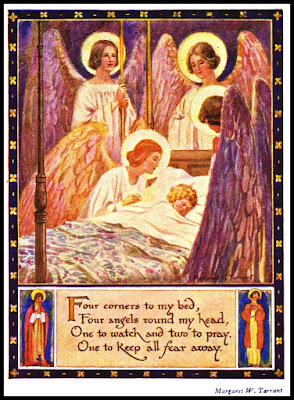
St. Bonaventure was known as the second founding father of the Franciscan Order after St. Francis. He was a classmate and friend of St. Thomas Aquinas, and like his friend was declared as one of 33 Doctors of the Church. He wrote an interesting summary of the help that our guardian angels give us, based on scriptures.

The Twelve Works of our Guardian Angel
by St. Bonaventure of Bagnoregio, OFM (1221-1271)

According to Sacred Scripture there are twelve works of charity which our guardian Angel does for us.

1. THE FIRST is to rebuke us for our faults. According to the Book of Judges, chapter 2, verse  1: The Angel of the Lord ascends from Galgala to the place of those weeping and says: "I have lead you forth from the land of Egypt...And you have not heard my voice."


2. THE SECOND is to absolve us from the bonds of our sins. According to Book of Acts, chapter 12, verse 7: The Angel stood by...and the chains fell from his hands, yet this must be understood as disposing this to happen.

3. THE THIRD is to take away from us those things impeding our progress in goodness, which is signified in the Book of Exodus, chapter 12, verse 12: where the Angel struck the first born of Egypt.


4. THE FOURTH is to constrain those demons afflicting us, according the Book of Tobias, chapter 12, verse 3: “He chased the demon from my wife”, says Tobias of the Archangel St. Raphael.

5. THE FIFTH is to teach us, according to the Book of Daniel, chapter 9, verse 22: Now I have entered, to teach you, and so that you might understand. 

6. THE SIXTH is to reveal secrets, for according to the Book of Genesis, chapter 18, verse 17, the three Angels expressed the Mystery of the Trinity and Unity, after which God said: Can I conceal from Abraham
what I am about to do?

7. THE SEVENTH is to console, according to the Book of Tobias, chapter 5, verse 13: Be of a strong spirit, it is nigh, that you are to be cured by God etc..

8. THE EIGHTH is to comfort us on the way to God, according to Third Book of Kings, chapter 19, verse 7: Rise and eat, for a grand way remains for you.

9. THE NINTH is to lead us forth on this way and to conduct us back to God, according to the Book of Tobias, chapter 5, verse 15: I shall lead, and I shall lead him back etc..

10. THE TENTH is to cast down our enemies, according the Book of Isaiah, chapter 37, verse 36: Having entered the Angel of the Lord struck upon the camps of the Assyrians etc..

11. THE ELEVENTH, to mitigate our temptations; and this is signified in the Book of Genesis, chapter 32, verse 24, where Jacob wrestled with the Angel, and was comforted after the match, having accepted his blessing, the nerve of his femur withered up.

12. THE TWELFTH is to pray for us and to carry our prayers to God, according the Book of Tobias, chapter 12, verse 12: When you were praying with tears . . . I offered your prayer etc..

All of these are the effects of our guardian Angel’s care of us, on account of which we ought to be submissive and grateful both to God and the Holy Angels.

A PRAYER TO OUR GUARDIAN ANGEL
Angel of God, my guardian dear,
to whom His Love commits me here,
ever this day be at my side,
to light and guard,
to rule and guide. Amen.

Wednesday, July 14, 2010

July 14, 2010: Wednesday Daily Homily "Child-like"


(I took this photo inside the new Basilica of Padre Pio in San Giovanni Rotondo, Italy. I noticed this 40-ish man approaching the crucifix when I heard a commotion in that direction. His parents were trying to keep him from approaching the roped off crucifix, calling out to him, "Marco, Marco!!!" This man seemed to have mental handicap. He approached the crucifix despite the protest from his parents. And spent his time conversing with Jesus.)

Hear the daily homily for July 14, talking about this child-like man.


(After spending a good minute or more conversing with Jesus on the Cross, this man was satisfied. His parents, however, were not.)

Funeral: Roberta "Bobbie" Mcdonald - July 12, 2010


The evening before Bobbie passed away, I was nearby her house at a hospice about 15 minutes away, giving Last Rites to a dying man. He was surrounded by his daughters, and before I began prayers, I reminded the family that our dying moment is sacred. It is sacred because it is during that moment that the veil between this world and the next is very thin. I said to them it is not unusual for the person dying to see and hear deceased loved ones, saints, and angels. In fact it is part of our faith. Listen to one of the prayers in the Last Rites. It says, "I commend you, my dear sister, to almighty God, and entrust you to your Creator. May you return to him who formed you from the dust of the earth. May holy Mary, the angels, and all the saints come to meet you as you go forth from this life. May you see your Redeemer face to face, and enjoy the vision of God forever." Earlier that day Bobbie's daughters, Cathy and Carol told me a powerful experience with her mother the previous night so I told that story to that family as a demonstration of that very "communion of saints."

On Monday night, Bobbie's daughter, Carol, was sleeping in a room next to where Bobbie was sleeping. Then Carol was awakened by a conversation going on in Bobbie's room. Carol approached the room and heard her mother Bobbie speaking to someone. Carol did not see anyone in front of Bobbie, and she could not make out what her mother was saying. So Carol decided to sit down on the chair next to her mother. As she sat there, Carol distinctly heard a lady's voice speaking to her mother. And her mother replied back to that voice. Again, Carol could not understand what was being spoken between the two. The next morning, she told what happened to her sister Cathy. And Cathy then told this to her best friend Tatsie. And Tatsie began to cry. She told Cathy that the previous evening, Tatsie was praying to her deceased mother, asking her to be with Cathy's mother. Is it not likely then, that Carol heard a conversation between Tatsie's mom and her own mother?

After giving the Last Rites to that dying man, I headed for Bobbie's house. When I got there, Bobbie was deep in sleep, taking very shallow breaths. Only few days ago, she was conscious, able to talk and plan her own funeral mass. Mike her husband, Carol, and JoAnn her daughter-in-law were present as well. I asked them, especially Bobbie, what they wanted me to preach about. Bobbie first said, "I want to tell the Lord that I have strong faith in Him, that I love Him, that I believe in Him with all my heart. I have always done my best, always taught my children right from wrong." Then Carol chimed in, "Mama always taught us to do the right thing." And Bobbie demonstrated to her children the right from wrong not by mere words but by her action. Deloris, the housekeeper for St. Aloysius rectory remembers Bobbie fondly for doing just that. Sometime back, Deloris found out that she may have cancer and was anxious and worried about all the tests and treatments. Cathy told her mother, and Bobbie, who was herself a cancer survivor, not having met Deloris, took her to the hospital and guided her through the process. Deloris remembers how comforting that was especially when Bobbie did not know her. Cathy also recalls how her mother was active with St. Vincent de Paul Society, Mary Bird Perkins Cancer Cen, and all the numerous volunteering she did for Melrose Elementary and preparing food for funerals. In the presence of Mike, Carol, Cathy, and Tuts, I said to Bobbie, "Bobbie, you are one of the first who is so well prepared for death. You have received every grace available for a soul that Church can give. I don't know what else to give you." Bobbie smiled at that.

You can say that Bobbie prepared well for her eternal life, just like the five wise virgins with their lamps mentioned in the Gospe today. What was the real difference between the five wise virgins and the five foolish virgins? Both groups knew ahead of time that the bridegroom was coming. But when the bridegroom came, the five wise virgins had oil to burn and five foolish virgins did not. What did that oil represent? The oil represents our faith in action; Word made flesh. Bobbie reminded me that I as a priest, know a lot about God, scriptures, and theology. I had 6 years of seminary, learning all about God. But just knowing about God is equivalent to a lamp without oil. With all that knowledge, we can get contemptuous. It can be equivalent to the attitude of the five foolish virgins who probably thought, "Yeah the Bridegroom may come sometime in distant future. But may be He doesn't care. May be He is not real. May be all this stuff about Mary, saints, and angels are all just a makebelief." A lamp full of oil is of humility; a soul who is humble to know that everything is a gift from God realizes that that there is responsibility in turning those gifts and grace into action. A lamp empty of oil is of pride; a soul who rejects child-like attitude asked for by Our Lord and instead charts his own life in his own stubborn way. In the end, for such prideful life, there is no oil in the reservoir to burn, there is not even a flickering of divine life. Can you imagine 6 years of seminary education or even many years of theology, and yet I may not have the divine life flickering in my soul, like the foolish virgins without oil. That's what Bobbie taught me. Do we believe in Jesus, sincerely and earnestly like Bobbie? Can we say like Bobbie, "I believe in Jesus with all my heart and always I have done my best for Him." Do we desire to hear from Our Lord at the end of our life, "Well done, good and faithful servant"?

A day after the incident where Carol heard the conversation between her mom and Tatsie's mother, Mike, Carol, and Cathy were by Bobbie's bedside. Bobbie woke up from sleep, looked around and said, "Why are you guys all standing around as though I'm dying. What time is it?" They replied, "Mama it's 8:30 at night." Bobbie said, "3:30." They replied, "No mama it's 8:30 at night." Bobbie insisted, "3:30." And Mike was puzzled. Bobbie was never known to care about what time of the day it was.

Early Friday morning at 2 AM, Cathy woke up to give her mom her medicine. She noticed how shallow her mother's breathing was. Carol woke up as well. After one look at her mom's face, she went and woke up her dad. Carol noticed how there seemed to be no life in her mom's face even as she breathed.

At last, that morning, Bobbie breathed her last. Our Lord in today's gospel said, "Therefore, stay awake, for you know neither the day nor the hour." Our Lord was again reminding us to prepare. When Mike, Carol, and Cathy looked at the clock when Bobbie passed, it read 3:30. I wonder how Bobbie knew.

Saturday, July 10, 2010

July 11, 2010: 15th Sunday Ordinary (C)

Click to preview Sunday7-11-10-Homily.mp3.mp3 Click to hear the audio of the homily

This Friday evening I was at a hospice giving Last Rites to a dying man. He was surrounded by his family, and before I began prayers, I reminded the family that our dying moment is sacred. It is sacred because it is during that moment that the veil between this world and the next is very thin. I said to them it is not unusual for the person dying to see and hear deceased loved ones, saints, and angels. In fact it is part of our faith. Listen to one of the prayers in the Last Rites. It says, "I commend you, my dear brother, to almighty God, and entrust you to your Creator. May you return to him who formed you from the dust of the earth. May holy Mary, the angels, and all the saints come to meet you as you go forth from this life. May you see your Redeemer face to face, and enjoy the vision of God forever."

Several weeks ago, I had a 6th grader from a Catholic school approach me with a deep anxiety in his heart. I asked "What's matter?" And he said, "Father, do we just disappear after we die?" I replied, "Why do you ask that?" He said, "My friend showed me a music video, and it scared me. It showed a guy who was dying and after he died, there was nothing but black things." I said, "Let's go inside the church." I took him first near the altar, in front of the tabernacle. After we genuflected toward the tabernacle, I said, "Well, here lies the answer to our question: what happens to us after we die. Here is Jesus who promised us, 'I'm going to be with you until the end of time.' And over 2,000 years, Jesus has been so physically close to us, to remind us that that's who we will be with beyond our life after death." Then I took him over to the Blessed Mother's statue. I said, "Do you see this statue? Although this statue is made of marble, we have this inanimate statue here as a reminder that there is a living Mother of Our Lord whom we can always go to ask for motherly help." Then I took him to the rest of the statues of the saints. As I saw him leave, I could not shake the thought, 'How many of our young people feel that same emptiness? How many of our adults and elderly feel that same emptiness?

In our gospel today, a scholar of the law--really a religious expert--asks Jesus a similar question: "Teacher, what must I do to inherit eternal life?" An religious expert should know the answer, or does he? Jesus turns it around and says to the expert, "What is written in the law? How do you read it?" And the expert said, "You shall love the Lord, your God, with all your heart, with all your being, with all your strength, and with all your mind, and your neighbor as yourself." Was that the correct answer? Partly. It's not enough to know. The more crucial part of the answer is obedience. Our Lord tells the expert, ""You have answered correctly; do this and you will live." Just like the this scholar of the religious law, most of us know what is the right thing to do--what Heavenly Father asks of us to do. In fact when I'm in the confessional, most of the people say, "Father, I know it is wrong to do this....BUT..." What most people struggle with is not knowing the right from wrong, but the struggle is, obeying the Lord out of love for Him. The mind knows, but the heart is not willing.

This brings us back to why I told you about my experience this Friday at the hospice with that dying man. Just like the 6th grader who is now doubting what awaits him at the end of his life, many of us have a foggy idea of what is at the end. We need a goal to mobilize all of our energies, but when there is no goal, there is nothing to hope or work for. When we came into this church, we saw a drawing of the new future church near the foyer. That is a beautiful goal, and it invigorates our hope for the future and changes the way we give our time and energy for this parish. Back at the hospice, I told the dying man and the family that at the end of his life, he will see his ultimate goal. Many folks who experienced near-death experience recounted that at the end of the dark tunnel, they saw Jesus, and Jesus gave them the most profound hug. In that embrace, the soul experienced the unconditional love that they have been searching for all their lives, albeit in all the wrong places. In that embrace, they will know how they could have done more in their earthly life to know Jesus better, but they didn't. What is the answer to, "What must I do to inherit eternal life?" It goes back to the answer from the old Baltimore Catechism, "God made me to know Him, to love Him, and to serve Him in this world, and to be happy with Him forever in the next."

The past two years as a priest, I have given many Last Rites, and I must say I've encountered many souls who regret not spending more time knowing Him, loving Him, and serving Him. How do you know Him and love Him? Mother Teresa gives a very short, beautiful answer: The fruit of silence is prayer.

The fruit of silence is prayer. It is in silence, away from the noise of all my wants and my appetites to sit silently before Jesus in the Eucharist that we begin to have a conversation or prayer with Jesus. It is in that silent prayer that we begin to hear from Jesus how much He loves us, how much He desires to guide us. We begin to hear how my wants and my appetites are stifling His hope for us. We begin to know then, not what I hope to do, but what Jesus hopes for me. And my hope for you is that when you ask me to be at your bed side as you die, and as I pronounce the words, "May you see your Redeemer face to face, and enjoy the vision of God forever," you would have already known Him, loved Him, and served Him on earth so that you look forward to seeing Him as you take your last breath.

Wednesday, July 7, 2010

Vatican Mass of Sts. Peter and Paul, "Pallium Mass"


Click the image above to see the video coverage of the Solemn Mass of St. Peter and St. Paul held on June 29, 2010 in Vatican City. 

I was privileged to distribute communion at this mass. 


Cave where St. Francis Prayed - Eremo delle Carceri


About 8 km outside the city of Assisi lies a place where St. Francis used to retreat in a tiny cave. Erected on that spot is now a monastery, surrounded by nature and silence.


On the right is the stone bed used by the saint
during periods of retreat toward the end of his life.

Homily at the Tomb of St. Francis of Assisi - June 22, 2010


The following homily was given during the mass celebrated at the tomb of St. Francis located in the crypt of the Basilica of St. Francis in Assisi, Italy. I talked about the deeper meaning of the Prayer of St. Francis as well as the prayer of Mother Teresa.

Prayer of St. Francis

Lord, make me a channel of thy peace;
that where there is hatred, I may bring love;
that where there is wrong, I may bring the spirit of forgiveness;
that where there is discord, I may bring harmony;
that where there is error, I may bring truth;
that where there is doubt, I may bring faith;
that where there is despair, I may bring hope;
that where there are shadows, I may bring light;
that where there is sadness, I may bring joy.
Lord, grant that I may seek rather to comfort than to be comforted;
to understand, than to be understood;
to love, than to be loved.
For it is by self-forgetting that one finds.
It is by forgiving that one is forgiven.
It is by dying that one awakens to eternal life.
Amen.


Fruit of Silence (by Mother Teresa)

The fruit of silence is prayer
the fruit of prayer is faith
the fruit of faith is love
the fruit of love is service
the fruit of service is peace.


Love to pray (Mother Teresa)
Feel often during the day the need for prayer and pray.
Prayer opens the heart, till it is capable of containing God himself.
Ask and seek and your heart will be big enough to receive Him
and keep Him as Your Own.

Angelus Bells of Assisi - June 22, 2010


The tolling of the 6AM Angelus Bells of the Basilica of St. Francis was recorded on June 22, 2010 on my pilgrimage to Assisi. It was a 50 deg. F morning with the sunlight hitting the front facade of the Basilica.

Saturday, July 3, 2010

July 4, 2010: 14th Sunday Ordinary (C)

(I'm spending time with my parents out of town, so I'm posting a small homilette. Beginning July 6th, I will begin my new assignment as the associate pastor of Immaculate Conception Catholic Church, Denham Springs, Louisiana)

The day that Korea was freed from Japanese occupation was on August 15, 1945 after decades of occupation. My mom tells me the story of what happened to her father. He was a judge, and he was active in the independence movement. He was imprisoned by police and tortured. He became invalid, and my mom recalls taking care of him as a child.

The word 'freedom' and 'independence' in this country evoke much different connotation than what my grand father fought for. Often here, it is freedom to do something unhindered and unfettered. But for Jesus, freedom meant much like what my grand father yearned for. With Jesus' arrival, a new kind of independence dawned--freedom from slavery to sin. We can be in a 'free country' and yet enslaved to sin. We can be in the most free and wealthy country, yet we can be enslaved to sin. Our Lord is looking for men and women of my grand father's caliber to be his co-workers to bring true freedom--freedom from sin--to others. Hence he said, "The harvest is abundant but the laborers are few; so ask the master of the harvest to send out laborers for his harvest."