Thursday, May 31, 2012

May 31, 2012 Thursday: Feast of Visitation

"And how does this happen to me,
that the mother of my Lord should come to me?"


"Here we are at last in the month of our beautiful Mother once again.... This dear Mother continues to lavish her maternal care upon me, especially during the present month. She takes care of me to an exceeding degree.... I am all aflame although there is no fire. I feel myself held fast and bound to the Son by means of this Mother.... I'd like to fly off to invite all creatures to love Jesus and Mary." -Padre Pio, Letter May 6, 1913

"Padre, say something to us."

"Love our Lady, make others love her. Always say your Rosary and say it well. Satan always tries to destroy this prayer, but he will never succeed. It is the prayer of her who triumphs over everything and everyone." -Padre Pio

Tuesday, May 29, 2012

May 30, 2012 Wednesday: 8th Week of Ordinary Time

Funeral Homily for Dot (May 29, 2012)

Have you ever asked yourself, "What is the purpose of life?" It's a question that we ask ourselves when we are going through some trials. Sometimes trials test our physical and emotional limit and even bring us to the unfamiliar terrain of doubt. Dot was no stranger to trials, even at the last moment of her life, as she suffered through cancer.

In his First Letter, St. Peter reveals what the purpose of life is as he writes to those in the Church of Asia Minor who were undergoing persecution and suffering. It is even more applicable for us today. He says, "Although you have not seen him you love him; even though you do not see him now yet believe in him, you rejoice with an indescribable and glorious joy, as you attain the goal of your faith, the salvation of your souls."

Someone unseen inspired Dot to spend much of her free time making rosaries. She trusted that these little labor of love, meant something for the One whom she loved. She believed that much glory will come to Heavenly Father as people,who are fortunate to receive her rosary, prayed and meditated on the life of Jesus.

And she was not the type to ask something for herself. Rather, she was the one who readily asked, "Is there anything I can do for you?" Perhaps that habit comes from the time when she used to work at Carp's Department Store and then at Lemann's Department Store in Donaldsonville for many years. Sandra, our choir director had an interesting encounter with Dot several days ago before she passed. As Dot laid in bed suffering from much pain, Sandra prayed the rosary out loud. Dot tried her best to mouth out the words, "Our Father" and "Hail Mary," but she could barely pronounce the words. As Sandra was about to leave after finishing the rosary, she heard Dot clearly say without difficulty, "Sandra, is there anything I can do for you?" Sandra replied, "Dot, please pray to Jesus for me when you see Him."

Here is something that Our Lord taught us as He hung from the Cross on the Calvary. When we accept suffering without complaining, we glorify the Father and the Son. We proclaim the message of the Father and the Son when we are obedient to the Father, just as His Son was obedient through trials and sufferings. Just imagine, conforming our will to Our Heavenly Father's will in a time of suffering brings glory to the Almighty God.

St. Peter explains why this is true in his First Letter. " In this you rejoice, although now for a little while you may have to suffer through various trials, so that the genuineness of your faith, more precious than gold that is perishable even though tested by fire, may prove to be for praise, glory, and honor at the revelation of Jesus Christ."

May we also imitate Dot's love for the Heavenly Father which led her to accept suffering with joy.

May 29, 2012 Tuesday: Week 8 of Ordinary Time

"We have put aside everything to follow You!" –Mark 10:28

Jesus, the Beloved of God, has a pure heart. Having a pure heart means willing one thing. Jesus wanted only to do the will of his heavenly Father. Whatever Jesus did or said, he did and said it as the obedient Son of God: "What I say is what the Father has taught me; he who sent me is with me, and has not left me to myself, for I always do what pleases him" (John 8:28-29). There are no divisions in Jesus' heart, no double motives or secret intentions. In Jesus there is complete inner unity because of his complete unity with God.

Becoming like Jesus is growing into purity of heart. That purity is what gave Jesus and will give us true spiritual vision.
-Fr. Henri Nouwen

Monday, May 28, 2012

May 28, 2012 Monday: Memorial Day

Jesus Is Merciful


Jesus, the Blessed Child of God, is merciful. Showing mercy is different from having pity. Pity connotes distance, even looking down upon. When a beggar asks for money and you give him something out of pity, you are not showing mercy. Mercy comes from a compassionate heart; it comes from a desire to be an equal. Jesus didn't want to look down on us. He wanted to become one of us and feel deeply with us.

When Jesus called the only son of the widow of Nain to life, he did so because he felt the deep sorrow of the grieving mother in his own heart (see Luke 7:11-17). Let us look at Jesus when we want to know how to show mercy to our brothers and sisters.
-Fr. Henri Nouwen

Friday, May 25, 2012

May 27, 2012: Pentecost

Click to hear Audio Homily

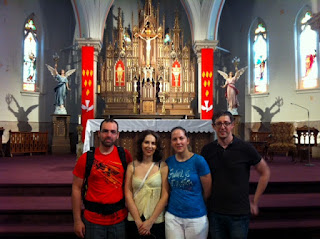
One day this week as I was leaving the Ascension office for the day, two young couples approached me and asked if the church was open. They were travelers from Vienna, Austria and as they were passing through our quaint town, they saw the huge steeple and had to stop by. When we entered the church for an impromptu tour, they exclaimed, “wow!” and they were mesmerized by the expansive and beautiful space. I wondered if they attended church as I remembered that Cardinal Schonborn of Vienna said that barely 15% of Catholics in Europe attend church. I was impressed that the beauty of the church attracted these young people to stop for a visit and that they were touched deeply by the experience. I pray that they realize that the expansive and beautiful space of this temple of God is a reflection of what their soul is like.  How many of us understand that our soul is the temple of the Living God, the Holy Spirit, and that God dwells in our hearts, always, even when we do not respond to Heavenly Father’s love?

Sometimes we realize who we are and what we have through a negative experience. A few days ago, I was called to the parish jail because two young ladies wanted a priest to hear their confessions. As I was waiting near the visiting area for entry into the main prison, I noticed a curious sight. There were two visitation rooms, one where the inmate could visit through a window using a telephone handset, and another room where the inmate could speak through a computer monitor much like Skype video chatting. I could tell by the facial expressions that the inmates cherished the time they had to speak with their loved one; however, they had to be separated by a barrier. Although the family members missed them dearly, they knew that their loved one in jail needed that time to come to realize the seriousness of their lifestyle and choices. Somehow the small, tight, stale, and musty concrete rooms inhabited by angry, resentful, and unforgiving people have a way of convincing inmates that they don’t belong there and that they were made for something greater.
As I was listening to the two young ladies and their confession, I noticed something different. They did not speak as though they were imprisoned in some awful place. They spoke of their daily scripture reading and prayer with their prayer group, and how they encouraged one another. They spoke about their desire for true peace in their heart, both desiring to make amends for hurts that they’ve caused, and wanting their life to be a life dedicated to God. I could sense that something was bubbling up in their hearts. Something unseen was moving them.
   
In today’s Gospel, we hear again about an evening of the first week of the Resurrection, when the disciples were in a place not too different from the Ascension parish jail. The doors were locked, and the disciples were further imprisoned by the fear they had for their lives. Jesus came and stood in their midst and said, “Peace be with you.” Then he breathed on them and said, “Receive the Holy Spirit. Whose sins you forgive are forgiven them, and whose sins you retain are retained.” Something unseen began to move the disciples, to open wide the doors, to preach boldly, and to affect change in other people’s lives. That’s what happens when we begin to be guided by the Holy Spirit.
Was the Holy Spirit given to only a select, privileged few? Is this transformation possible only for those who are the spiritual giants? No. Each of us received this Holy Spirit when we were baptized, and this Spirit dwells in us even when we do not respond to the Heavenly Father’s love. We experience true peace when we allow the Holy Spirit to enliven us and guide our lives. How do we allow the Holy Spirit to guide us? A prayer from St. Francis of Assisi teaches us how to do exactly that!
Lord, make me a channel of thy peace.
That where there is hatred I may bring love,
That where there is wrong, I may bring the spirit of forgiveness,
That where there is discord, I may bring harmony,
That where there is error I may bring truth,
That where there is doubt I may bring faith,
That where there is despair I may bring hope,
That where there are shadows I may bring light,
That where there is sadness I may bring joy.
Lord, grant that I may seek rather to comfort than to be comforted,
To understand than to be understood,
To love than to be loved.
For it is by forgetting self that one finds.
It is by forgiving that one is forgiven,
it is by dying that one awakens to eternal life.

May 25, 2012 Friday: 7th Week of Easter

Jesus is Gentle

Jesus, the Blessed One, is gentle.  Even though he speaks with great fervor and biting criticism against all forms of hypocrisy and is not afraid to attack deception, vanity, manipulation and oppression, his heart is a gentle heart.  He won't break the crushed reed or snuff the faltering wick (see Matthew 12:20).  He responds to people's suffering, heals their wounds, and offers courage to the fainthearted.

Jesus came to bring good news to the poor, sight to the blind, and freedom to prisoners (see Luke 4:18-19) in all he says, and thus he reveals God's immense compassion.   As his followers,  we are called to that same gentleness.
- Fr. Henri Nouwen

Wednesday, May 23, 2012

May 23, 2012 Wednesday: 7th Week of Easter

Jesus' Self-Portrait

Jesus says:  "Blessed are the poor, the gentle, those who mourn, those who hunger and thirst for uprightness, the merciful, the pure in heart, the peacemakers, and those who are persecuted in the cause of uprightness"   (Matthew 5:3-10).   These words offer us a self-portrait of Jesus.  Jesus is the Blessed One.  And the face of the Blessed One shows poverty, gentleness, grief, hunger, and thirst for uprightness, mercy, purity of heart, a desire to make peace, and the signs of persecution.

The whole message of the Gospel is this:  Become like Jesus.  We have his self-portrait.  When we keep that in front of our eyes, we will soon learn what it means to follow Jesus and become like him.
-Fr. Henri Nouwen

Tuesday, May 22, 2012

May 22, 2012 Tuesday: St. Rita of Cascia

St. Rita of Cascia


Rita was born in 1381 in a little Italian village. Her parents, who were elderly, had begged God to send them a child. They loved Rita and brought her up well. When she was twelve, Rita wanted to enter the convent, but her parents decided that she should marry instead. The man they chose for Rita turned out to be a cruel and angry husband. He had such a violent temper that everyone in the neighborhood was afraid of him. Yet for eighteen years his wife patiently put up with his insults. Her prayers, gentleness and goodness finally won his heart. He apologized to Rita for the way he had treated her and he was very sorry. Rita’s happiness over her husband’s conversion did not last long. One day, shortly after, he was murdered. Rita was shocked and heartbroken. But she forgave the murderers, and tried to make her two sons forgive them too. She saw that the boys, instead, were determined to avenge their father’s death. Rita prayed that they would not commit murder. Within several months, both boys became seriously ill. Rita nursed them lovingly. During their illness, she persuaded them to forgive, and to ask God’s forgiveness for themselves. They did, and both died peacefully.
Now that her husband and her children were dead, Rita asked several times to enter the convent of the Augustinian nuns in Cascia. But the rules of the convent did not permit a woman who had been married to join even if her husband had died. Rita didn’t give up, however. At last the nuns made an exception for her. In the convent, Rita stood out for her prayer, mortification and charity. She had great devotion to the crucified Jesus. Once, while praying in front of a crucifix, she asked Jesus to let her share some of his pain. One thorn from Jesus’ crown of thorns pierced her forehead and made a wound that never healed. In fact, it grew so bad that Rita had to stay away from the other sisters, who were afraid of contagion. But she was happy to suffer to show her love for Jesus.

Rita died on May 22, 1457, when she was seventy-six. Like St. Jude, St. Rita is often called the “Saint of the Impossible.”

Maybe someone we know and love is not living close to God. We can ask St. Rita to help us know how to pray for that person. Our kindness and understanding can be a reflection of God’s love for that person.

-Daughters of St Paul

Saturday, May 19, 2012

May 20, 2012: Ascension of Our Lord


Click to hear audio homily

On Friday, I celebrated mass at the nursing home, and I took out a twenty-dollar bill and asked a couple of question to the residents starting with, “When did you graduate from high school?” I heard, “1940, 50, 58...” I then asked, “How much did it cost to go see movies?” Some replied, “25 cents.” How much was popcorn and soda, I asked. “10 cents.” I asked the same questions to the graduating class of 2012 at the baccalaureate mass this week. When I asked, “Can you take your date to the movies with $20,” they all laughed. A ticket to a 3D movie costs $12 per person and with the popcorn at $6 a bucket, you can’t even get yourself a movie ticket, popcorn, and coke for $20, let alone the same for your date. (Pictured below: Grand Theater, Donaldsonville)

Standing before the 2012 Ascension Catholic School graduates, their parents, and friends, I held out the $20 bill and asked them the following question. “If I were to rip, stomp, crumple, and spit upon this $20 bill, I bet that I can still take it to a local grocery store and redeem it for $20 worth of stuff. Who stands behind the value and worth of this $20 bill?” “US Government,” one of the students answered. Then I asked, “Who stands behind your worth and your dignity?” “God?” a student answered. “That’s right”, I replied, “each of you is worth so much that God himself redeemed you by sacrificing His very own life...Look at who is sitting behind you, your parents, grandparents, your family and friends. You don’t stand alone. Backing each of you is the love and sacrifice of all your family, but most of all, God’s got your back.”
We heard in the first reading today two angels asked a profound question to the disciples who stood dumbfounded as Jesus ascended into the clouds. “Why are you standing there looking at the sky?” The first part of this profound question is, “Why are you standing?” Why are you here on earth? Our answer is that we are here on earth because God has put us here as the crowning work of his creation. He gave us the dignity of being children of God and the gift of immortality. We know that man went astray, misused the gift of freedom and said “No” to God, thus condemning himself to a life marked by evil, sin, suffering and death. We also know that God was not resigned to this situation and so after seeing the sad situation of His children on Earth, Our Heavenly Father, out of His great love for us, sent His Son into the world. And His Son’s love for us was so great that He died for all of us. Where do we get our dignity and worth?  Our dignity and worth comes from the infinite love that the Father and the Son have for us.  This infinite love is demonstrated every day on the altars throughout the world. Jesus left us the greatest gift, himself in the Eucharist to be our nourishment on our way home to the Father.
How do we react to this love? If we are honest, we know that at times we react coldly to this love. At times, we admit that we never notice this love and are ungrateful for this love. I told the high school graduates that after graduating high school, I took my parents’ love and sacrifice for granted. They paid for my college and living expenses while I was in Austin, Texas, but my gratefulness for them was so meager. What’s more, I pretended that I graduated from religion as well; I seldom attended church in my first year of college. I forgot who ‘had my back.’ After enjoying my freedom and living apart from the love of my parents and the love that God has for me, I ended up feeling empty. I was asking myself, “Is this all there is? Is this my final destiny?”

 We need to turn to the second part of the biblical question: “Why do you stand looking up to heaven?” The disciples looked up to heaven because they looked to Jesus Christ, the Crucified and Risen One, raised up on high. Here on earth, we are called to look up to heaven, to turn our minds and hearts to the inexpressible mystery of God. We are called to look towards this divine reality, to which we have been directed from our creation. For there we find life’s ultimate meaning. Jesus showed us how to ascend to the Father: we must love. At times, we may fall into the trap of measuring our worth by how many $20 bills we can accumulate, but we must remember that our worth is measured by the greatest sacrifice that God made for us. There is no greater love than this, to lay down one’s life for one’s friend. Just as our family and God back us up, we must do the same for one another.

Friday, May 18, 2012

May 18, 2012 Friday: 6th Week of Easter

The Breath of God Within Us


When we speak about the Holy Spirit, we speak about the breath of God, breathing in us. The Greek word for "spirit" is pneuma, which means "breath." We are seldom aware of our breathing. It is so essential for life that we only think about it when something is wrong with it.

The Spirit of God is like our breath. God's spirit is more intimate to us than we are to ourselves. We might not often be aware of it, but without it we cannot live a "spiritual life." It is the Holy Spirit of God who prays in us, who offers us the gifts of love, forgiveness, kindness, goodness, gentleness, peace, and joy. It is the Holy Spirit who offers us the life that death cannot destroy. Let us always pray: "Come, Holy Spirit, come."
-Fr. Henri Nouwen

Thursday, May 17, 2012

May 17, 2012 Thursday: 6th Week of Easter

Love Will Remain


Hope and faith will both come to an end when we die. But love will remain. Love is eternal. Love comes from God and returns to God. When we die, we will lose everything that life gave us except love. The love with which we lived our lives is the life of God within us. It is the divine, indestructible core of our being. This love not only will remain but will also bear fruit from generation to generation.

When we approach our deaths let us say to those we leave behind, "Don't let your heart be troubled. The love of God that dwells in my heart will come to you and offer you consolation and comfort."
-Fr Henri Nouwen

Tuesday, May 15, 2012

May 16, 2012 Wednesday: 6th Week of Easter

Pope John Paul and Mother Teresa - Message to Seminarians and Priests

May 15, 2012 Tuesday: 6th Week of Easter

Holding the Cup


We all must hold the cups of our lives. As we grow older and become more fully aware of the many sorrows of life - personal failures, family conflicts, disappointments in work and social life, and the many pains surrounding us on the national and international scene - everything within and around us conspires to make us ignore, avoid, suppress, or simply deny these sorrows. "Look at the sunny side of life and make the best of it," we say to ourselves and hear others say to us. But when we want to drink the cups of our lives, we need first to hold them, to fully acknowledge what we are living, trusting that by not avoiding but befriending our sorrows we will discover the true joy we are looking for right in the midst of our sorrows.
-Fr. Henri Nouwen

Monday, May 14, 2012

May 14, 2012 Monday: 6th Week of Easter


Message from Blessed Mother in Medjugorje
“Dear children! With motherly love I implore you to give me your hands, permit me to lead you. I, as a mother, desire to save you from restlessness, despair and eternal exile. My Son, by His death on the Cross, showed how much He loves you; He sacrificed Himself for your sake and the sake of your sins. Do not keep rejecting His sacrifice and do not keep renewing His sufferings with your sins. Do not keep shutting the doors of Heaven to yourselves. My children, do not waste time. Nothing is more important than unity in my Son. I will help you because the Heavenly Father is sending me so that, together, we can show the way of grace and salvation to all those who do not know Him. Do not be hard hearted. Have confidence in me and adore my Son. My children, you can not be without the shepherds. May they be in your prayers every day. Thank you. ” 
(May 2, 2012, Apparition to Mirjana)

Sunday, May 13, 2012

May 13, 2012: 6th Sunday of Easter (B)

Click to hear Audio Homily
Typically moms shower their children with unconditional love. I experienced my mom’s love for me through her cooking. The meals were always abundant and delicious, and she always cooked my favorites. As I reflect back into my childhood, there were a few occasions when I dreaded going home from school. My mom was the disciplinarian in the house, and on the days when I brought home my report card from elementary school, I usually lingered outside our home longer than usual. Although I knew mom loved me, on those days I feared that I didn’t deserve that love, and sometimes I feared for my poor calves. As a young child, it was difficult to process this unconditional love that at times seemed conditional; I feared that affections and approvals would be withheld for not living up to expectations and responsibilities. How do we make sense of this unconditional love that seems conditional to us?

The first step in understanding this begins with a great spiritual axiom that we heard today in the letter from St John that we should memorize by heart. St. John wrote, "In this is love: not that we have loved God, but that he loved us and sent his Son as expiation for our sins." God's love is a love that anticipates our every need first, even before we recognize that there is a need. I think a person doubts God’s love if he himself has never really loved. If he does not know what love is, then he thinks of it as a fleeting passion. How sad it is to know that many believe that selfish passion is real love.

Love is far from a passing infatuation. I have learned from my own experience that love is a firm direction of will. Yes, we have to choose to love. Real love is a force of spirit that surpasses all flesh, endures all struggles. Love that can die or weaken with any change in circumstances, such as illness or job loss, is not love. True love is faithful and there is no sacrifice that is too great for true love. Love that is worthy of the name will always have this eternal quality. In Jesus, eternal Love became flesh and through Him, we came to see real love. Jesus knew His Father’s love and knew it well. He said in today's Gospel, "As the Father loves me, so I also love you.”  His love was a love that was so great, that He gave his life for our sins.
Jesus said, “Remain in my love. If you keep my commandments, you will remain in my love, just as I have kept my Father’s commandments and remain in his love." So we know that without condition the Father and His Son love us. God is God and He doesn't need us to complete Him. He is perfect and self-sufficient in Himself. His love for us is freely given, without condition attached. Did Jesus add a condition when He said, "IF you keep my commandments?" Is Jesus saying that IF we are good enough, holy enough, or free of sin, then He will love us?

We must focus on His words, "Remain in my love." Jesus’ desire is for us to receive His love, freely, without fear, and without anxiety that somehow a string is attached. God's love for us will never diminish despite any mistakes we may make. I often encounter people who believe otherwise; they presume God was so disappointed with their mistakes and failure to keep His commandments that His love was withdrawn until it was earned again. How contrary this is to God's way! What kept me outside of my parents’ house on report card days was fear. I presumed, out of fear, to stay away, therefore I cut myself off from mom’s unconditional love for me.

Here is the second part about ‘remaining in His love.’ Jesus said, “If you keep my commandments, you will remain in my love...I have told you this so that my joy may be in you and your joy might be complete. This is my commandment: love one another as I love you.” So that is another spiritual axiom to memorize. If you want to keep the unconditional love that you receive, then you have to give it away. Once you stop giving the love away to others, the flow of love stops, it becomes stagnant and selfish. Mothers tend to have a keen sense about this and so they teach it to their children, always reminding them to love.
It is amazing that God uses ordinary men and women like us to reach those who live in darkness. We carry God’s light within us. Our very presence in a room will insure that others become aware, not only of the grace that surrounds us, but also of the grace that surrounds them. Therefore, do not ever think that it is useless to bring Jesus to another, regardless of his condition.

Friday, May 11, 2012

May 11, 2012 Friday: 5th Week of Easter

The Cup of Life


When the mother of James and John asks Jesus to give her sons a special place in his Kingdom, Jesus responds, "Can you drink the cup that I am going to drink?" (Matthew 20:22). "Can we drink the cup?" is the most challenging and radical question we can ask ourselves. The cup is the cup of life, full of sorrows and joys. Can we hold our cups and claim them as our own? Can we lift our cups to offer blessings to others, and can we drink our cups to the bottom as cups that bring us salvation?

Keeping this question alive in us is one of the most demanding spiritual exercises we can practice
-Fr. Henri Nouwen

Thursday, May 10, 2012

May 10, 2012 Thursday: 5th Week of Easter

Sharing Freely Our Knowledge


Often we think that we do not know enough to be able to teach others. We might even become hesitant to tell others what we know, out of fear that we won't have anything left to say when we are asked for more.

This mind-set makes us anxious, secretive, possessive, and self-conscious. But when we have the courage to share generously with others all that we know, whenever they ask for it, we soon discover that we know a lot more than we thought. It is only by giving generously from the well of our knowledge that we discover how deep that well is.
-Fr. Henri Nouwen

Wednesday, May 9, 2012

May 9, 2012 Wednesday: 5th Week of Easter

Seeing the Miracle of Multiplication


The opposite of a scarcity mentality is an abundancy mentality. With an abundancy mentality we say: "There is enough for everyone, more than enough: food, knowledge, love ... everything." With this mind-set we give away whatever we have, to whomever we meet. When we see hungry people we give them food. When we meet ignorant people we share our knowledge; when we encounter people in need of love, we offer them friendship and affection and hospitality and introduce them to our family and friends.

When we live with this mind-set, we will see the miracle that what we give away multiplies: food, knowledge, love ... everything. There will even be many leftovers.
-Fr. Henri Nouwen

May 8, 2012 Tuesday: 5th Week of Easter

Temptation to Hoarding


As fearful people we are inclined to develop a mind-set that makes us say: "There's not enough food for everyone, so I better be sure I save enough for myself in case of emergency," or "There's not enough knowledge for everyone to enjoy; so I'd better keep my knowledge to myself, so no one else will use it" or "There's not enough love to give to everybody, so I'd better keep my friends for myself to prevent others from taking them away from me." This is a scarcity mentality. It involves hoarding whatever we have, fearful that we won't have enough to survive. The tragedy, however, is that what you cling to ends up rotting in your hands.
-Fr. Henri Nouwen

May 7, 2012 Monday: 5th Week of Easter

God's Generosity


God is a god of abundance, not a god of scarcity. Jesus reveals to us God's abundance when he offers so much bread to the people that there are twelve large baskets with leftover scraps (see John 6:5-15), and when he makes his disciples catch so many fish that their boat nearly sinks (Luke 5:1-7). God doesn't give us just enough. God gives us more than enough: more bread and fish than we can eat, more love than we dared to ask for.

God is a generous giver, but we can only see and enjoy God's generosity when we love God with all of our hearts, minds, and strength. As long as we say, "I will love you, God, but first show me your generosity," we will remain distant from God and unable to experience what God truly wants to give us, which is life and life in abundance.
-Fr. Henri Nouwen

May 6, 2012: 5th Sunday of Easter, Audio Homily


Saturday, May 5, 2012

May 6, 2012: 5th Sunday of Easter (B)

One of the things I marvel about is how many kindergarten children we can fit into one church pew at a school mass. I have seen as many as 20 kids in one pew, wiggling around and feeling restless. I was thinking about that this Saturday morning when I had 11 persons in my office!

A few days ago, a Spanish-speaking family approached me for information on a Baptismal seminar. Although I speak a little Spanish, I am not proficient enough to give a seminar, so hoping that I would find something on the Internet to use as a handout, I agreed to provide the seminar on Saturday. Thanks to Internet, I found both the handouts and an instructional video in Spanish on the Sacrament of Baptism, written and developed by a seminary in Monterrey, Mexico. When I answered the doorbell on Saturday morning, standing there were 4 adults and 7 little ones all below the age of 6. I invited all of them into my office and I asked the little ones to sit quietly on one side while I showed the parents the video. How many minutes do you think the kids were able to keep quiet and sit still?
I didn’t understand everything that the narrator on the video was saying, but I could understand the images on the video. One image was a scene from the miniseries Jesus of Nazareth where John was baptizing Jesus. The next scene was a very moving picture of Moses leading thousands of people through the Red Sea that was parted in the middle. At that point I could not help but recall one of the funerals this week where the great granddaughter of the deceased carried the processional cross, followed by pallbearers, in the entrance procession into the church.  As she was slowly leading the casket toward the altar, the mass began with the hymn, “Be Not Afraid,” which includes the moving verse, ‘If you pass through raging waters in the sea, you shall not drown.’ During mass, I noticed that the great granddaughter, who was serving as the altar server, was in tears and that her mother had gotten up from her pew to be with her daughter in the sanctuary to comfort her. Although the little girl was in tears, she stood firm and as soon as she was needed for a task, she wiped her tears with her hands and carried out her duty promptly. 

The little altar server and her mother are a beautiful model of what Our Lord does for us when we face insurmountable challenges. All of us here (without exception) will make that ultimate journey one day, to cross that raging sea of water that engulfs our life here on earth. Before that day of our death, we will continue to face daily the overwhelming waters that cause us to lose heart and even reduce us to tears. Just as that that little altar server’s mom came to her side to support her and guide her, Our Lord leads us through the raging waters of life’s challenges, through his Father’s help. Our Lord says to us today in the Gospel, “I am the true vine, and my Father is the vine grower. Remain in me, as I remain in you. Just as a branch cannot bear fruit on its own unless it remains on the vine, so neither can you unless you remain in me. I am the vine and you are the branches.”

Using the image of the vine, the branches, and the vine grower, Our Lord tells us that our Heavenly Father is the total source of our life, and that it is through Jesus that the Father supplies all our needs just as a vine supplies everything for the branches. Just as the branches are intimately connected to the whole plant and belong to the plant, we know that we are intimately connected to the Father and belong to Him, who created us, and who knows our joys and our sorrows, our every need. The very love and Spirit of Our Father are within us, and are greater than the evil that lurks in the world in which we live. The evil tendency destroys us and destroys the family; it destroys our relationship with Our Father. Our Lord reminds us in the Gospel, “He takes away every branch in me that does not bear fruit...Anyone who does not remain in me will be thrown out like a branch and wither.” We have been given all that it takes to overcome the evil, but we have to remain in Him.

How do we remain in union with Him? One way is through intimate prayer. I could tell that the family that was in my office Saturday morning remains connected to the Father through prayer. When all 11 of us were through with the Baptismal seminar, I invited them to take a photo. They instinctively knew to stand beside Our Lady of Guadalupe’s picture and the statue of Sacred Heart of Jesus that are in my office. They may have been surprised to see the image of Our Lady of Guadalupe, the Patroness of Mexico, here in Donaldsonville. Back home, they prayed to her in their home and churches, and She gave them motherly comfort and encouragement to remain in prayer to Our Lord.  Her presence in my office was a confirmation for them that their prayers are answered. Prayer not only nourishes us, it makes us one mind and heart with Our Lord. How often this poor priest is apart from the mind and heart of Jesus because he does not pray well and therefore does not bear fruit! Therefore, we need to look into our lives and  and see what we need to prune so that we may pray more faithfully and bear fruit for Our Lord.

Friday, May 4, 2012

May 4, 2012 Friday: 4th Week of Easter (B)

We were not the ones to lay the foundations. It was He who created us. We must receive ourselves from his hand. Many men of our time are no longer willing to accept this fact: that we are as we are, that is, with certain characteristics, with a certain prior history, at a certain stage of the world, in a certain social and cultural condition. To say yes to myself; to say yes to the fact that God causes me to live here and now, thus and not otherwise; to say yes to my own limitations, but also to say yes to you, my neighbor, to the fact that he was created by God as he is: all of this inevitably forms part of our yes to God.
-Blessed John Paul II

Wednesday, May 2, 2012

May 3, 2012 Thursday: Saint Philip and Saint James, Apostles

Friends and Their Limitations

We need friends.  Friends guide us, care for us, confront us in love, console us in times of pain.  Although we speak of "making friends," friends cannot be made.  Friends are free gifts from God.  But God gives us the friends we need when we need them if we fully trust in God's love.

Friends cannot replace God.  They have limitations and weaknesses like we have.  Their love is never faultless, never complete.  But in their limitations they can be signposts on our journey towards the unlimited and unconditional love of God.  Let's enjoy the friends whom God has sent on our way.
-Fr. Henri Nouwen

May 2, 2012 Wednesday: 4th Week of Easter

Friends and Their Unique Gifts


No two friends are the same. Each has his or her own gift for us. When we expect one friend to have all we need, we will always be hypercritical, never completely happy with what he or she does have.

One friend may offer us affection, another may stimulate our minds, another may strengthen our souls. The more able we are to receive the different gifts our friends have to give us, the more able we will be to offer our own unique but limited gifts. Thus, friendships create a beautiful tapestry of love.
-Fr. Henri Nouwen

Tuesday, May 1, 2012

May 1, 2012 Tuesday: St. Joseph the Worker


St. Joseph the Worker

This is St. Joseph’s second feast day on the Church calendar of celebrations. We honor him also on March 19. St. Joseph is a very important saint. He is the husband of Mary and the foster-father of Jesus.

Today we celebrate the witness of Joseph’s hard work. He was a carpenter who labored long hours in his little shop. St. Joseph teaches us that the work we do is important. Through it we give our contribution and our service to our family and society. But even more than that, we follow God’s plan for us by carrying out the special work he has given us to do. That is why we want to try to always do our work carefully and well.

Many countries set aside one day a year to honor workers. This encourages people to appreciate the dignity and importance of work. The Church has given us St. Joseph as a wonderful example to follow in doing our own work. In 1955, Pope Pius XII proclaimed that this feast of St. Joseph the Worker should be celebrated every year.
-Daughters of St. Paul